A Terrestrial Exception That Sustains the Biosphere
Throughout the physical universe, the overwhelming majority of substances contract and increase in density as they transition from liquid to solid. Water (H2O), however, departs dramatically from this thermodynamic rule. This profound phenomenon is known as the density anomaly of water, where water expands and becomes significantly less dense as it approaches and undergoes freezing.
The Molecular Physics of Maximum Density at 4°C
As liquid water cools from room temperature, thermal kinetic energy decreases, causing molecules to pack closer together like typical fluids. Yet, this thermal contraction halts precisely at 3.98°C (commonly rounded to 4°C) under standard atmospheric pressure (1 atm). At this critical temperature, liquid water reaches its maximum density of approximately 0.99997 g/cm³.
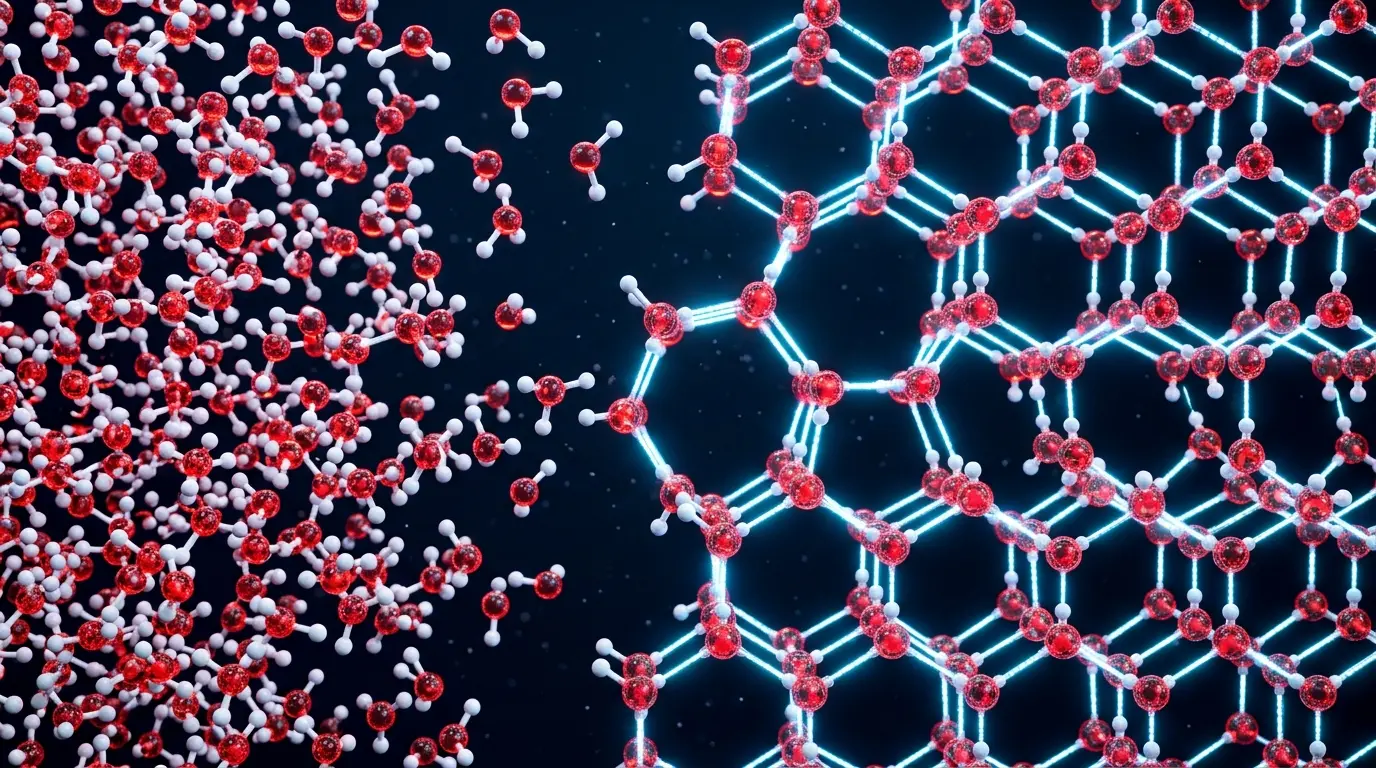
When cooling continues below 4°C toward the 0°C freezing point, intermolecular hydrogen bonds increasingly assemble the molecules into a rigid, open hexagonal crystal lattice (known as Ice Ih). This open geometric framework creates hollow spaces between molecules, resulting in two fundamental physical consequences:
- Volumetric Expansion: Water expands by approximately 9% in volume upon crystallizing into solid ice.
- Density Reduction: The density of ice at 0°C drops to roughly 0.917 g/cm³, making it significantly lighter and more buoyant than liquid water.
Water's density anomaly is not merely a curious chemical quirk; it represents an indispensable geophysical mechanism that prevents temperate and polar aquatic biomes from freezing solid.
Why Freshwater Lakes Freeze from the Surface Down
This unusual density behavior creates a life-sustaining inverse thermal stratification in freshwater bodies as winter arrives, unfolding in distinct physical stages:
- Fall Turnover: Surface water chilling down to 4°C achieves maximum density and sinks to the basin floor, displacing warmer water upward until the entire water column stabilizes at 4°C.
- Inverse Stratification: With further atmospheric cooling, surface water drops from 4°C toward 0°C. Because water below 4°C is lighter, it remains buoyant at the surface rather than sinking.
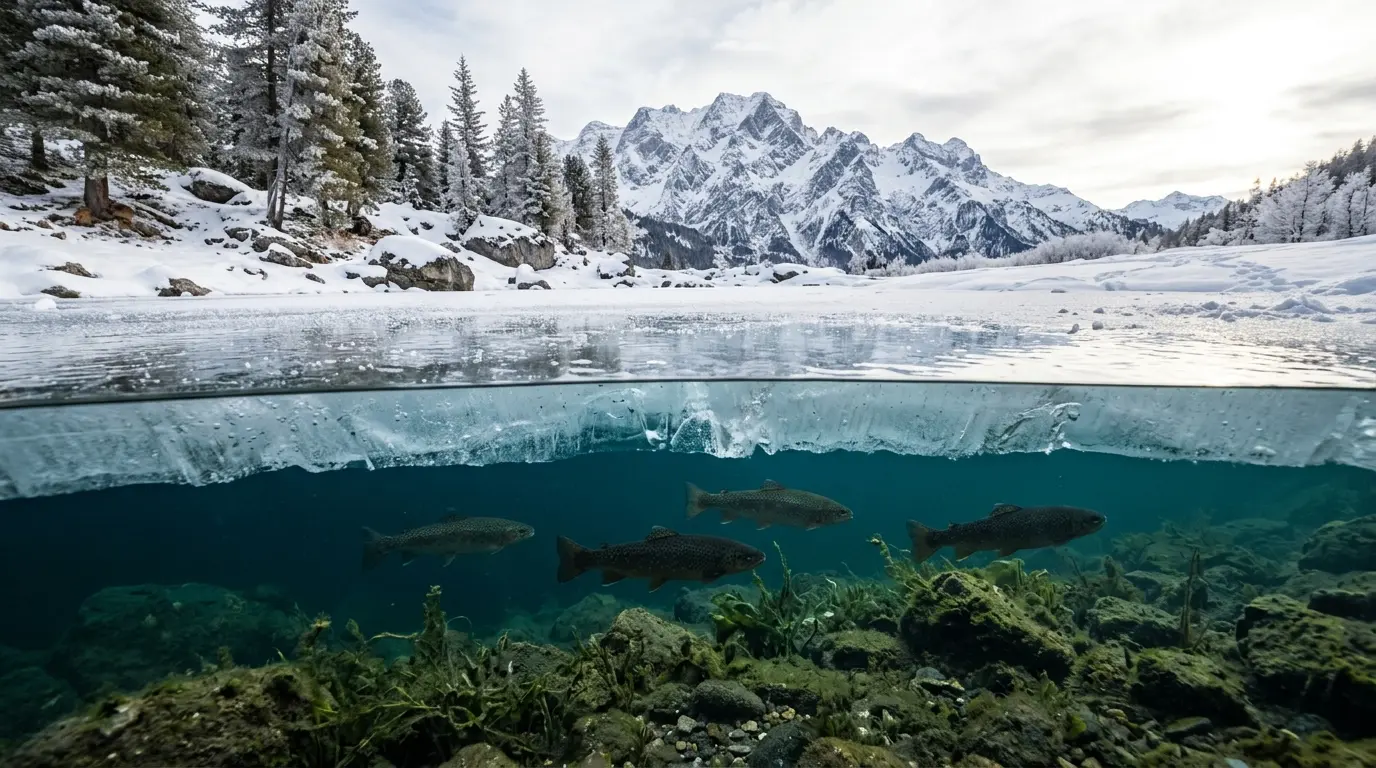
- Surface Ice Formation: Ice crystals nucleate exclusively at the water-air interface, floating serenely above the denser 4°C liquid water below.
Ecological Lifeline for Aquatic Biodiversity
Solid ice possesses relatively low thermal conductivity (approximately 2.2 W/m·K), and surface snow provides even greater insulating capacity. This floating crust acts as a natural thermal insulator, decoupling the underlying liquid water from subzero atmospheric air and fierce winter winds.
If water conformed to conventional thermodynamic behavior, ice would relentlessly sink to the bottom. Over prolonged winters, entire lakes, ponds, and slow rivers would freeze solid from the bedrock upward. Fish, brumating amphibians, rooted macrophytes, and benthic invertebrates would be crushed and entombed in solid ice. Because ice floats, the lower lake layer remains a sheltered liquid sanctuary at roughly 4°C, safeguarding freshwater ecosystems and preserving global aquatic biodiversity until the spring thaw.