Ancient Relics at the Solar System's Outer Frontier
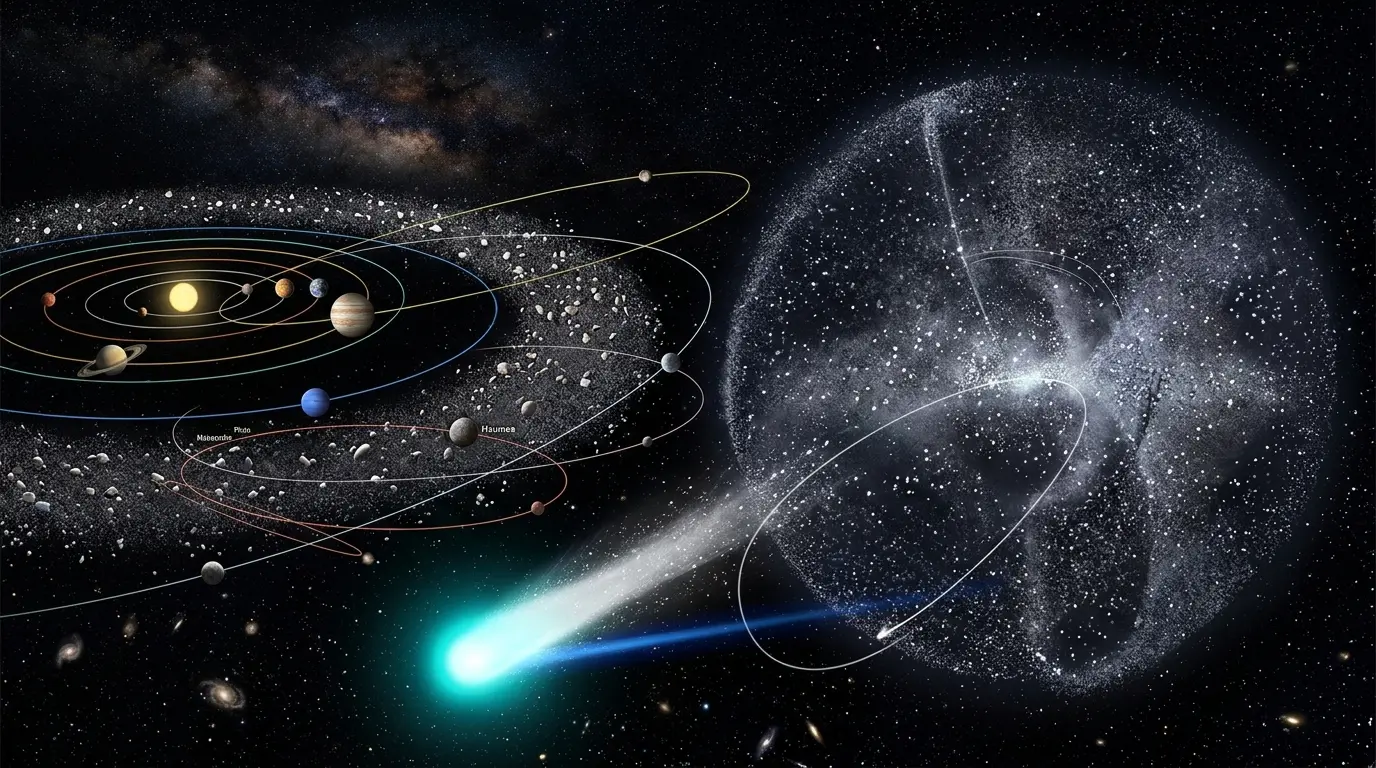
Far beyond the orbit of Neptune lies a frozen expanse that harbors the primordial secrets of our cosmic neighborhood. This distant realm is known as the Kuiper Belt, a vast circumstellar disc of icy remnants extending roughly 30 to 50 astronomical units (AU) from the Sun. Far from being an empty void, this frigid zone serves as a cosmic archive and the primary nursery for many short-period comets.
Discovery and Anatomy of the Kuiper Belt
The existence of this belt was theoretically hypothesized by astronomer Kenneth Edgeworth in 1943 and Gerard Kuiper in 1951. However, definitive observational confirmation came only in 1992, when astronomers David Jewitt and Jane Luu discovered the first modern Kuiper Belt Object (KBO), designated 1992 QB1.
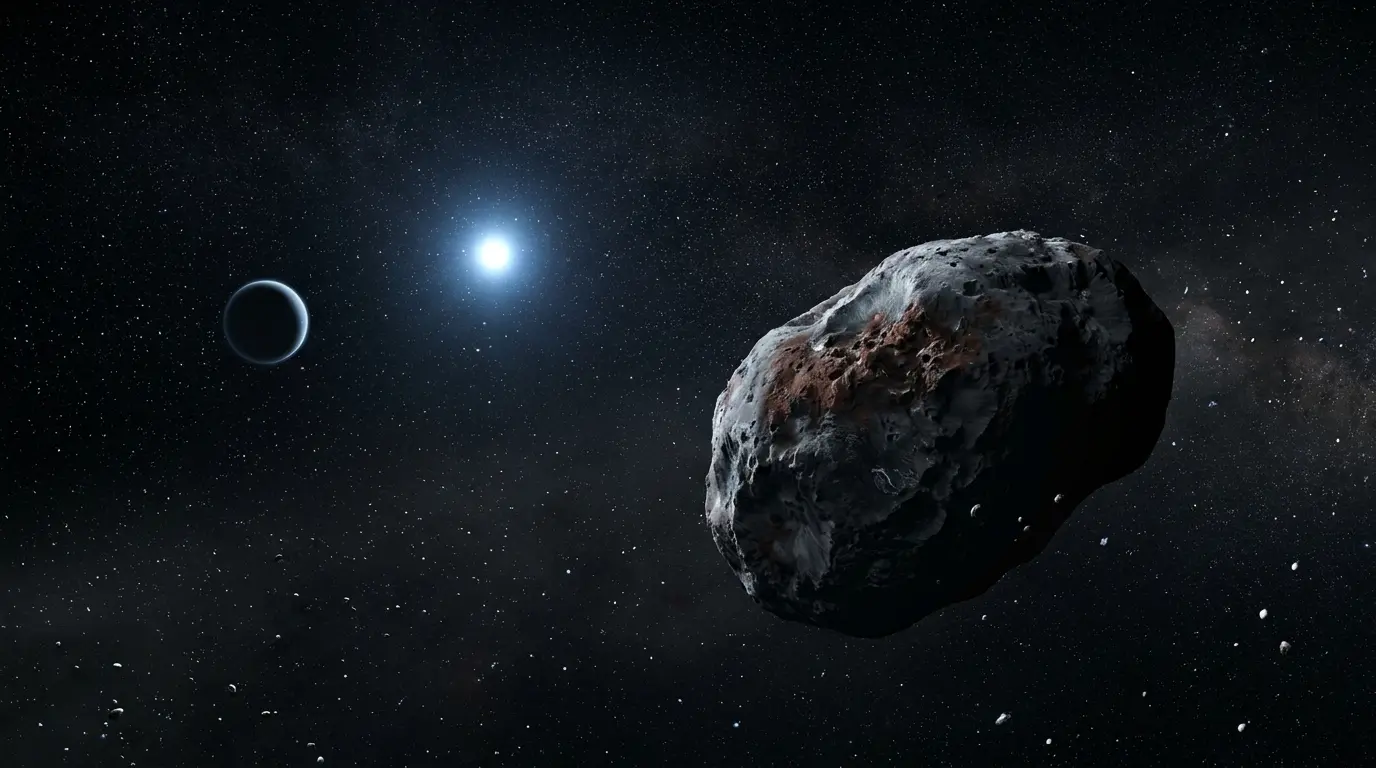
Kuiper Belt Objects are ancient planetesimals that never coalesced into full planets when the solar system formed approximately 4.6 billion years ago. Among the countless icy bodies populating this outer boundary are several prominent dwarf planets and planetesimals:
- Pluto: The largest known KBO, famously explored up close by NASA's New Horizons spacecraft in July 2015.
- Haumea and Makemake: Fast-spinning dwarf planets characterized by frozen volatile surfaces and unique geometries.
- Arrokoth: A pristine contact binary planetesimal imaged by New Horizons on January 1, 2019, providing direct evidence of gentle, low-velocity accretion during early solar system assembly.
Where Do Comets Come From?
Comets observed across our skies are broadly categorized based on their orbital dynamics, pointing to two distinct outer reservoirs:
- Short-Period Comets: Bodies with orbital periods of less than 200 years (such as Comet Encke or Jupiter-family comets like 67P/Churyumov–Gerasimenko). These originate from the Kuiper Belt and its dynamically active scattered disc. Gravitational perturbations from giant planets—particularly Neptune—deflect these icy bodies inward toward the Sun.
- Long-Period Comets: Objects with orbits spanning thousands or millions of years, originating from the distant spherical Oort Cloud, located thousands of astronomical units beyond the Kuiper Belt.
"Comets and Kuiper Belt objects serve as pristine time capsules, preserving the original chemical ingredients present when the Sun and planets condensed."
Chemical Composition and Planetary Significance
Often described as dirty snowballs, comets consist of water ice, frozen carbon monoxide, methane, ammonia, and carbon-rich silicate dust. Billions of years of solar ultraviolet radiation and cosmic rays trigger chemical reactions that produce complex organic polymers called tholins, lending many Kuiper Belt surfaces a distinctive reddish hue.
Deciphering the origin of comets and the Kuiper Belt provides invaluable clues to the history of terrestrial planets. Early cometary impacts are widely hypothesized to have delivered significant amounts of water and prebiotic organic molecules to the primordial Earth, laying the foundation for planetary habitability.