The Eternal Colossus of Jovian Polar Lights
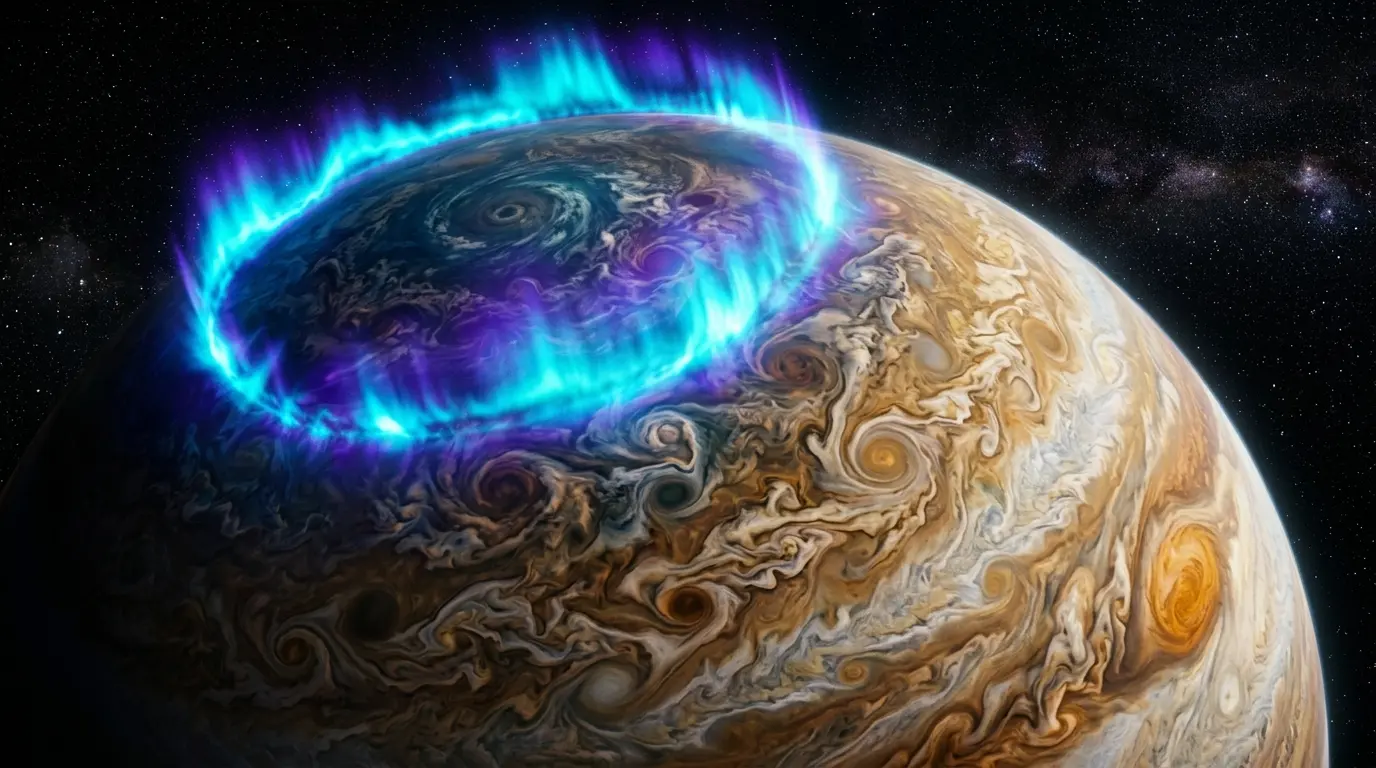
On Earth, the shimmering auroras of the north and south are transient spectacles governed by incoming solar wind storms. However, on our solar system's reigning gas giant, Jupiter, polar light shows operate on a scale that defies earthly comparison. Rather than sporadic displays, Jupiter’s giant polar auroras glow continuously, generating hundreds of gigawatts to tens of terawatts of electromagnetic energy across an expanse larger than our entire home planet.
A Dynamo Unleashed: 20,000 Times Stronger Than Earth
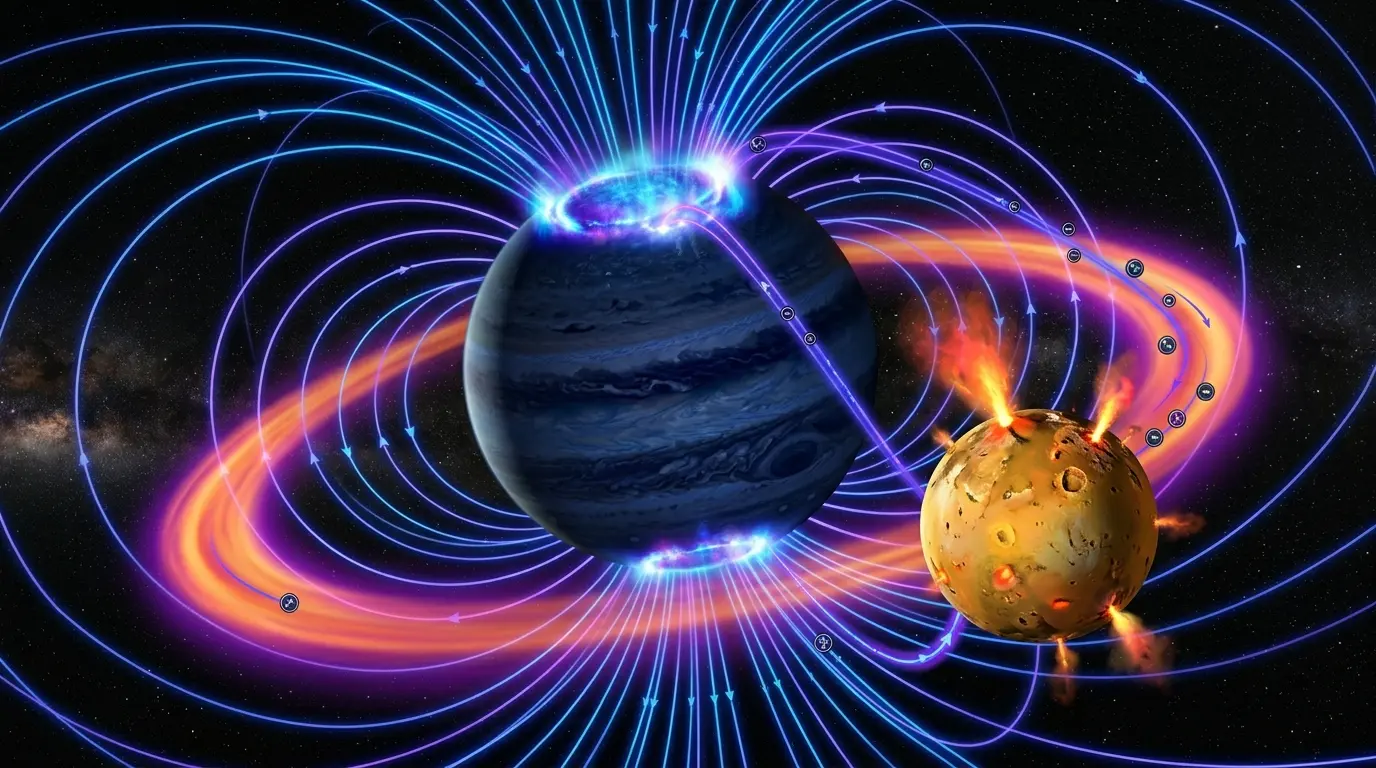
The primary engine driving this perpetual celestial spectacle is Jupiter’s immense magnetic field. Unlike Earth's geodynamo powered by a molten nickel-iron core, Jupiter’s magnetic shield is generated by a churning ocean of liquid metallic hydrogen under extreme interior pressures. Combined with the planet's lightning-fast rotation, this dynamo creates a magnetic dipole moment roughly 20,000 times more powerful than Earth's.
The Jovian magnetosphere is the largest structure in the solar system, stretching millions of kilometers toward the Sun and trailing an enormous magnetotail that reaches past the orbit of Saturn. This colossal magnetic bubble acts as a boundless natural particle accelerator, funneling energetic charged particles relentlessly into the gas giant's polar ionosphere.
Moon Io: The Volcanic Plasma Factory
While Earth’s auroral activity depends primarily on solar gusts, Jupiter’s auroral engine is largely self-powered from within. Its inner volcanic moon, Io, spews approximately one metric ton of sulfur dioxide gas per second into space through its unrelenting volcanic eruptions.
Solar radiation and electron impacts rapidly ionize this ejected material, creating a vast doughnut-shaped ring of charged particles known as the Io plasma torus. As Jupiter spins at breakneck speed—completing a rotation every 9 hours and 55 minutes—its rigid magnetic field drags this dense plasma ring along. Centrifugal forces trigger massive field-aligned electric currents that accelerate electrons and ions along magnetic field lines, hurling them directly into the upper Jovian atmosphere.
Key Drivers of Jupiter's Auroral Powerhouse
- Colossal Magnetic Dynamo: Driven by interior liquid metallic hydrogen, establishing a magnetic moment tens of thousands of times stronger than Earth's.
- Blistering Planetary Rotation: A sub-10-hour spin period provides the centrifugal torque required to accelerate charged particles.
- Volcanic Fuel from Io: Continuous volcanic venting supplies one ton of ionized sulfur and oxygen per second into the magnetosphere.
Invisible Radiance: Ultraviolet Glow and Pulsing X-Rays
If human eyes could observe Jupiter directly from orbit, the auroras would not appear in familiar curtains of green and red. Because Jupiter's atmosphere is predominantly hydrogen, its auroras radiate overwhelmingly in the ultraviolet (UV) and X-ray wavelengths. NASA’s Hubble Space Telescope and the Juno spacecraft have captured these ultraviolet auroral ovals in breathtaking detail.
Furthermore, collaborative observations between Juno and the European Space Agency’s XMM-Newton observatory revealed that heavy ions surf electromagnetic ion cyclotron (EMIC) waves down into the atmosphere. This interaction generates periodic X-ray flares that pulse with regular, clockwork periodicity.
Jupiter’s polar auroras are not mere atmospheric glows; they are planetary-scale particle accelerators operating continuously at the outer frontier of space physics.
A Laboratory for the Extreme Cosmos
Adding to this cosmic panorama are the distinct auroral footprints carved by moons like Io, Europa, and Ganymede as their electrical wakes intersect Jupiter's ionosphere. Deciphering the intricate physics governing Jupiter's magnetic field and supercharged polar lights provides astrophysicists with a crucial roadmap for studying magnetospheres around giant exoplanets across deep space.