The Grandeur of Perpetual Light at Jupiter's Poles
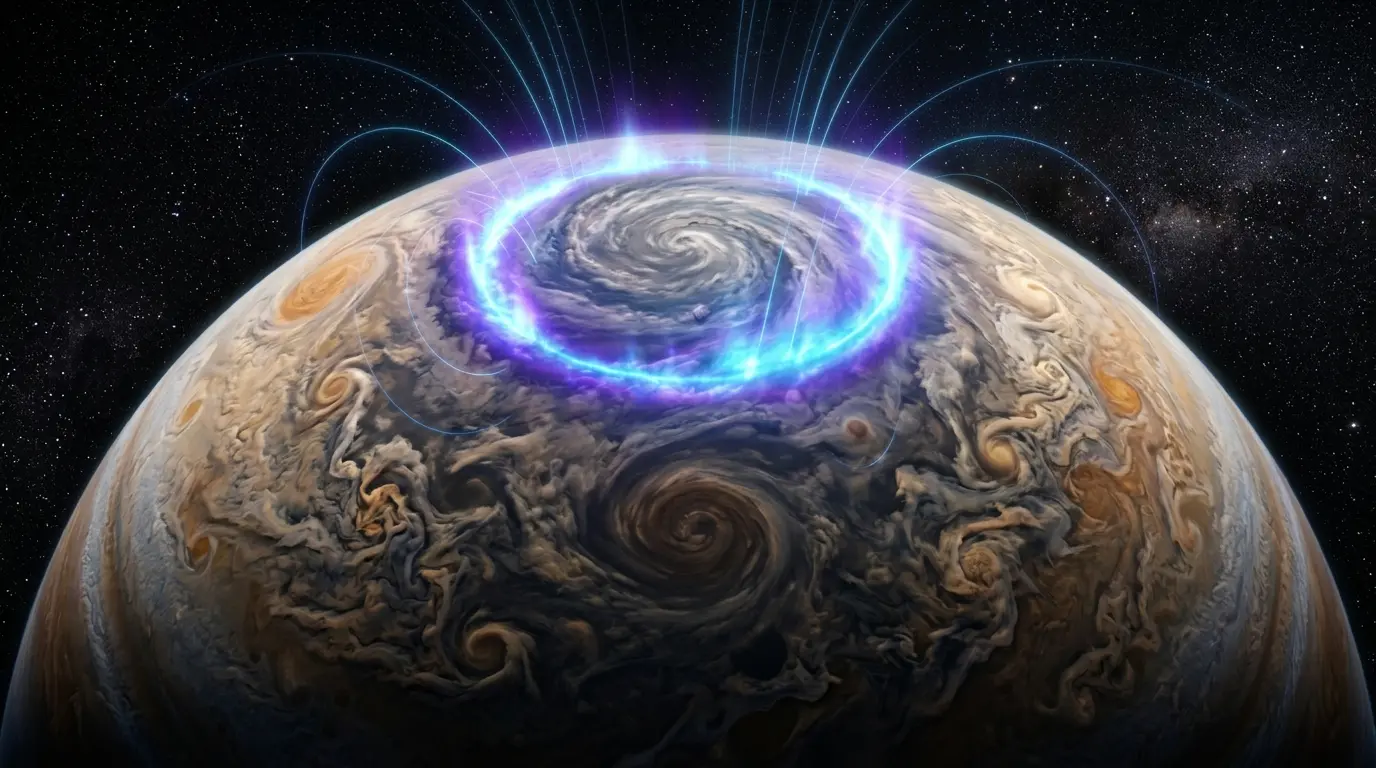
Across the northern and southern poles of Jupiter lies the most energetic auroral light show in the Solar System. Unlike Earth's northern and southern lights, which flicker and fade in response to shifting solar storms, Jupiter's polar auroras burn perpetually. This immense planetary phenomenon unleashes thousands of gigawatts of continuous power—hundreds of times more energetic than the most intense auroras ever documented on Earth.
A Colossal Magnetic Shield: The Liquid Metallic Hydrogen Dynamo
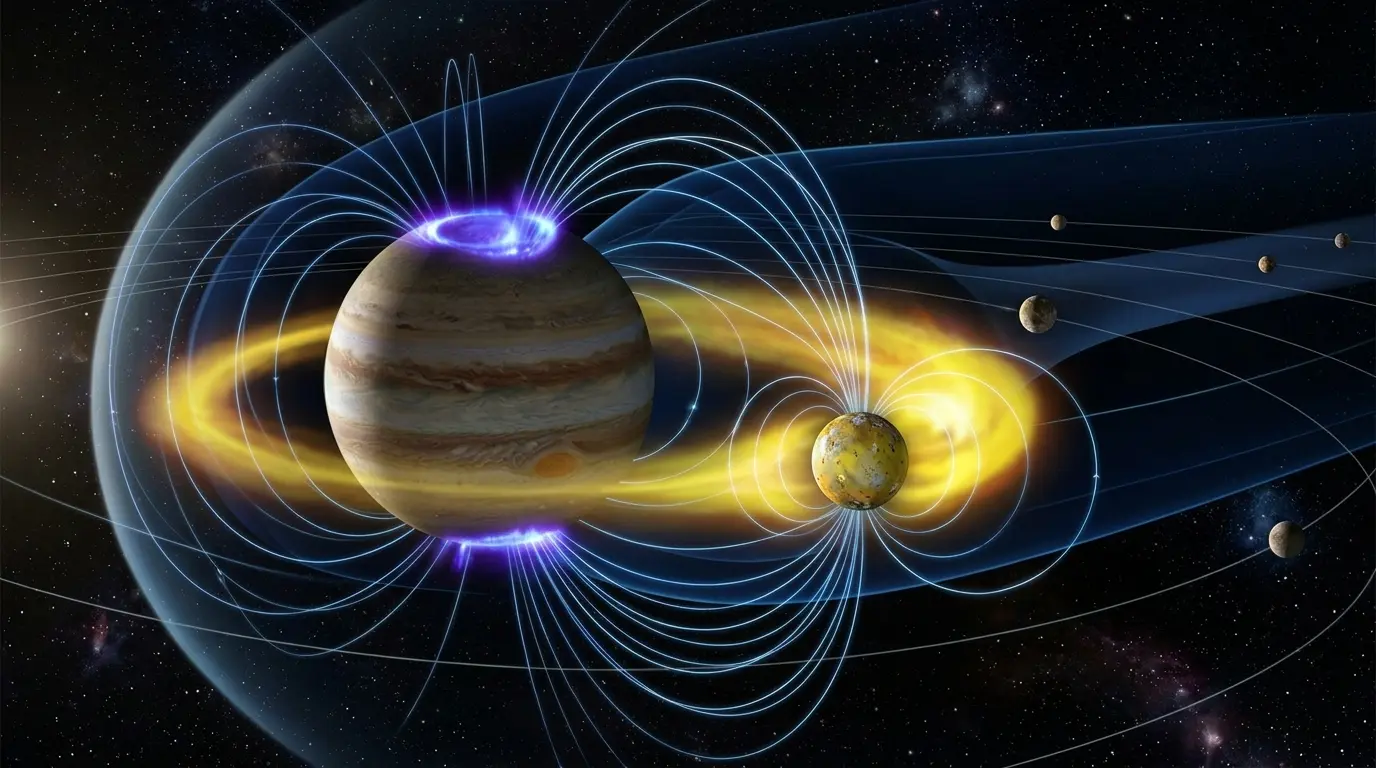
The engine powering this cosmic spectacle is Jupiter's colossal magnetic field, the strongest planetary field in our Solar System. Deep within the gas giant's interior, crushing pressures compress hydrogen into an electrically conductive fluid known as liquid metallic hydrogen. The swift convection and rotation of this metallic mantle create a massive planetary dynamo.
Jupiter's magnetic dipole moment is roughly 20,000 times larger than that of Earth. Its magnetosphere—the vast protective bubble carved out of space by its magnetic influence—stretches millions of kilometers toward the Sun and trails past the orbit of Saturn. If Jupiter's magnetosphere were visible to the naked human eye from Earth, it would span a region in the night sky several times wider than the full Moon.
The Moon Io: An Internal Plasma Factory
A fundamental distinction between Earth's auroras and those on Jupiter is the origin of their charged particles. While terrestrial auroras rely on gusts of solar wind hitting Earth's magnetosphere, Jupiter's primary auroral engine is driven from within its own planetary neighborhood by its volcanic moon, Io.
As the most volcanically active body in the Solar System, Io spews approximately one ton of sulfur dioxide and oxygen ions into space every second. These ejected particles are immediately trapped by Jupiter's magnetic lines, forming a dense, donut-shaped ring of ionized gas known as the Io plasma torus.
The Three Pillars of the Jovian Auroral Engine
- Liquid Metallic Hydrogen Dynamo: Generates a magnetic dipole moment roughly 20,000 times more powerful than Earth's.
- Io's Plasma Pipeline: Continuous volcanic activity injecting 1,000 kilograms of sulfur and oxygen ions into the magnetosphere every second.
- Ten-Hour Rapid Rotation: The planet's rapid spin creates extreme centrifugal forces that fling energized particles into the polar skies.
Jupiter's auroras do not wait for the solar wind; the planet's ferocious rotation and Io's volcanic exhaust act as an eternal generator, funneling millions of volts of charged particles directly into the Jovian poles.
Rapid Rotation and Particle Bombardment
Jupiter spins at an astonishing pace, completing a full planetary rotation in just about 9 hours and 55 minutes. This swift rotation drags the surrounding magnetospheric plasma along with the magnetic field. However, as the plasma drifts outward, centrifugal force causes it to break co-rotation with the planet.
This velocity mismatch sets up immense field-aligned electrical currents that accelerate electrons along magnetic field lines straight toward the polar regions. When these hyper-energetic particles slam into Jupiter's hydrogen-dense upper atmosphere, they trigger brilliant auroral emissions that radiate predominantly across the ultraviolet (UV) and X-ray spectra.
Insights from NASA's Juno Mission
Observations from the Hubble Space Telescope and NASA's Juno spacecraft, which has orbited Jupiter since 2016, have illuminated the intricate mechanics of these polar crowns. Juno's ultraviolet spectrographs even captured distinct auroral footprints etched into the polar glow by magnetic flux tubes tethered to Io, Europa, and Ganymede.
Studying Jupiter's giant auroras does more than demystify our solar system's largest planet; it offers vital blueprints for understanding the magnetospheres, radiation belts, and space weather of distant giant exoplanets across the galaxy.