Extreme Velocity and the Evolutionary Mastery of the Cheetah
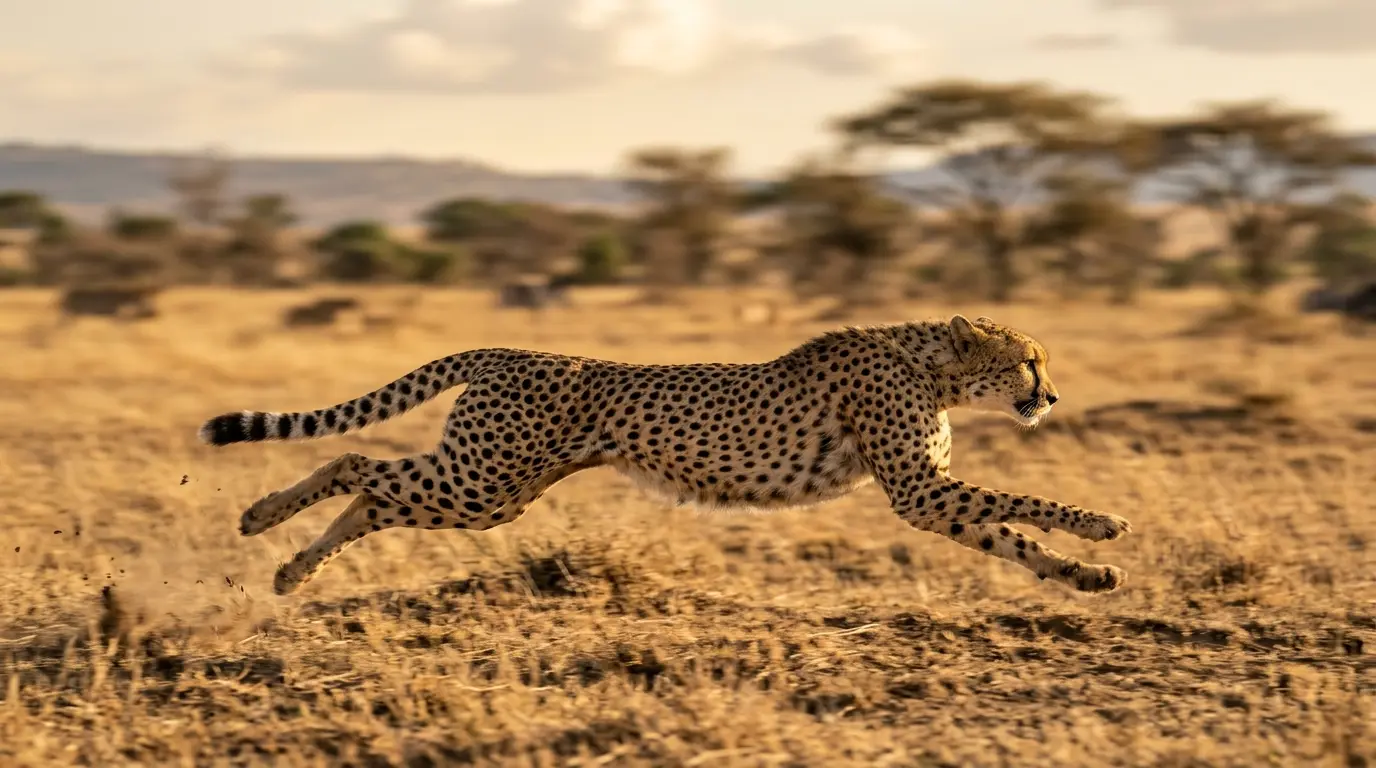
The cheetah (Acinonyx jubatus) stands as the undisputed fastest terrestrial mammal on Earth. Capable of accelerating from 0 to 96 km/h in approximately three seconds, its verified maximum sprint velocity ranges between 26 and 29 meters per second (roughly 93 to 104 km/h). This astonishing biomechanical performance is not merely the product of powerful limb muscles, but rather a seamless mechanical integration of extreme spinal flexibility, a specialized rotary gallop, and aerodynamic body shaping.
The Vertebral Column: A Biological Dynamic Spring
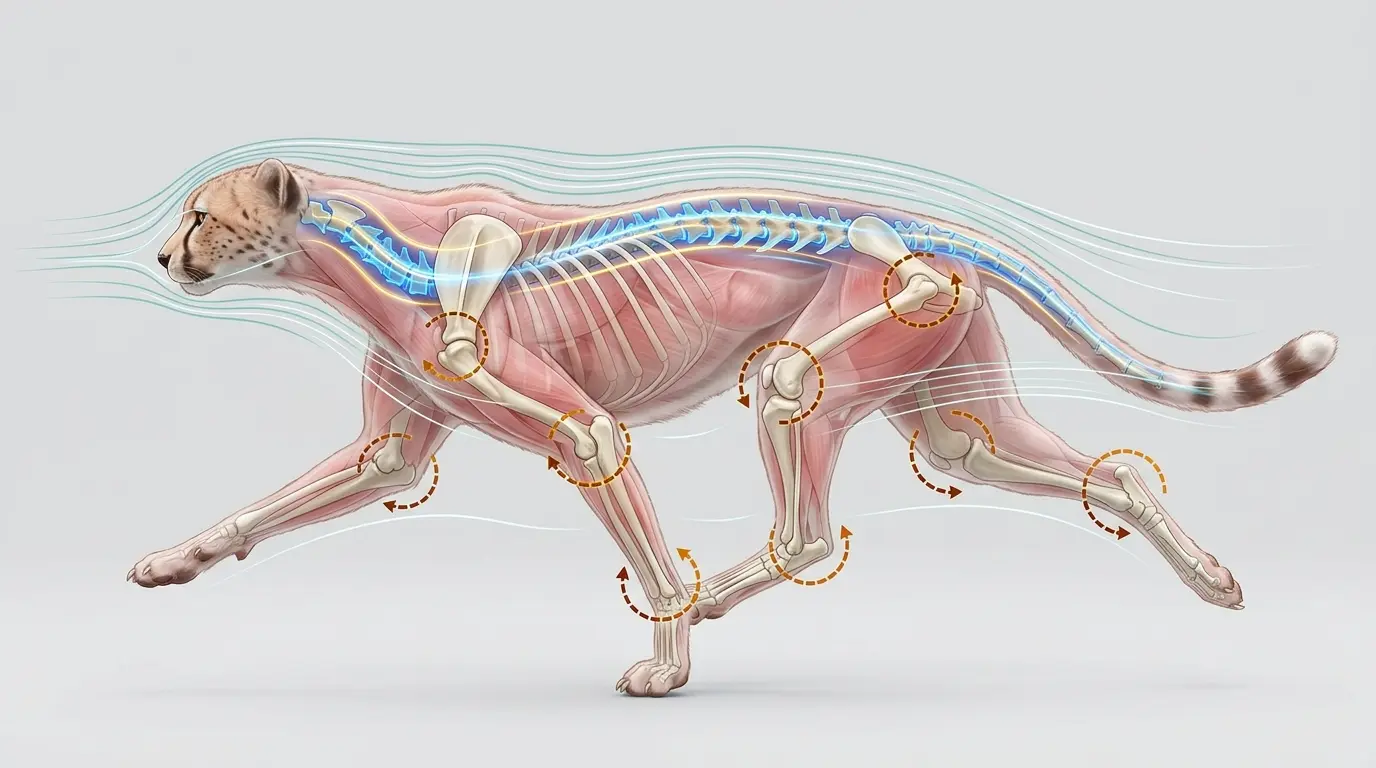
The linchpin of cheetah sprint efficiency resides in its remarkably flexible vertebral column. Unlike ungulates such as racehorses, the cheetah's spine features highly compliant intervertebral facet joints supported by elastic ligaments and powerful epaxial musculature, predominantly the longissimus dorsi.
Throughout each high-speed locomotion cycle, the spine functions analogously to a biological spring or catapult:
- Maximum Extension Phase: The lumbar spine extends dorsally into a flattened arch, maximizing linear distance between the forelimbs and hindlimbs.
- Maximum Flexion Phase: The spine sharply flexes ventrally, allowing the hind paws to swing substantially forward past the placement of the front paws.
This dynamic sagittal bending contributes between 0.7 and 1.0 meter to every single stride, yielding a staggering total stride length of 6.5 to 7.5 meters while maintaining a rapid stride frequency of roughly 3.2 to 3.5 strides per second.
Rotary Gallop Mechanics and Dual Flight Phases
Cheetahs propel themselves using a rotary gallop gait. A key biomechanical distinction setting cheetahs apart from other terrestrial cursors is the inclusion of two distinct aerial flight phases per stride cycle: the extended flight phase, where limbs stretch horizontally, and the gathered flight phase, where limbs overlap beneath a flexed torso. This dual suspension optimizes ground reaction forces while conserving metabolic energy by maintaining a low center-of-mass trajectory.
Aerodynamic Drag Reduction and Inertial Stabilization
At velocities exceeding 90 km/h, aerodynamic drag forces become a crucial physical constraint. The cheetah's external morphology has evolved specifically to minimize this resistance. A deep yet narrow chest cavity, a flattened skull with compact ears, and an aligned sagittal profile drastically reduce frontal cross-sectional area, ensuring laminar airflow around the body.
"The cheetah's spinal flexibility does not merely extend stride reach; it serves as a dynamic dampener that stabilizes the center of mass on an exceptionally flat trajectory."
Complementing its streamlined profile is the long, muscular tail, which functions as an active inertial rudder. When performing rapid, evasive turns during a predatory pursuit, the cheetah swings its tail through the air, generating counteracting angular momentum that suppresses adverse yaw and roll torques.
Traction Synergy and Biomechanical Harmony
Completing this locomotion system are semi-retractile claws that lack cutaneous sheaths. These claws act identically to track spikes, biting firmly into the terrain to transmit explosive propulsive forces without slippage. Through the harmonious synchronization of spinal elastic energy, aerodynamic streamlining, and inertial stabilization, the cheetah epitomizes optimal locomotive physics in nature.