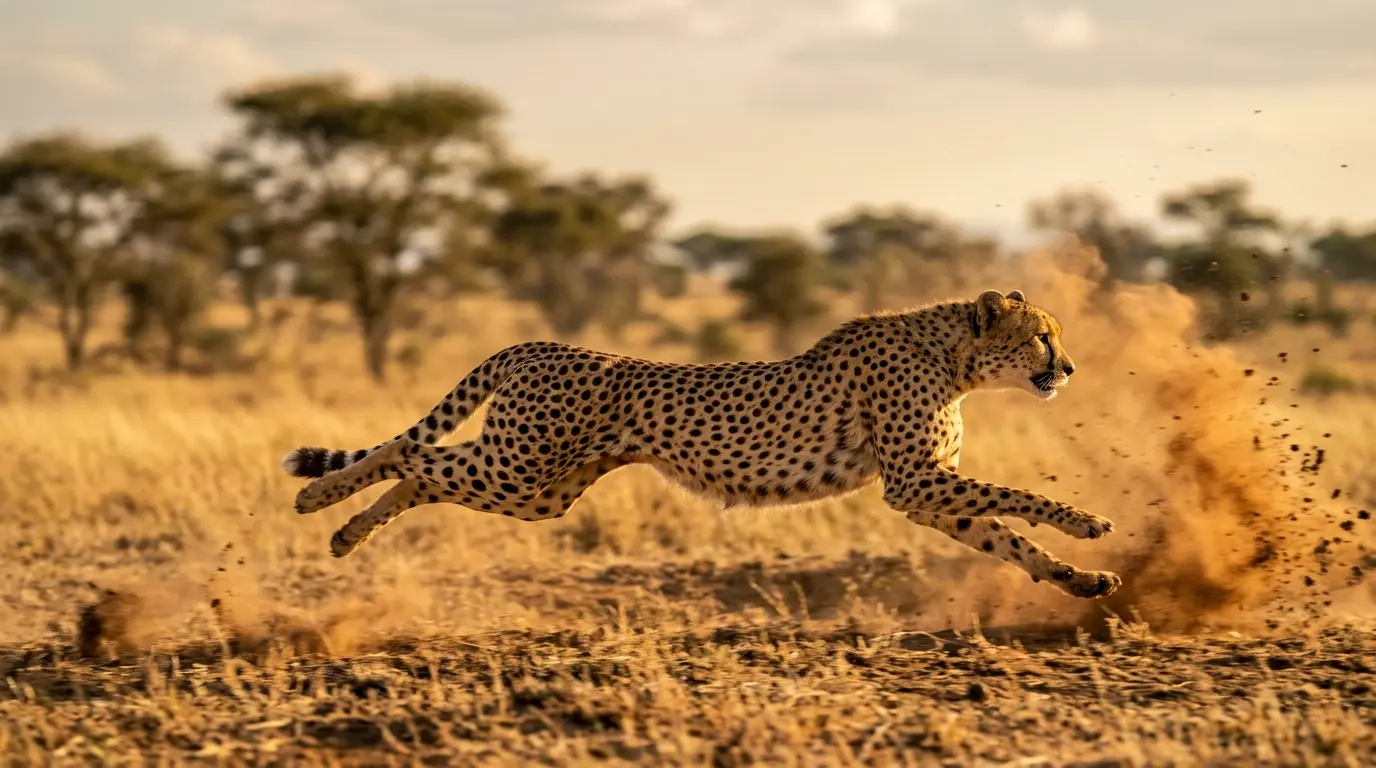
The cheetah (Acinonyx jubatus) reigns as the fastest terrestrial mammal on Earth. In open habitats, this specialized predator can accelerate from a standstill to over 90 km/h in roughly three seconds. Rigorous field tracking utilizing high-precision GPS and inertial sensor collars led by Professor Alan Wilson at the Royal Veterinary College recorded peak wild hunting speeds reaching 25.9 meters per second (approximately 93 km/h). This remarkable velocity stems not merely from muscular force, but from an exquisite integration of vertebral biomechanics and dynamic aerodynamic control.
Vertebral Dynamics: Biological Springs and Dual Flight Phases
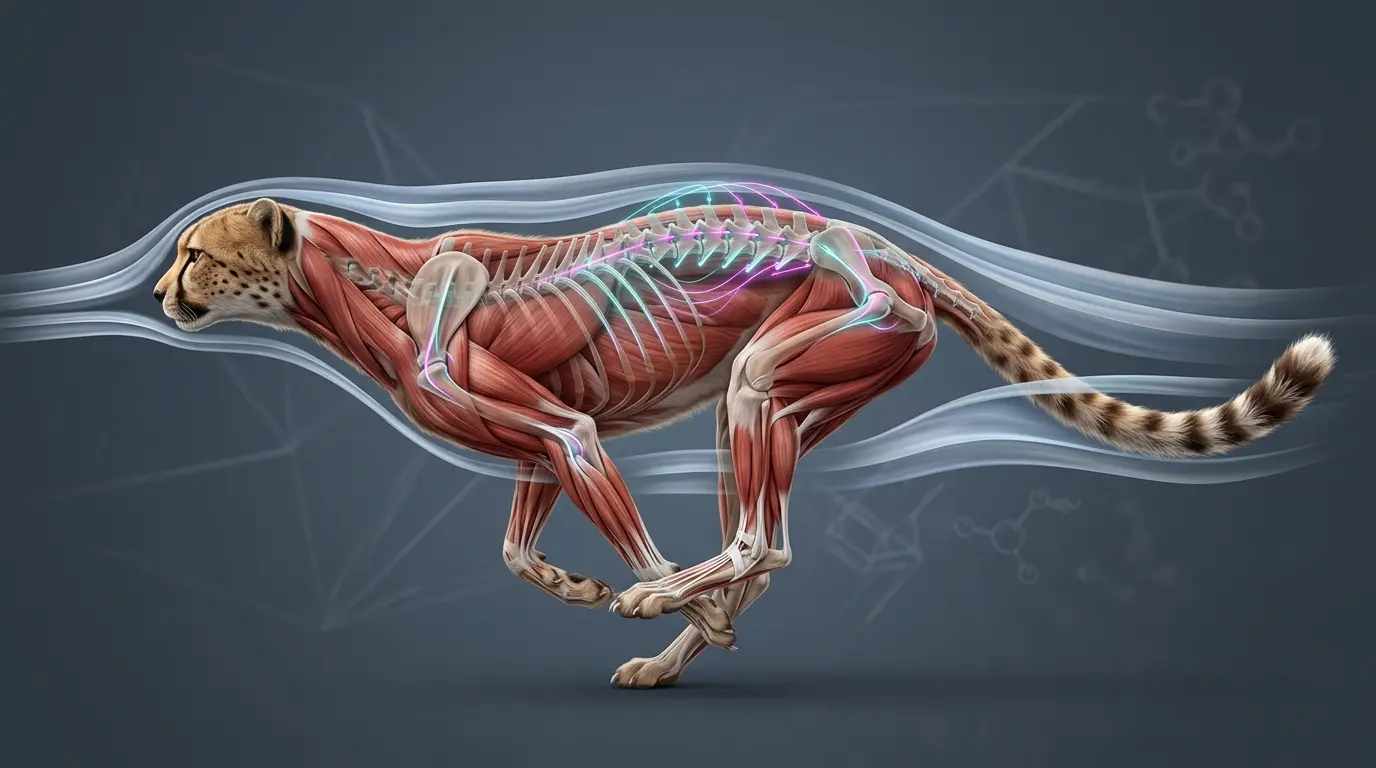
Unlike large cursorial quadrupeds such as horses, which maintain a stiffened spine to support heavy body mass, the cheetah possesses an exceptionally flexible thoracolumbar spine. This vertebral column functions as a composite bow and biological spring, continuously storing and releasing elastic strain energy throughout each stride cycle.
Cheetah locomotion relies on a specialized asymmetrical rotary gallop. As pioneered by zoologist Milton Hildebrand and verified through dynamic mathematical modeling by Dr. Tomoya Kamimura in 2021, sagittal spinal flexion and extension enable the cheetah to exhibit two distinct flight phases per stride:
- Gathered Flight: The thoracolumbar spine flexes sharply in the sagittal plane, pulling the pelvic girdle toward the pectoral girdle. The hind limbs swing far forward outside the front limbs, storing elastic strain energy in the epaxial musculature and supraspinous ligaments.
- Extended Flight: The spine extends forcefully, propelling the body forward like an uncoiling spring. This vertebral extension directly accounts for more than 10 percent of total stride length, enabling strides of up to 7 meters at stride frequencies exceeding 3 strides per second.
Torso Aerodynamics and the Tail as an Aerodynamic Rudder
At sprint velocities exceeding 25 meters per second, aerodynamic drag escalates quadratically with velocity. To combat this resistance, the cheetah's morphology is aerodynamically optimized. A small, streamlined cranium, flattened thoracic cage, and backward-facing fur substantially reduce both frontal surface area and skin-friction drag.
Furthermore, spinal flexibility actively mitigates vertical pitch oscillations. By dampening sudden changes in body trajectory, the flexed spine maintains a steady, level head height. This mechanical stability empowers the cheetah's vestibulo-ocular reflex to preserve uninterrupted visual fixation on dodging prey.
Crucial aerodynamic stabilization during sharp turns is delivered by the tail. Research by Professor Amir Patel at the University of Cape Town revealed that the cheetah's tail—representing only about 2 percent of total body mass—does not act merely as an inertial counterweight. Because dense fur effectively doubles its surface area, swinging the tail through the air generates considerable aerodynamic drag, functioning as an aerodynamic rudder. This air resistance creates counter-torque that prevents skidding and stabilizes yaw during sudden, high-speed lateral turns.
A cheetah's sprint is a masterpiece of biological engineering: an elastic spine acting as a mechanical catapult, synchronized with an aerodynamic rudder that ensures directional control.
Biomimetic Inspirations for Agile Robotics
These biological discoveries provide critical blueprints for bio-inspired robotics. By incorporating flexible, actuated spinal joints and lightweight aerodynamic stabilizers modeled on cheetah morphology, roboticists are developing agile quadruped robots that achieve greater energy efficiency, higher speed, and robust balance across challenging terrains.