Harnessing the Sun: From Photons to Electric Current
Every single second, the sun bathes our planet in vast streams of light energy traveling across the vacuum of space. Modern solar photovoltaic cells capture these incoming light packets and convert them directly into electricity without mechanical moving parts, chemical emissions, or audible noise. But what exact quantum physics mechanism enables solid silicon to transform sunlight into clean electric power?
Historical Roots: The Photoelectric and Photovoltaic Effects
The core scientific foundation of solar power originated from quantum phenomena deeply tied to the photoelectric effect. In 1905, Albert Einstein published a landmark paper establishing that light behaves not merely as continuous waves, but as discrete energy packets called light quanta (now termed photons).
Einstein's groundbreaking equation revealed that photon energy is directly proportional to radiation frequency (E = hf), a discovery that earned him the 1921 Nobel Prize in Physics.
While the classical external photoelectric effect ejects electrons entirely away from a metal surface into empty space, modern solar cells harness the closely related photovoltaic effect (an internal photoelectric phenomenon). Instead of ejecting electrons outward, incoming photons liberate electrons within the internal crystal lattice of a semiconductor.
Semiconductor Architecture and the P-N Junction
Most commercial photovoltaic panels utilize crystalline silicon, a semiconductor element with four valence electrons. In its pure crystalline state, silicon is a poor electrical conductor. Manufacturers enhance its conductive properties through intentional chemical doping:
- N-Type Silicon: Silicon doped with trace phosphorus atoms (five valence electrons), introducing surplus mobile conduction electrons.
- P-Type Silicon: Silicon doped with trace boron atoms (three valence electrons), leaving vacancies known as positively charged "holes."
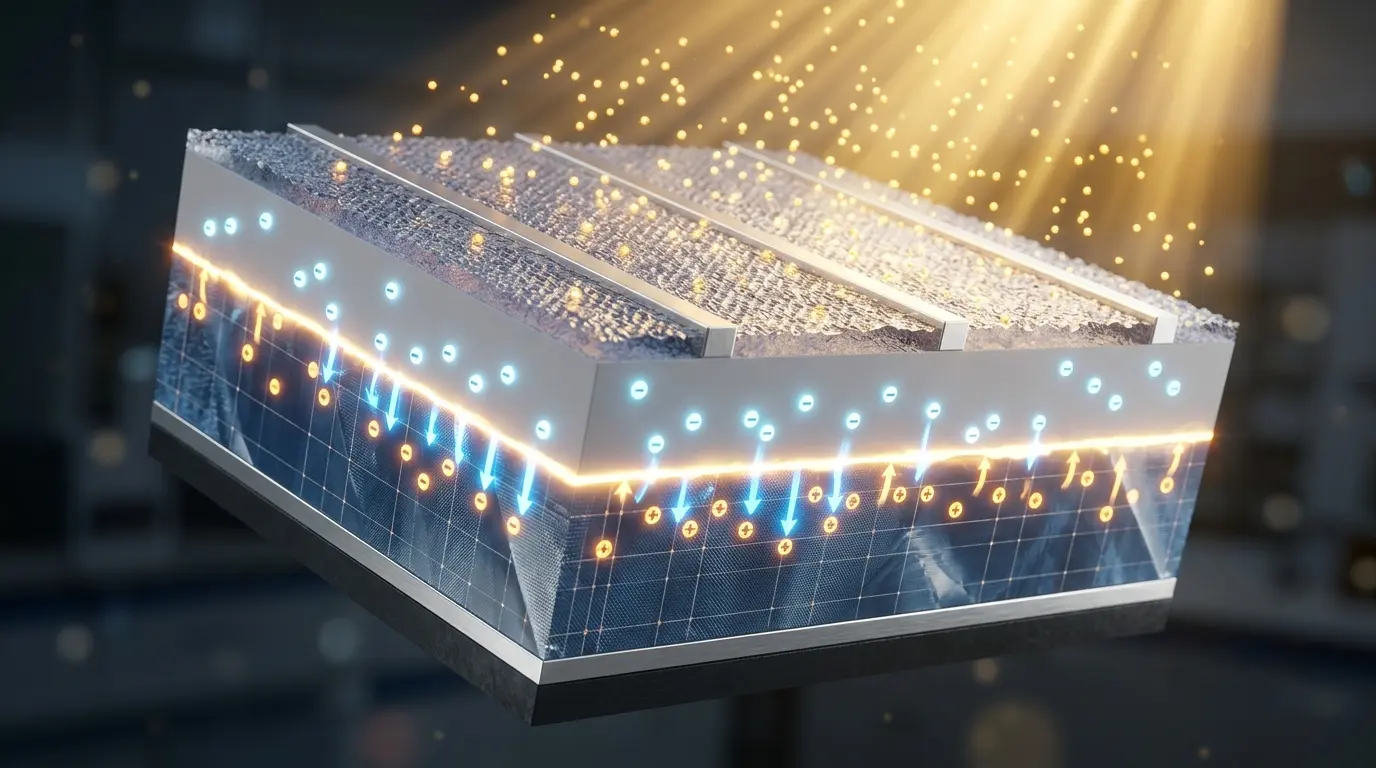
Joining these contrasting layers creates a p-n junction. Mobile electrons spontaneously diffuse across the boundary until a stable depletion zone forms, producing a permanent built-in internal electric field that prevents backward charge migration.
Step-by-Step Conversion: Absorption, Separation, and Current Flow
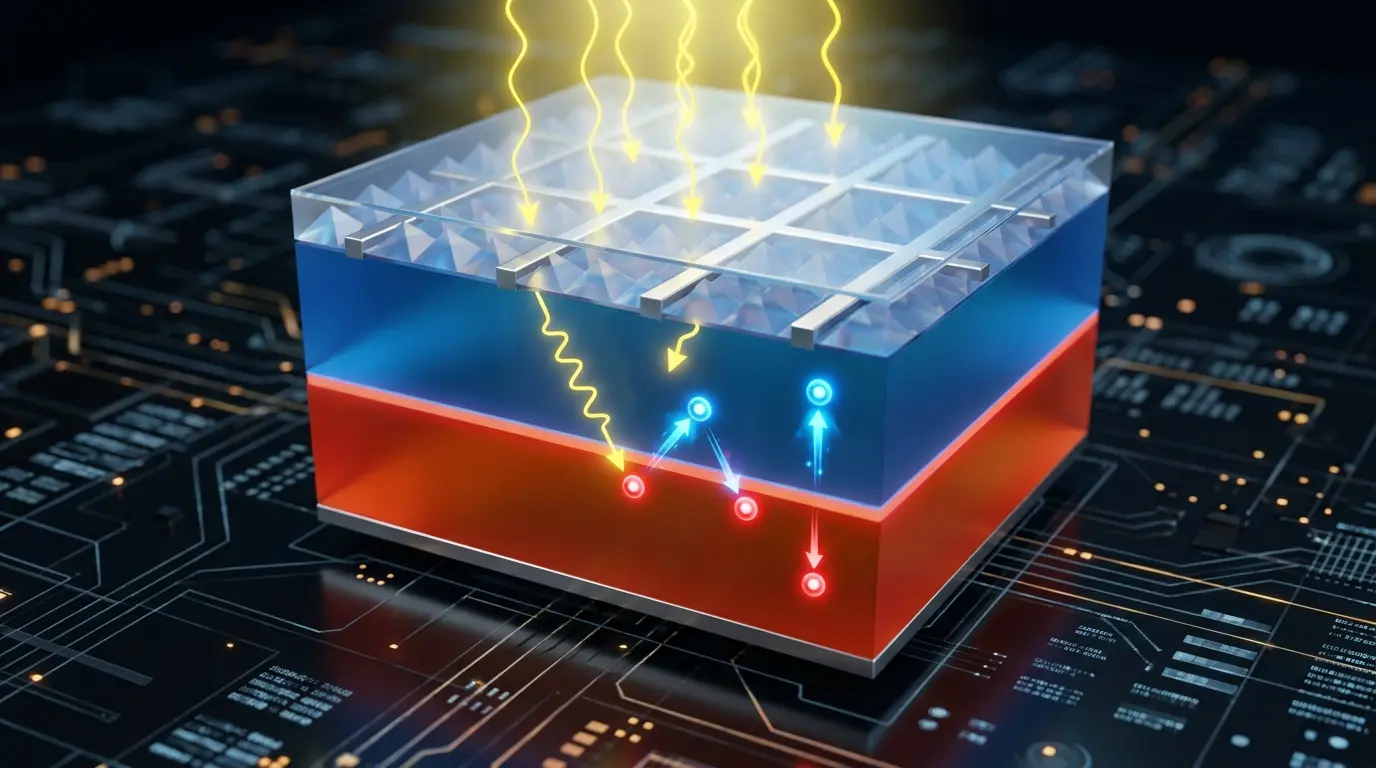
When sunlight strikes the solar cell through an anti-reflective coating, photons penetrate directly into the silicon crystal lattice. If a photon possesses energy equal to or higher than silicon's bandgap threshold—approximately 1.1 electron-volts (eV) at room temperature—it triggers energy conversion:
- Generation of Electron-Hole Pairs: The photon transfers its discrete quantum energy to a bound valence electron, knocking it free into the conduction band and creating an electron-hole pair.
- Carrier Separation: The built-in electric field at the p-n junction sweeps the excited free electrons toward the n-side collector and the holes toward the p-side base, stopping immediate recombination.
- Direct Current (DC) Flow: Ultra-thin metallic contact grids collect the separated electrons. Flowing through an external circuit back to the p-layer, these mobile electrons generate usable direct current (DC).
Finally, a power inverter converts this direct current into alternating current (AC) matching grid frequencies, safely powering domestic appliances and industrial infrastructure worldwide.