
The Marvel of Biosonar in the Ocean Depths
Among all marine dwellers, the common bottlenose dolphin (Tursiops truncatus) occupies a unique scientific standing, combining acute sensory perception with profound cognitive intellect. In murky or dark aquatic environments where vision is severely limited, these cetaceans perceive their surroundings in vivid detail through echolocation—a biological sonar system of extraordinary sophistication.
How Dolphin Echolocation Operates
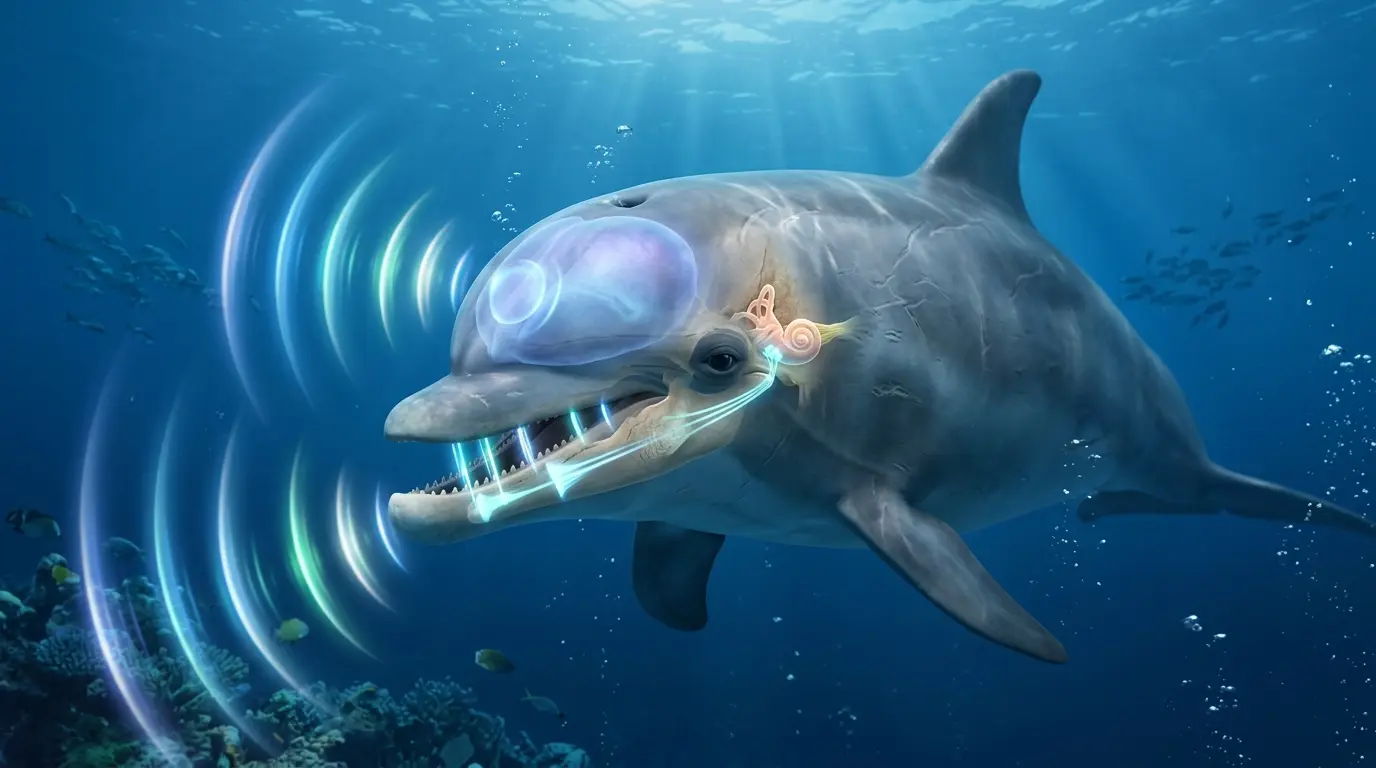
Echolocation is far more than ordinary hearing; it functions as an acoustic three-dimensional imaging mechanism. The biological pathway relies on specialized anatomical structures working in seamless harmony:
- Phonic Lips: Situated just beneath the blowhole within the nasal passages, these muscular flaps clap together to generate rapid bursts of ultrasonic clicks with frequencies often exceeding 100 kilohertz.
- The Melon: A bulbous forehead organ composed of specialized acoustic lipids functions precisely like an acoustic lens, focusing the emitted sound waves into a directed, directional beam through the water column.
- The Lower Jaw (Mandible): Rather than relying on external ear openings, returning echoes that bounce off prey or obstacles are captured by lipid-filled channels in the dolphin's lower jawbone, which conduct acoustic vibrations directly to the inner ear.
Dolphins can detect an object as small as a ping-pong ball from hundreds of feet away and discern its internal density.
Profound Intelligence and Self-Awareness
Bottlenose dolphin intelligence is supported by an Encephalization Quotient (EQ) second only to humans among mammals, reflecting an exceptionally convoluted cerebral cortex. Empirical research has uncovered multiple hallmarks of advanced intellect:
- Mirror Self-Recognition: Controlled cognitive trials have demonstrated that bottlenose dolphins readily inspect markings on their bodies using mirrors, confirming an explicit sense of self-awareness.
- Signature Whistles: Each dolphin develops an individually distinctive frequency-modulated whistle in early life, operating effectively as an acoustic personal name used for social recognition.
- Cultural Tool Use: In Shark Bay, Western Australia, dolphins fit marine sponges over their rostra to shield themselves from abrasions while foraging along rocky sea bottoms—a sophisticated foraging tradition transmitted matrilineally across generations.
The Threat of Underwater Noise Pollution
This finely tuned biosonar and rich acoustic culture face escalating interference from human industrial activities. Engine cavitation from commercial shipping, naval sonar systems, and marine seismic exploration flood the oceanic soundscape, risking acoustic trauma and masking crucial communicative whistles. Preserving quiet oceanic corridors is vital to safeguarding the acoustic world and survival of these remarkably intelligent marine mammals.