Solar Wind: High-Speed Charged Particles from the Corona
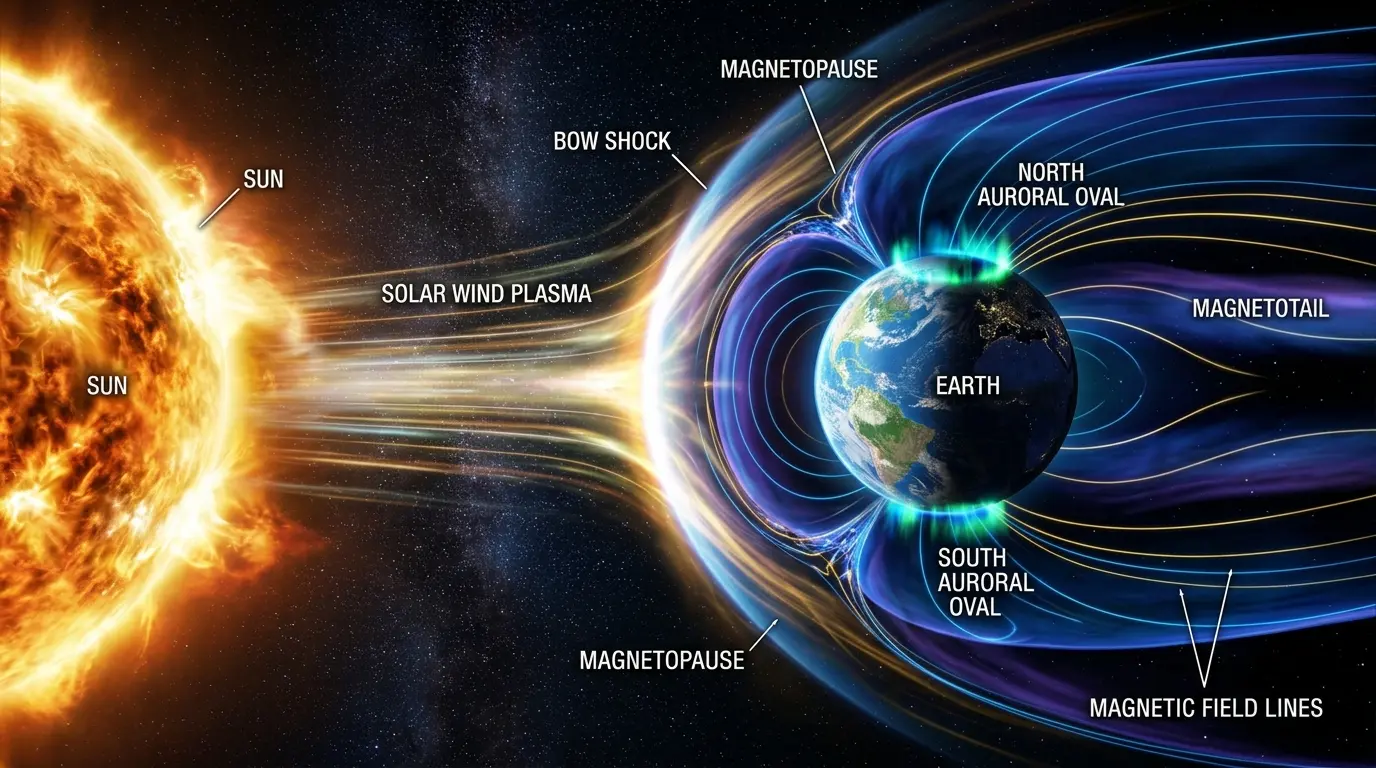
Our Sun constantly radiates more than heat and visible light; it continuously ejects a torrent of electrically charged subatomic particles known as the solar wind. Originating within the Sun's scorching outermost atmosphere—the corona—this solar wind consists primarily of high-energy protons and free electrons organized in a plasma state. Escaping the Sun's gravitational pull, these particles traverse interplanetary space at speeds ranging from 300 to over 800 kilometers per second, dragging the Interplanetary Magnetic Field (IMF) along with them.
The Magnetosphere and Magnetic Reconnection
Without an invisible barrier, this relentless bombardment would gradually strip away Earth's atmosphere and bathe the surface in lethal radiation. Fortunately, the convective motion of molten iron within Earth's outer core generates a colossal magnetic field known as the magnetosphere. As the solar wind slams into this shield, it forms a standing shockwave—the bow shock—which deflects the majority of incoming charged particles safely around the planet.
However, Earth's shield is not completely impermeable. When the orientation of the solar wind's magnetic field aligns southward (known to geophysicists as negative Bz), it triggers magnetic reconnection. Earth's magnetic field lines break and cross-link directly with interplanetary field lines, funneling solar plasma into the magnetotail on Earth's nightside. When tension in the magnetotail builds, explosive reconnection snaps the lines back, accelerating energized particles down along converging geomagnetic field lines directly toward the polar upper atmosphere.
Atomic Excitation and the Auroral Color Spectrum
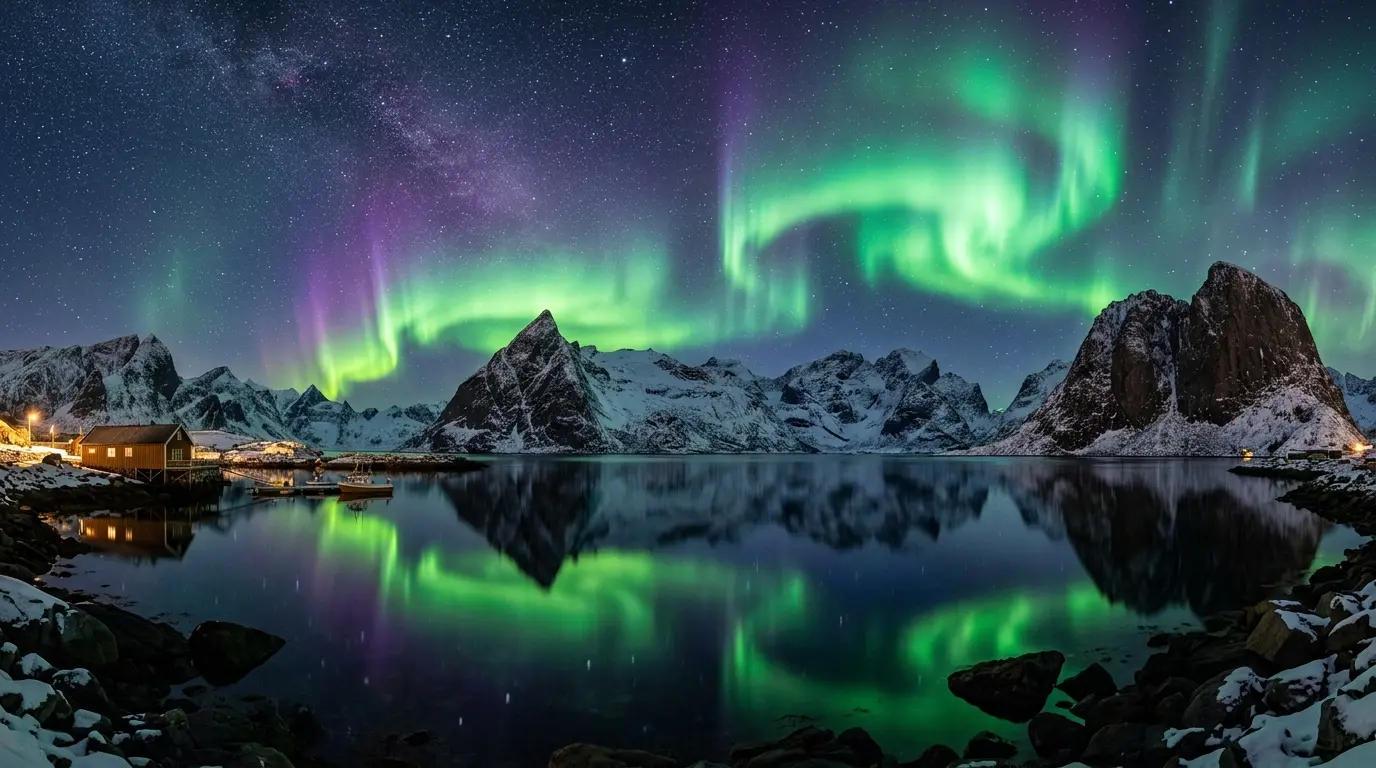
As these charged particles plunge into the thermosphere and ionosphere at altitudes between 80 and 400 kilometers, they collide violently with atmospheric gas particles. These collisions transfer kinetic energy to atomic electrons, elevating them into an excited state. When these atoms decay back down to their ground state, they release that surplus energy as discrete packets of light (photons):
- Emerald green (557.7 nm): The most frequent display, produced by excited atomic oxygen at altitudes between 100 and 150 kilometers.
- Deep crimson red (630.0 nm): Emitted by atomic oxygen above 200 kilometers, where sparse atmospheric density permits forbidden transitions to occur without collision deactivation.
- Purple, blue, and pink borders: Produced by ionized and molecular nitrogen collisions at lower boundaries, typically between 80 and 100 kilometers.
Auroral activity peaks during periods of intense solar activity within the Sun's 11-year solar cycle, especially when Coronal Mass Ejections (CMEs) compress the magnetosphere and push the auroral oval toward mid-latitudes.