Infrasonic Rumbles in the Ocean Depths
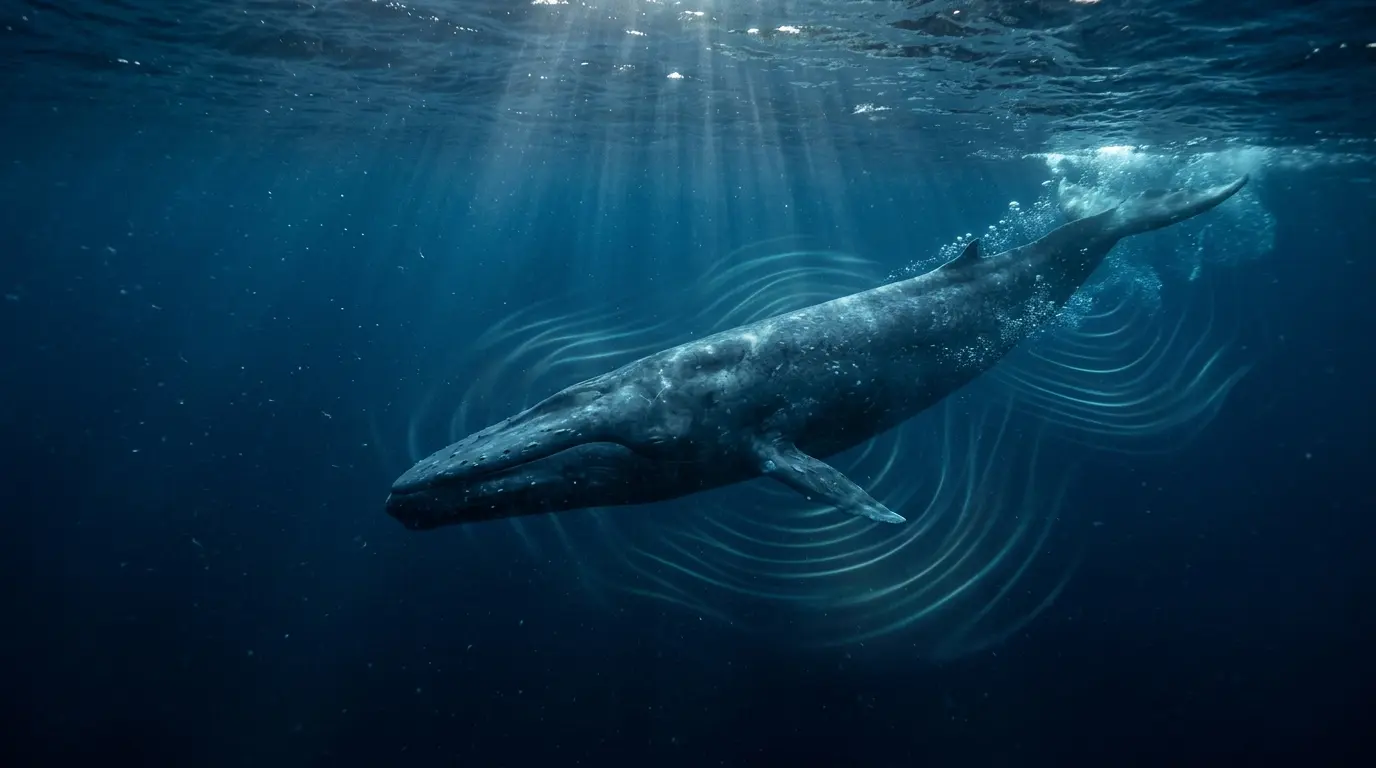
Beneath the seemingly silent ocean surface, the blue whale (Balaenoptera musculus) emits some of the most powerful acoustic signals in the animal kingdom. The largest creature on Earth produces songs with fundamental frequencies ranging between 10 and 40 Hertz (Hz). Because human hearing begins around 20 Hz, the lowest components of these vocalizations are classified as infrasound—imperceptible to our ears without specialized hydrophones or audio acceleration.
The vocal output of blue whales is remarkably potent. Emitted at source levels estimated between 155 and 188 decibels (dB re 1 µPa at 1 meter), these deep vocalizations possess the unique capability to travel hundreds and even thousands of kilometers across open ocean basins.
Acoustic Physics: Why Low Frequencies Travel Vast Distances
The extraordinary propagation of blue whale songs relies on fundamental underwater acoustics. Two primary physical principles explain why low-frequency rumbles endure across vast expanses:
- Minimal Attenuation: Seawater absorbs acoustic energy through viscous friction and chemical relaxation involving dissolved minerals such as magnesium sulfate and boric acid. This attenuation increases sharply with frequency. A 20 Hz wave loses only a fraction of a decibel per thousand kilometers, whereas high-frequency dolphin clicks exceeding 100 kHz dissipate within a few kilometers.
- Enormous Wavelengths: Given sound speed in seawater of roughly 1,500 m/s, a 20 Hz sound has an acoustic wavelength of about 75 meters. These expansive waves easily diffract around oceanic obstacles without severe scattering losses.
The SOFAR Channel: Nature’s Underwater Acoustic Highway
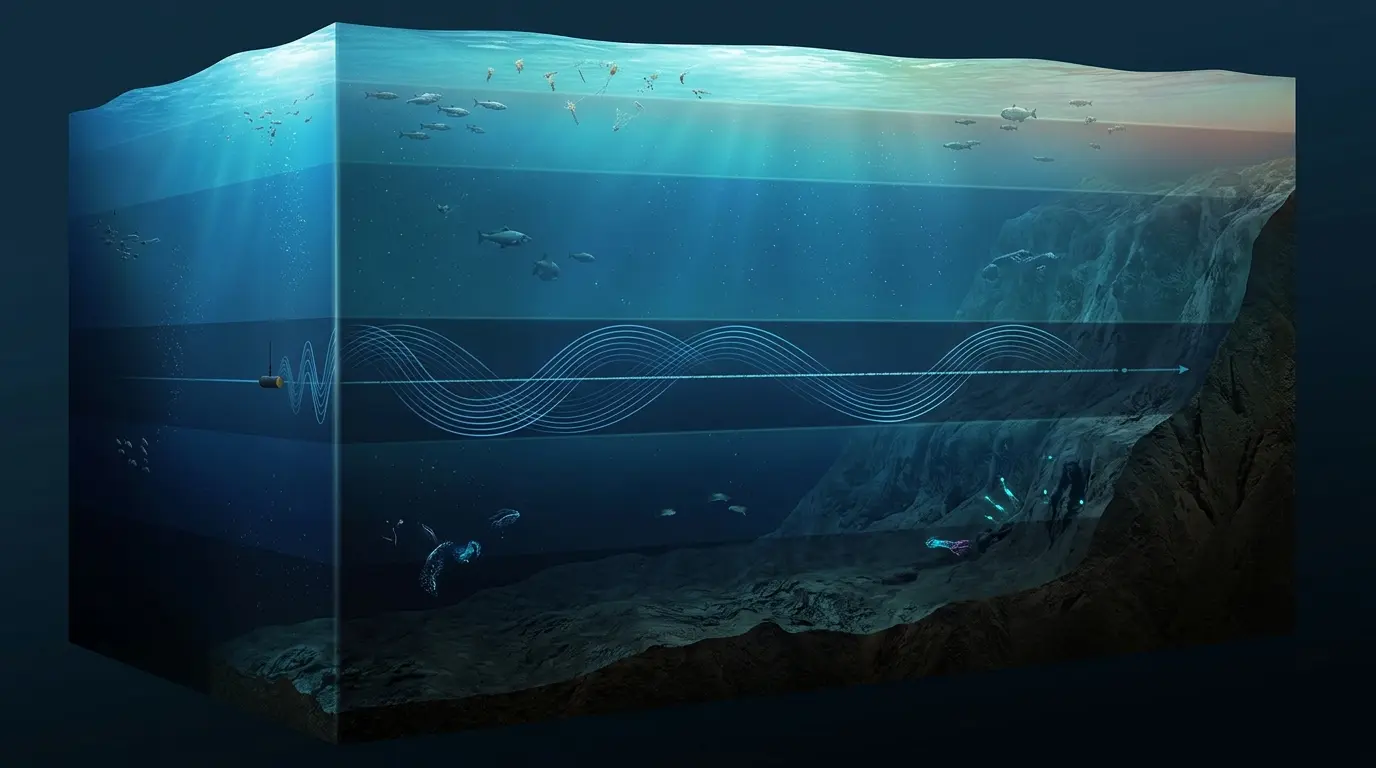
The decisive oceanographic mechanism facilitating long-range transmission is the SOFAR (Sound Fixing and Ranging) channel, often termed the deep sound channel, spanning depths between 600 and 1,200 meters.
Refraction and Waveguide Dynamics
Within the SOFAR channel, the downward drop in water temperature balances with the upward increase in hydrostatic pressure, forming a layer where sound speed reaches its absolute minimum. According to Snell’s Law, sound waves wandering away from this axis are continuously refracted back toward the minimum-velocity depth.
Acting like a colossal fiber-optic cable, the SOFAR channel confines acoustic energy to cylindrical rather than spherical spreading, conserving signal intensity over thousands of kilometers.
Biological Significance and Noise Pollution
Predominantly produced by males, these rhythmic vocal displays facilitate long-range mate attraction, navigational charting, and social coordination across sparse populations.
The Impact of Anthropogenic Noise
Unfortunately, this ancient acoustic highway is increasingly compromised by human activity. Commercial cargo ships and seismic airgun surveys emit pervasive low-frequency noise in the identical 10 to 100 Hz band. This acoustic smog masks blue whale vocalizations, shrinking their historical communication range from thousands of kilometers to mere dozens near congested shipping corridors.