Hidden Forces Beneath the Ocean Surface
The vast majority of Earth's volcanic activity does not unfold on towering mountain peaks, but remains concealed thousands of meters beneath the waves. Scientists estimate that roughly 70 to 80 percent of our planet's annual magma output erupts from submarine volcanoes, primarily along mid-ocean ridges and tectonic subduction zones. When persistent eruptions rise toward shallow waters, a spectacular geological event takes place: the birth of a brand-new oceanic island.
The Geological Stages of Island Genesis
The emergence of a volcanic island from the seabed is not an instantaneous event, but rather a sequence of distinct geological phases:
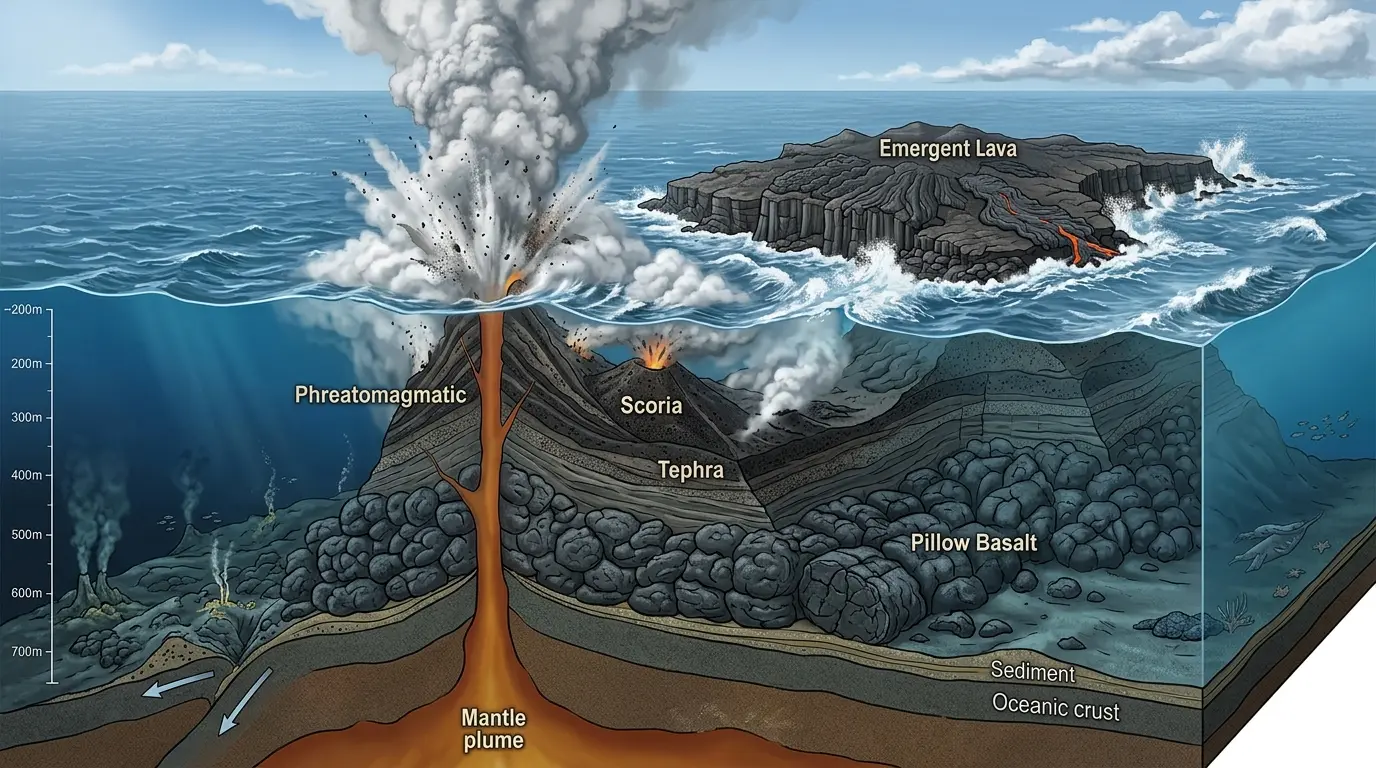
- Deep-Sea Effusion: In the ocean abyss, crushing hydrostatic pressure suppresses explosive gas expansion. Basaltic magma quenching rapidly against freezing seawater forms bulbous structures known as pillow lava. Over millennia, repeated flows gradually build colossal seamounts rising toward the photic zone.
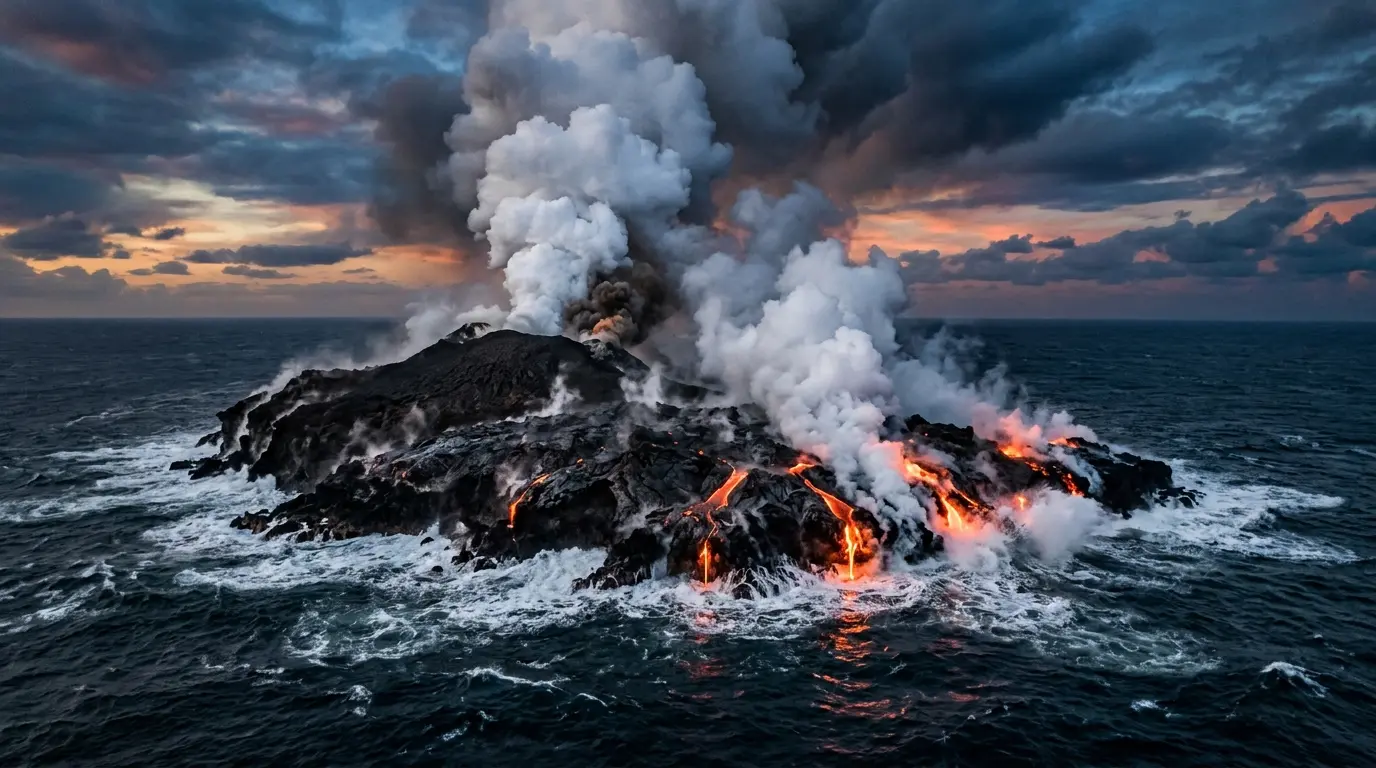
- Phreatomagmatic Explosions: As the summit approaches shallow depths (typically under 200 meters), hydrostatic pressure wanes. Magma exceeding 1,000°C comes into volatile direct contact with seawater, triggering violent phreatomagmatic detonations. Known as Surtseyan eruptions, these explosions blast dense black tephra, steam plumes, and volcanic bombs high into the atmosphere, eventually piercing the surface.
- Subaerial Armoring: Once the accumulated tephra cone isolates the vent from seawater influx, eruptions transition from explosive to effusive. Fluid subaerial lava spreads across the loose volcanic debris, capping the nascent island in durable rock.
"The birth of a volcanic island represents a continuous struggle between magma surging from Earth's mantle and the relentless erosive power of ocean waves."
Natural Laboratories: From Surtsey to Hunga Tonga
The most iconic modern benchmark of this phenomenon is Surtsey, which emerged off the southern coast of Iceland. Beginning roughly 130 meters below sea level on November 14, 1963, eruptions persisted until June 1967, producing an island of approximately 2.7 square kilometers. Designated a UNESCO World Heritage site, Surtsey has served as a pristine laboratory for ecological succession and coastal geomorphology.
More recently, Hunga Tonga-Hunga Ha'apai formed in early 2015 in the South Pacific, providing planetary scientists with crucial insights into oceanic landforms. However, its catastrophic paroxysm on January 15, 2022, obliterated most of the emergent landmass, illustrating the deeply volatile and cyclical nature of newborn volcanic islands.
The Race Against Marine Erosion
Not every volcanic cone that breaches the waves survives long enough to become a permanent feature on world maps. Loose ash and scoria are rapidly stripped away by marine waves within months unless stabilized. Long-term permanence depends critically on protective basaltic lava caps and palagonitization—a hydrothermal alteration process that transforms porous volcanic glass into durable palagonite tuff, cementing the island against the sea.