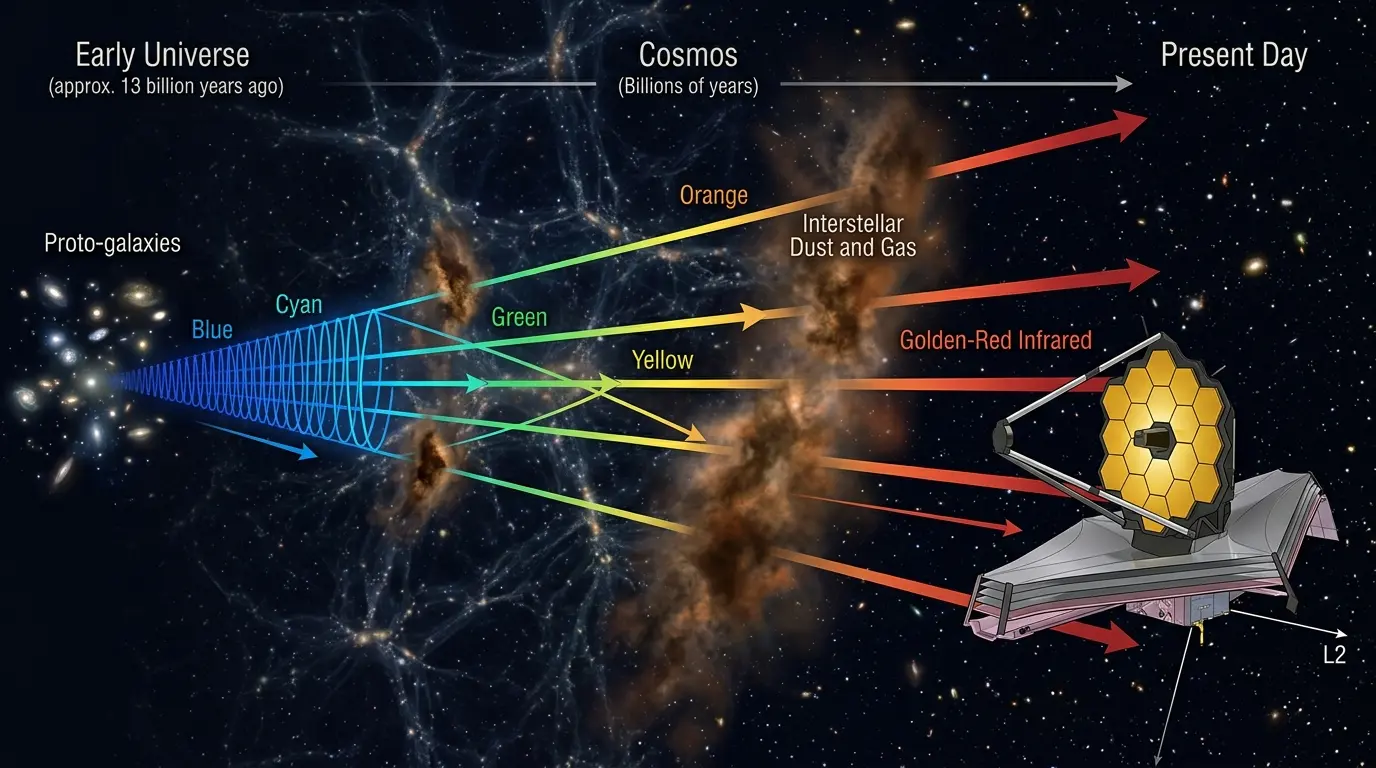
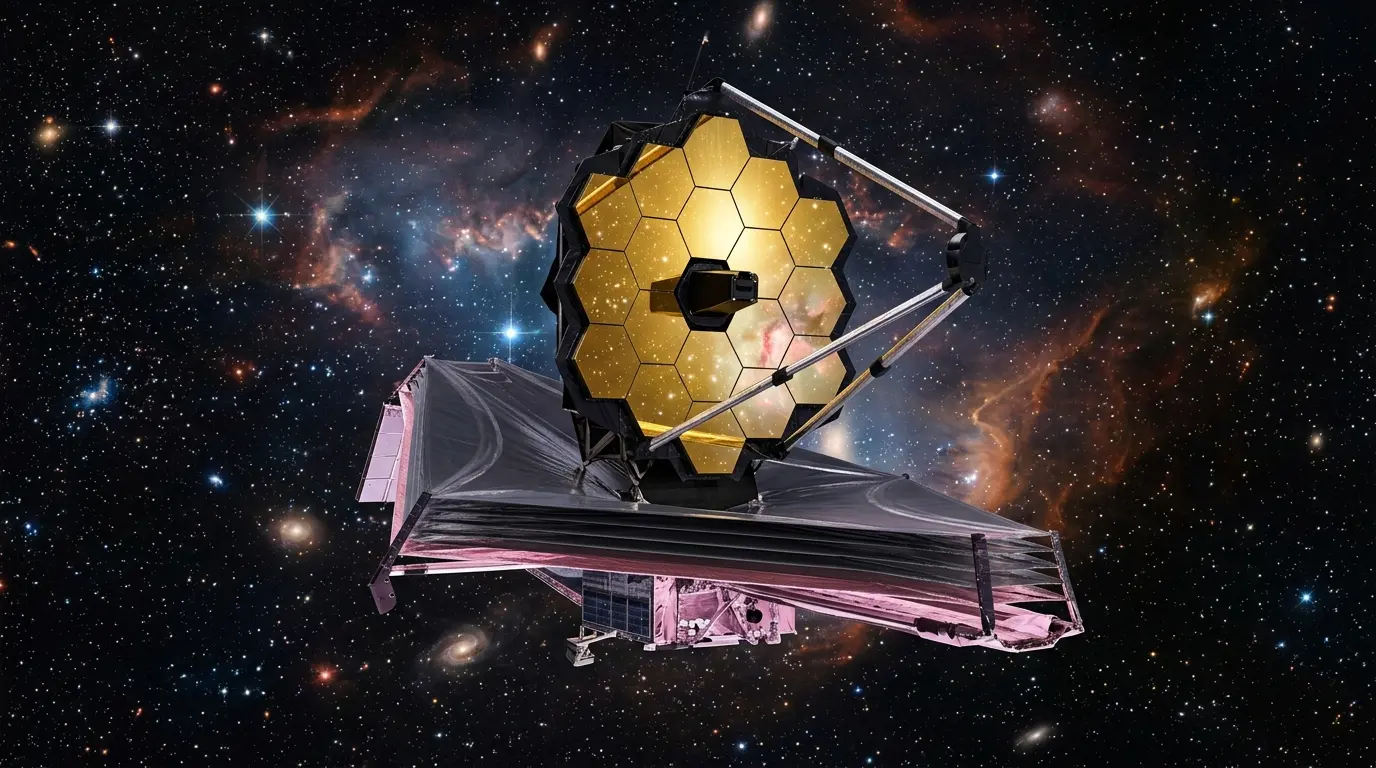
Since its launch on December 25, 2021, and its arrival at the Sun-Earth Lagrange Point 2 (L2) roughly 1.5 million kilometers from Earth, the James Webb Space Telescope (JWST) has fundamentally transformed observational astrophysics. While the veteran Hubble Space Telescope operated predominantly across visible and ultraviolet wavelengths, JWST was intentionally engineered as an unprecedented infrared flagship observatory. This strategic architecture is not merely an engineering choice; it represents the only physical mechanism capable of peering across deep time to collect the ancient photons emitted during the universe's infancy.
Why the Infrared Spectrum Holds the Key
Two fundamental cosmological phenomena make infrared observation non-negotiable when investigating the primordial universe:
- Cosmological Redshift: Over the course of 13.8 billion years of cosmic expansion, the metric expansion of space stretches propagating light waves. Photons originally emitted in energetic ultraviolet or optical wavelengths by the very first stars and protogalaxies have stretched into longer near-infrared and mid-infrared bands by the time they reach our modern instruments.
- Piercing Interstellar Dust Screens: Active stellar nurseries and early galactic cores are blanketed by dense clouds of cosmic dust. Shorter visible wavelengths scatter heavily against microscopic dust grains, whereas longer infrared wavelengths glide past these obstacles, unveiling stellar births that were previously hidden from optical view.
Precision Engineering: Gold Mirrors and Cryogenic Shielding
Collecting scarce, faint infrared photons originating billions of light-years away demands supreme sensitivity. JWST solves this with a massive 6.5-meter primary mirror formed by 18 hexagonal beryllium segments. Each segment is vapor-deposited with an ultra-thin coating of pure gold approximately 100 nanometers thick, optimized because gold achieves exceptionally high reflectivity—exceeding 98 percent across infrared wavelengths.
The primary hurdle in infrared observation is combating the telescope's own thermal radiation. Any warm mechanical structure emits infrared noise that would overwhelm faint cosmic signals. JWST mitigates this through a five-layer Kapton sunshield spanning roughly the dimensions of a tennis court. This barrier shields the scientific instruments from solar, terrestrial, and lunar heat, keeping the cold side chilled below -223 degrees Celsius (50 Kelvin). Moreover, the Mid-Infrared Instrument (MIRI) incorporates a dedicated closed-cycle helium loop cryocooler, bringing detector temperatures down below 7 Kelvin (-266 degrees Celsius).
"Viewing the cosmos in infrared is not simply about producing sharper images; it represents unlocking a portal into the Cosmic Dawn, when the first luminous bodies pierced the primordial darkness."
Illuminating the Cosmic Dawn
Armed with flagship instruments including NIRCam and NIRSpec, JWST has confirmed primordial systems such as JADES-GS-z14-0, shining brightly a mere 290 million years following the Big Bang. These discoveries have startled astrophysicists globally, demonstrating that the earliest galaxies were significantly brighter, more massive, and formed far earlier than conventional cosmological models anticipated. By decoding ancient infrared radiation, JWST is systematically rewriting cosmic history and illuminating the origins of the elements that eventually fostered stars, planets, and life.