An Alternative Evolutionary Path to Complex Cognition
Among Earth's invertebrates, the octopus holds a unique position in neurobiology. Over 500 million years ago, the evolutionary lineages of vertebrates and cephalopods diverged from a simple bilateral ancestor. While vertebrates concentrated their nervous systems into a spinal cord and an encephalized brain within a skull, octopuses pursued a radical form of convergent evolution: engineering advanced intelligence through a distributed nervous system.
Neural Architecture: Allocating 500 Million Neurons
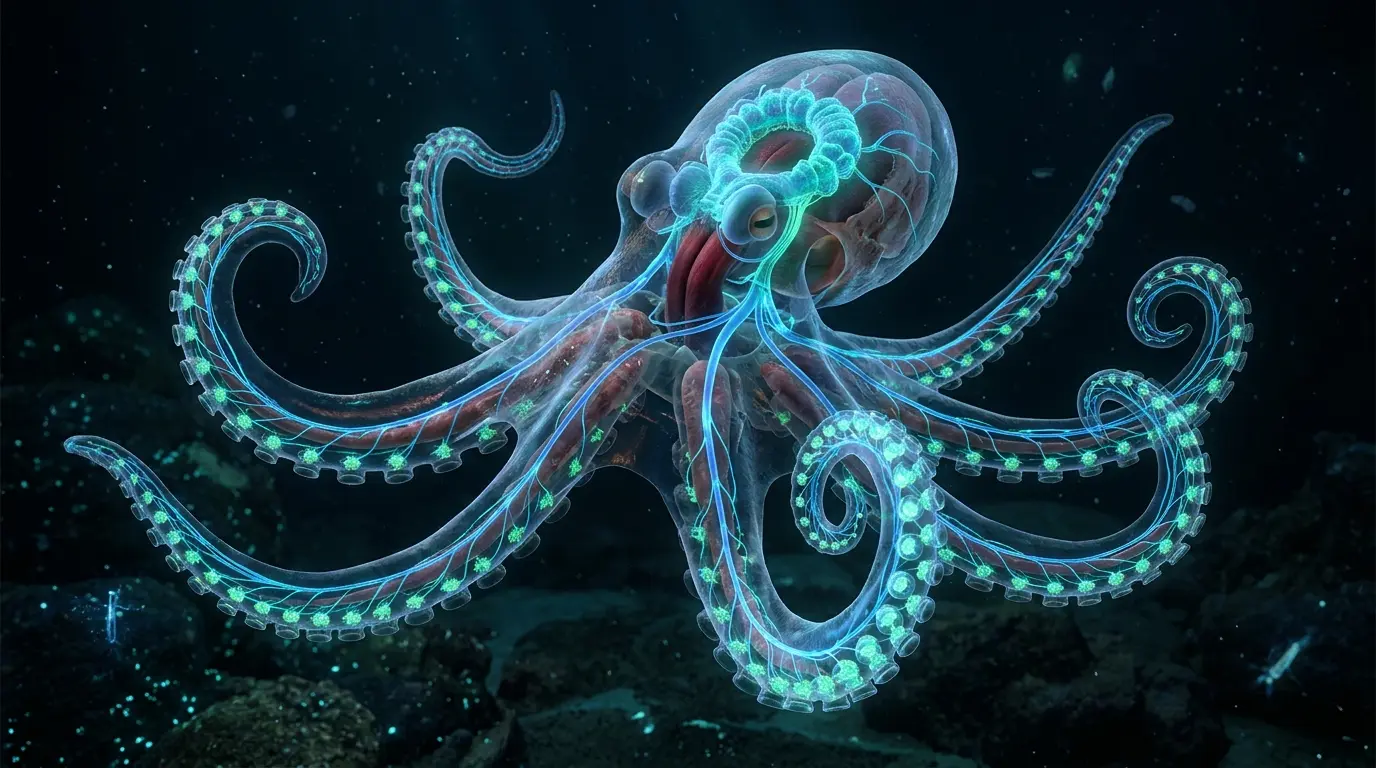
A typical common octopus (Octopus vulgaris) possesses roughly 500 million neurons—a count comparable to domestic dogs or cats. However, their anatomical arrangement diverges sharply from any mammalian blueprint:
- Central Brain and Optic Lobes: Approximately 150 to 180 million neurons (one-third of the total) form a ring around the esophagus. This central structure is flanked by prominent optic lobes for vision and a vertical lobe dedicated to associative learning and memory retention.
- Peripheral Nervous System: Roughly 320 to 350 million neurons (two-thirds of the total) reside along the eight arms. Each individual limb contains an axial nerve cord housing around 40 million neurons.
- Autonomous Sensory Units: Each individual sucker contains roughly 10,000 sensory neurons capable of chemotactile perception—allowing the limb to simultaneously taste and feel its immediate surroundings.
Arm Autonomy and Hierarchical Neural Control
This division between central and peripheral clusters creates remarkable biological computing efficiency. The central brain does not micromanage the infinite degrees of freedom in eight boneless limbs. Instead, it issues high-level tactical directives, such as exploring a reef crevice or pursuing targeted prey.
Once commanded, the arm's peripheral nervous system takes over semi-autonomously. It navigates obstacles, modulates suckers, senses chemical signatures, and solves complex inverse kinematics locally, operating effectively even without direct continuous input from the central brain.
"The octopus demonstrates that sophisticated cognition does not require a single centralized skull; intelligence can flourish distributed across an entire body."
Empirical Evidence: Tool Use, Camouflage, and Problem Solving
This decentralized architecture underpins an impressive repertoire of empirically documented cognitive behaviors:
- Deliberate Tool Use: The veined octopus (Amphioctopus marginatus) collects, stacks, and transports discarded coconut shell halves across the seafloor, reassembling them as defensive mobile armor.
- Complex Problem Solving: In laboratory settings, octopuses unscrew childproof jars from both inside and outside, navigate multi-choice mazes, and retain spatial solutions across long intervals.
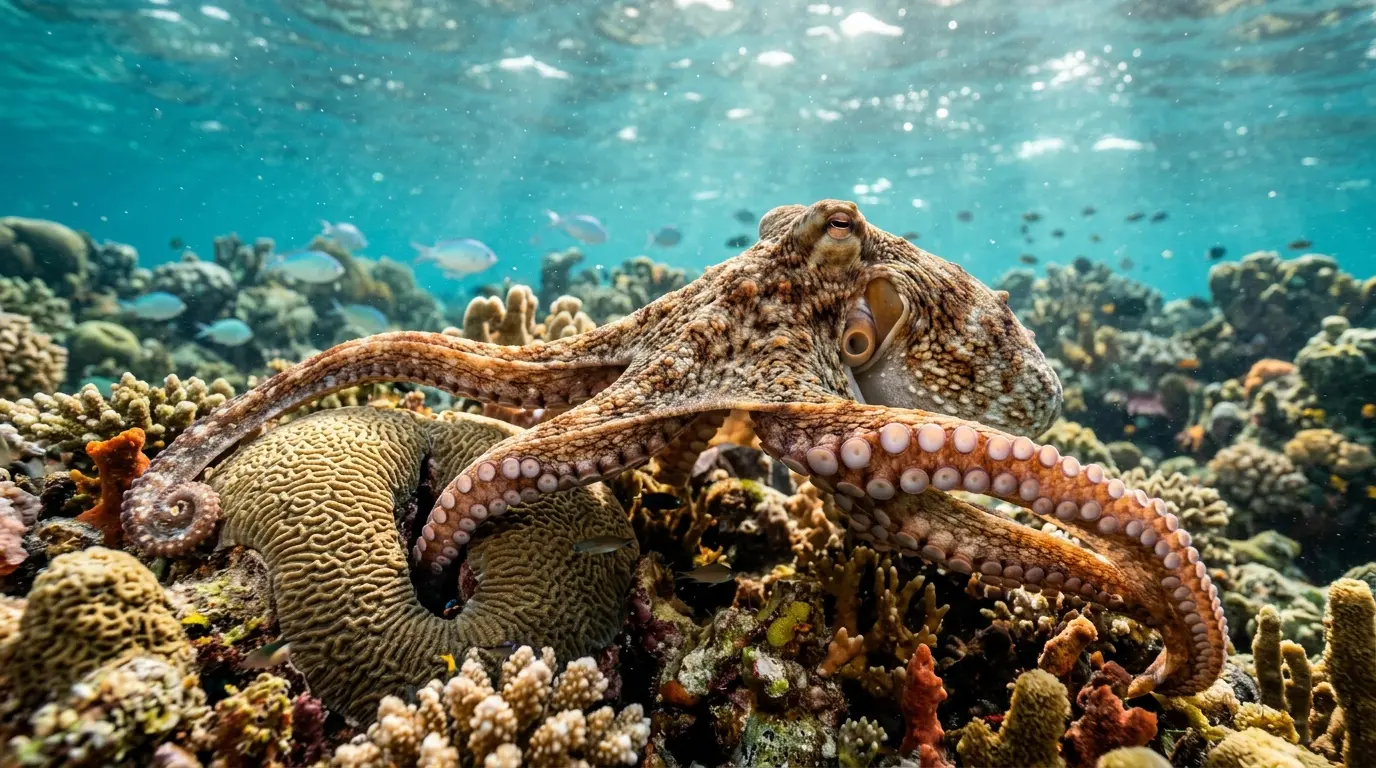
- Millisecond Camouflage: Through direct neural control of millions of chromatophores, iridophores, and leucophores—along with muscular dermal papillae—octopuses alter coloration, reflectivity, and 3D skin texture in under 200 milliseconds.
Implications for Soft Robotics and Distributed AI
For contemporary roboticists and neuroscientists, the octopus serves as the living archetype of embodied cognition. Modern engineers look directly to cephalopod biology to design autonomous soft robotics and edge-computing networks, proving that decentralized agency is among nature's most resilient computing paradigms.