Among all invertebrates on Earth, the octopus occupies an extraordinary position in neuroscience. These cephalopods can open childproof jars from the inside, recognize individual human caretakers, and solve complex mazes—yet they do so with a neural architecture fundamentally different from vertebrates. The vast majority of their cognitive power is not confined inside a rigid skull; instead, it flows dynamically through a distributed nervous system.
A Decentralized Neural Architecture
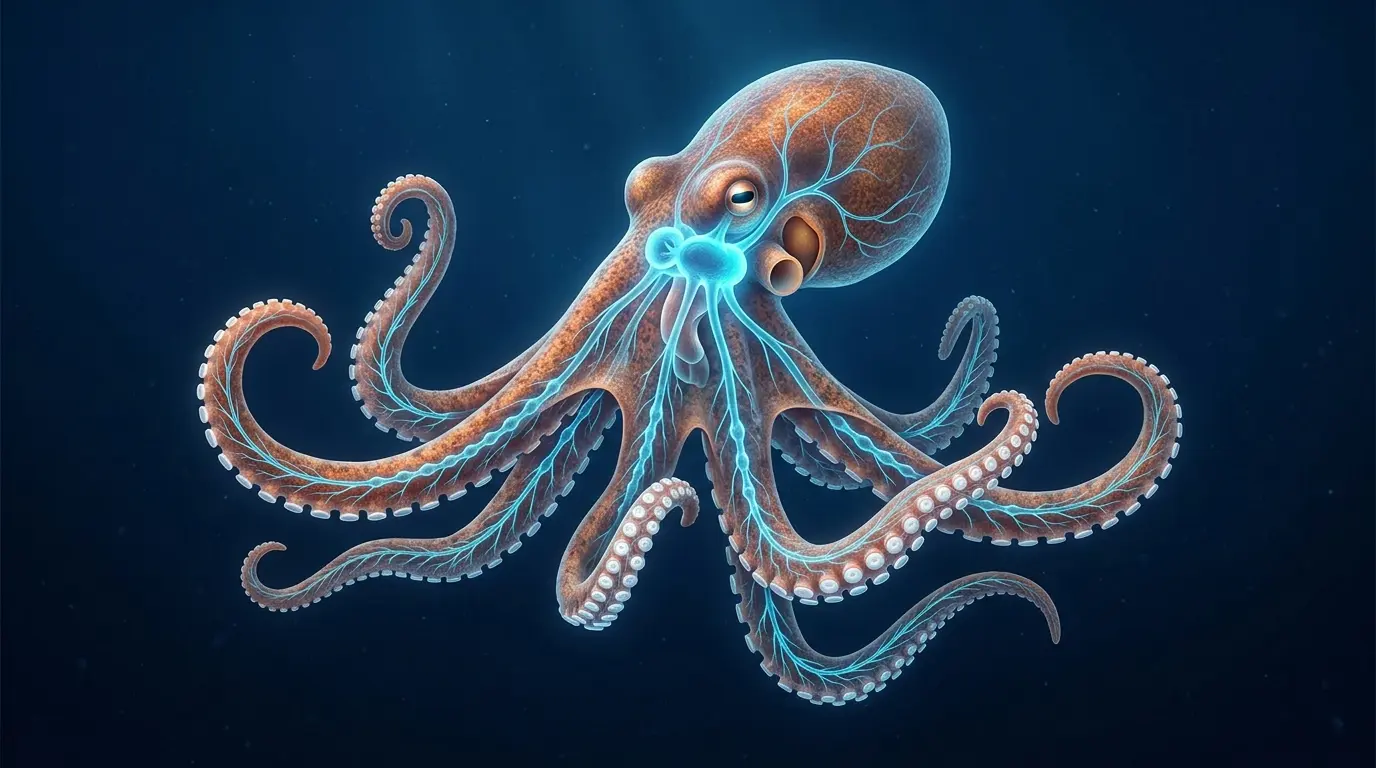
Anatomically, a common octopus (Octopus vulgaris) possesses roughly 500 million neurons—a count comparable to that of a domestic dog or cat. However, the true divergence lies in how these cells are organized across the body:
- Central Brain: Contains only about one-third (approximately 180 million) of the total neurons, arranged in a ring surrounding the esophagus, with a vertical lobe specialized in learning and memory.
- Brachial Nervous System: The remaining two-thirds (over 300 million neurons) are distributed along the axial nerve cords of the eight arms.
This biological configuration grants each arm an astonishing degree of sensorimotor autonomy. An octopus arm can touch, taste textures, retract from noxious stimuli, and explore crevices independently, without requiring micro-management from the central brain.
Touch That Can Taste and Smell
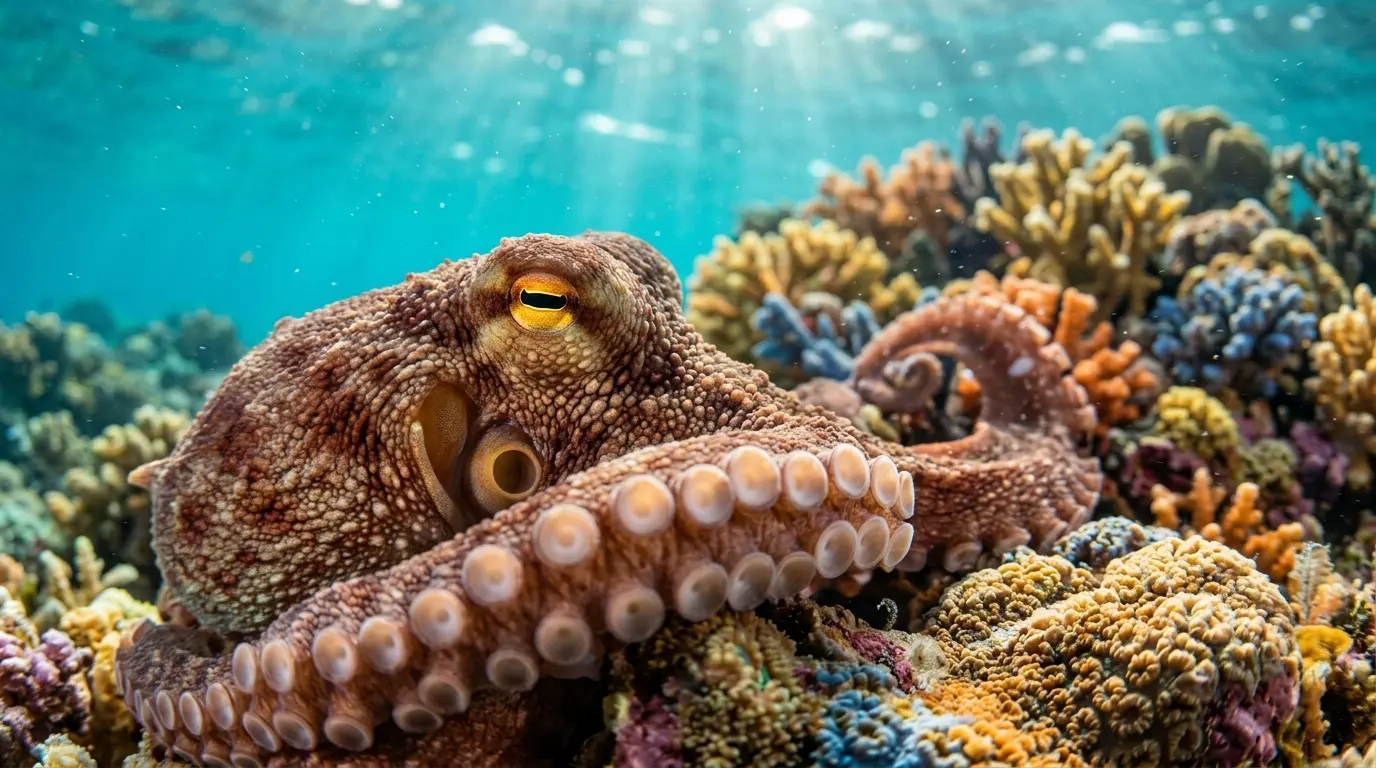
Each arm is equipped with hundreds of suckers, and every sucker contains tens of thousands of chemical and mechanical receptors. Through this chemotactile sensing system, an octopus literally tastes and smells chemical compounds in seawater the moment its suction cups touch underwater surfaces or hidden prey.
Cognitive Flexibility and Tool Use
Octopus intelligence is further highlighted by sophisticated problem-solving in laboratories and in the wild. One of the most famous examples was observed in the veined octopus (Amphioctopus marginatus) in Indonesia. Marine researchers documented these animals excavating discarded coconut halves, carrying them across the seafloor via an awkward "stilt-walking" gait, and reassembling the halves as a protective shelter when threatened.
"This behavior represents the first documented case of true tool use by a marine invertebrate that involves carrying shelter for future defense."
Beyond tool manipulation, captive octopuses regularly demonstrate exploratory curiosity and play behavior—such as repeatedly releasing floating pill bottles into water filtration currents—which are recognized hallmarks of advanced cognitive function.
Convergent Evolution: An Alien Mind on Earth
The existence of cephalopod intelligence is a profound example of convergent evolution. The evolutionary lineages of mollusks and vertebrates diverged over 550 million years ago, when our last common ancestor was a primitive, worm-like bilaterian with little more than a simple nerve net. Complex cognition in octopuses evolved entirely independently from that of mammals or birds.
Studying the octopus distributed nervous system offers far more than marine biology trivia. Its principles of decentralized control and flexible manipulation are directly transforming bio-inspired soft robotics and distributed artificial intelligence, proving that complex minds can emerge along vastly different evolutionary paths.