The Natural Marvel of Spider Dragline Silk
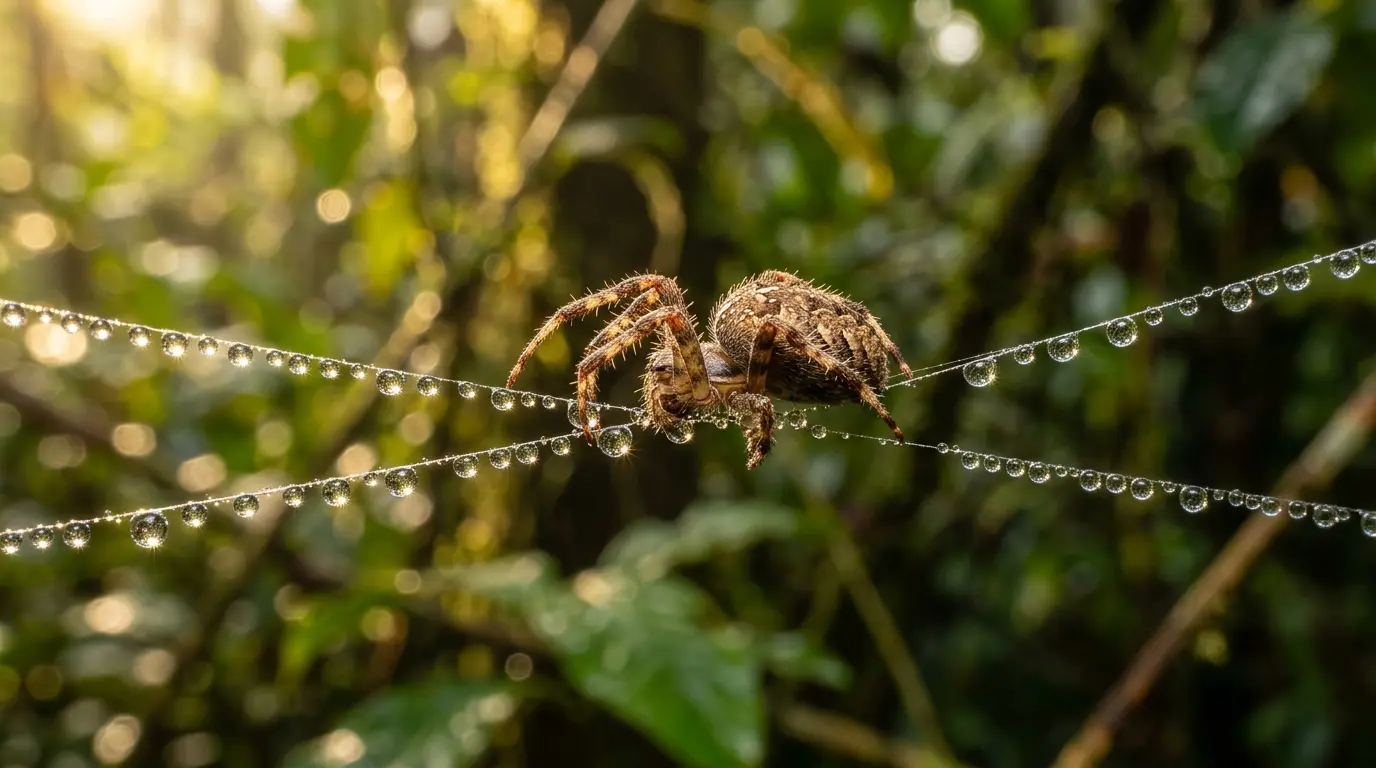
Glittering unobtrusively in forest canopies and morning dew, spider webs harbor one of nature's most sophisticated mechanical achievements. Spider silk—specifically dragline silk, which forms the outer frame and structural lifelines of orb webs—has long captivated biophysicists and materials engineers worldwide due to its unmatched synergy of high tensile strength and extensive extensibility.
By the Numbers: Truly Stronger Than Steel?
The popular claim that spider silk is "stronger than steel" is not an exaggeration, but a verified scientific principle when measured on a per-weight basis (specific strength). Verified biomechanical benchmarks highlight these extraordinary metrics:
- Tensile Strength: Reaches between 1.0 and 1.5 Gigapascals (GPa). In contrast, standard structural steel yields approximately 0.4 to 0.5 GPa, and specialized high-strength alloy steels peak around 1.5 GPa.
- Ultra-Low Density: Spider dragline silk has a density of only 1.3 g/cm³, vastly lighter than steel (approximately 7.8 g/cm³). Consequently, its strength-to-weight ratio is roughly five times greater than that of steel.
- Unrivaled Toughness: Pure tensile strength is only half the equation. Dragline silk absorbs roughly 150 to 160 Megajoules per cubic meter (MJ/m³) of kinetic energy before rupturing—nearly three times the toughness of Kevlar (~50 MJ/m³) and drastically outperforming carbon fiber. Remarkably, Darwin's bark spider (Caerostris darwini) synthesizes dragline silk with toughness averaging 350 MJ/m³.
"By combining tensile strength exceeding one gigapascal with the ability to stretch 30% to 40% before failure, spider dragline silk stands as nature's ultimate shock-absorbing composite."
Nanoscale Architecture: The Spidroin Matrix
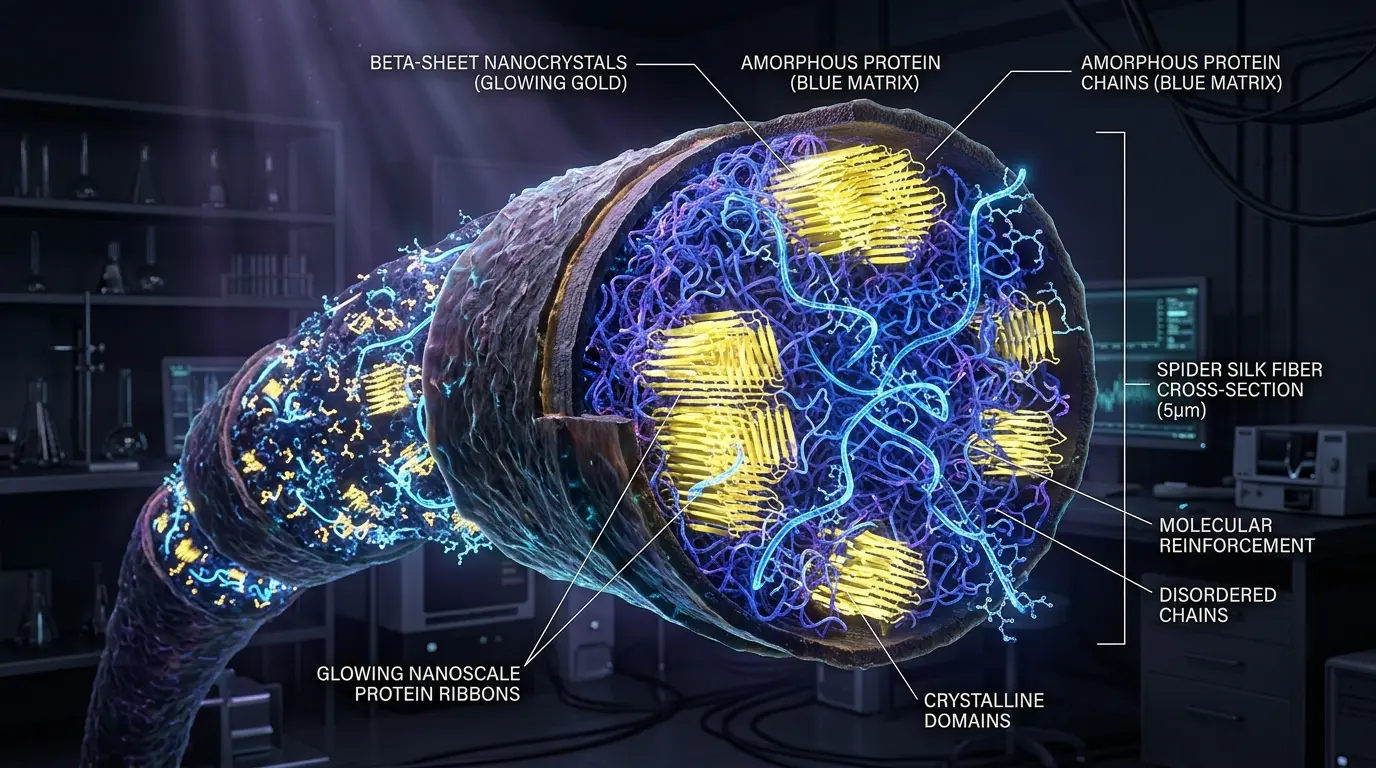
This remarkable mechanical balance originates at the sub-microscopic level within specialized spidroin proteins (predominantly MaSp1 and MaSp2). Dragline silk exhibits a dual-phase architecture:
- Crystalline Beta-Sheet Nanocrystals: Alanine-rich amino acid repeats interlock via dense networks of hydrogen bonds, forming rigid nanocrystals measuring 2 to 5 nanometers across. These crystalline blocks supply rigid tensile strength and load resistance.
- Amorphous Semi-Amorphous Matrix: Surrounding the nanocrystals is an elastic, glycine-rich matrix comprising loose helical coils and random turns. This region functions like molecular spring systems, redistributing stress and granting elasticity.
Biological Spinning and Technological Horizons
Spiders fabricate this material on demand inside their major ampullate glands. Here, spidroins exist as a concentrated liquid crystalline dope. As the fluid travels through a tapering duct, an orchestrated drop in pH (from ~7.2 to below 5.5), alongside ion exchange and mechanical shear stress, triggers instant self-assembly into insoluble fibers without toxic reagents or high temperatures.
Today, researchers are leveraging synthetic biology—using transgenic yeasts and bacteria—to produce recombinant spidroins at scale. The biomimetic applications are staggering: from biodegradable, biocompatible surgical sutures and artificial ligaments to lightweight ballistic composites and tear-resistant aerospace textiles.