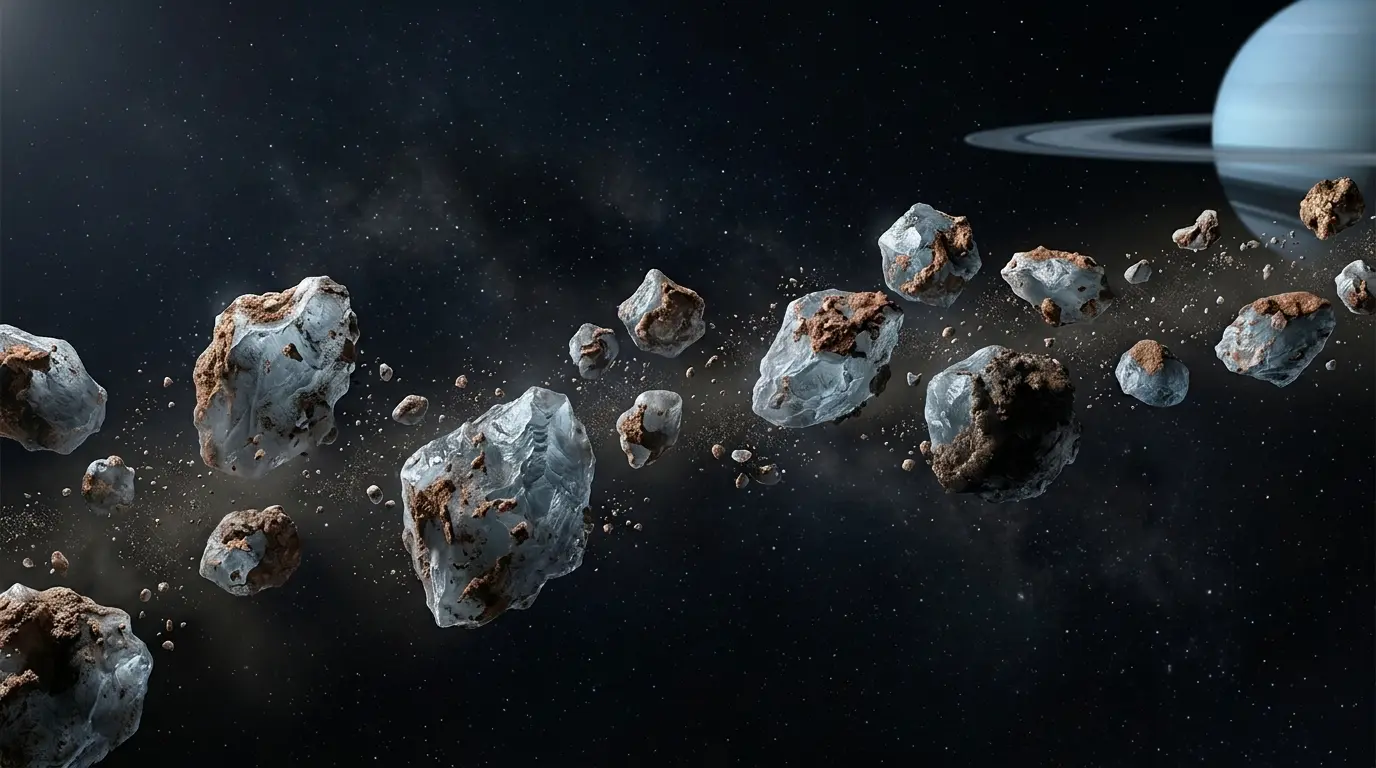
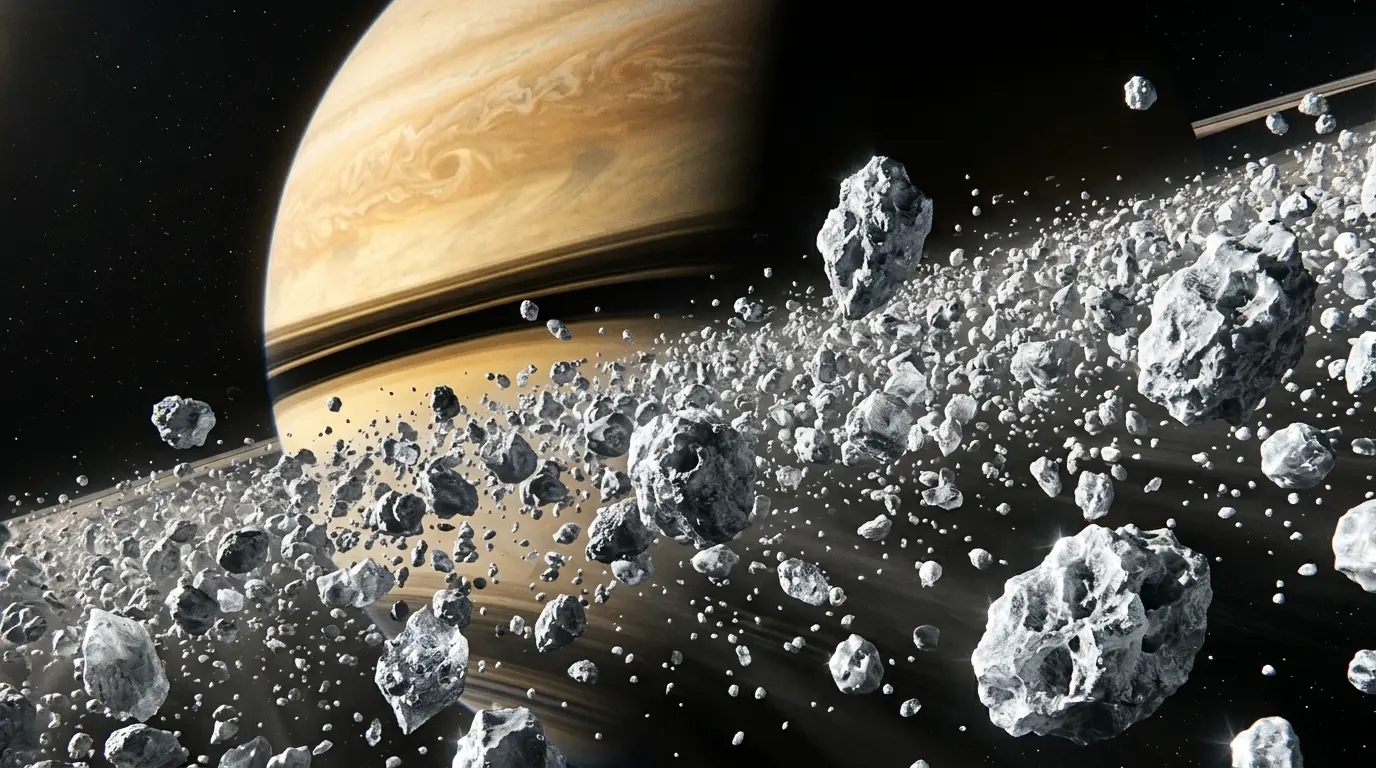
When viewed through terrestrial optical telescopes, Saturn's rings appear as a solid, gleaming golden disk. However, high-resolution spectroscopic data gathered by the Cassini-Huygens mission (NASA/ESA/ASI) reveal a breathtaking physical reality: this iconic ring system is composed of trillions of individual particles orbiting the gas giant in dynamic gravitational equilibrium.
Absolute Dominance of Pure Water Ice
The primary chemical constituent of Saturn's ring system is water ice (H2O). Measurements from the Visual and Infrared Mapping Spectrometer (VIMS) aboard Cassini confirmed that more than 99% of the main rings' mass (specifically the dense A and B rings) consists of pristine frozen water, giving the rings their remarkably bright optical albedo.
Near-infrared reflection spectra exhibit prominent diagnostic absorption bands of crystalline water ice at wavelengths of 1.5 and 2.0 micrometers. Within the frigid environment of Saturn's orbital plane, ring particle temperatures hover between 70 and 110 Kelvin (-203°C to -163°C). At such cryogenic temperatures, water ice possesses mechanical rigidity comparable to terrestrial silicate rock, resisting thermal sublimation and rapid structural degradation.
Rocky Silicates and Cosmic Impurities
Despite the overwhelming dominance of water ice, Saturn's rings are not chemically sterile. The remaining ~1% of non-ice material introduces distinctive chromatic nuances across the rings:
- Silicates and Rocky Minerals: Microscopic rocky fragments intermixed within the icy debris, found in slightly higher concentrations within the C Ring and the Cassini Division.
- Complex Organics (Tholins): Carbon-rich macromolecules synthesized via solar ultraviolet photolysis and energetic particle irradiation, contributing subtle reddish-tan hues.
- Iron Oxides and Amorphous Carbon: Trace hematite and nanoscale carbonaceous dust continuously delivered by hypervelocity interplanetary micrometeoroid bombardments.
"The pristine cleanliness of Saturn's water ice serves as an astronomical chronometer; low concentrations of cosmic dust indicate the ring system is geologically youthful."
Particle Size Spectrum and Extreme Thinness
Saturn's rings do not exhibit a uniform granular distribution. Stellar and radio occultation measurements conducted by the Ultraviolet Imaging Spectrograph (UVIS) demonstrate an immense range of particle diameters:
- Microscopic Dust: Sub-micrometer icy grains dominant within diffuse outer structures such as the E and F rings.
- Pebbles and Boulders: Ice chunks ranging from centimeter-sized marbles to house-sized boulders that make up the vast bulk of the A and B rings.
- Propeller Moonlets: Aggregates measuring tens to hundreds of meters across that induce distinct propeller-shaped gravitational density wakes.
Although the main ring architecture spans an immense radial distance exceeding 280,000 kilometers, its vertical thickness is astonishingly modest—averaging only 10 to 30 meters. Continuous inelastic collisions among particles continually damp out vertical inclinations, confining the debris into an exceedingly flat equatorial plane.
Dynamic Age and the "Ring Rain" Phenomenon
Data from Cassini's Cosmic Dust Analyzer (CDA) tracking the accumulation rate of interplanetary meteoroid dust reveal that the rings likely formed merely 100 to 400 million years ago, likely from the tidal disruption of a massive comet or icy moon crossing Saturn's Roche limit. Furthermore, Cassini's Grand Finale confirmed the active phenomenon of ring rain, in which magnetic field lines siphon thousands of kilograms of water and organics per second into Saturn's upper atmosphere, indicating that this magnificent structure is steadily draining away over cosmic timescales.