Photosynthesis is the primary bioenergetic engine of planet Earth, converting solar radiation into chemical energy while producing the molecular oxygen (O2) that sustains aerobic life. While standard biology introduces photosynthesis as the synthesis of sugars from carbon dioxide and water, the precise molecular mechanism that liberates oxygen is nature's most sophisticated photochemical process.
The Origin of Oxygen: Water Photolysis, Not Carbon Dioxide
Until the early twentieth century, scientific consensus assumed photosynthetic oxygen stemmed from the splitting of carbon dioxide (CO2). This assumption was challenged in the 1930s by Cornelis van Niel and empirically demonstrated in 1941 by Samuel Ruben and Martin Kamen using oxygen-18 (18O) isotopes. Their work proved conclusively that molecular oxygen originates entirely from water (H2O) through water photolysis.
The Role of Chlorophyll P680 in Photosystem II
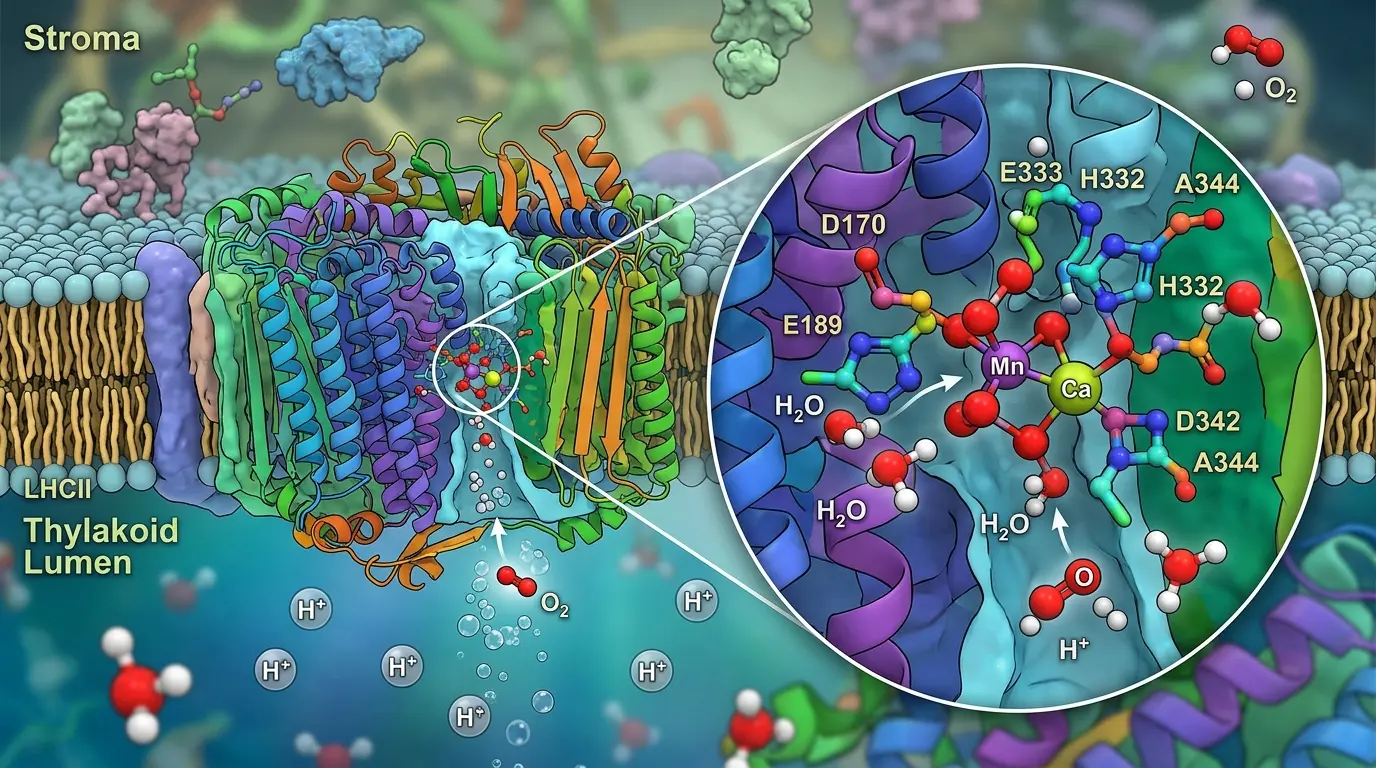
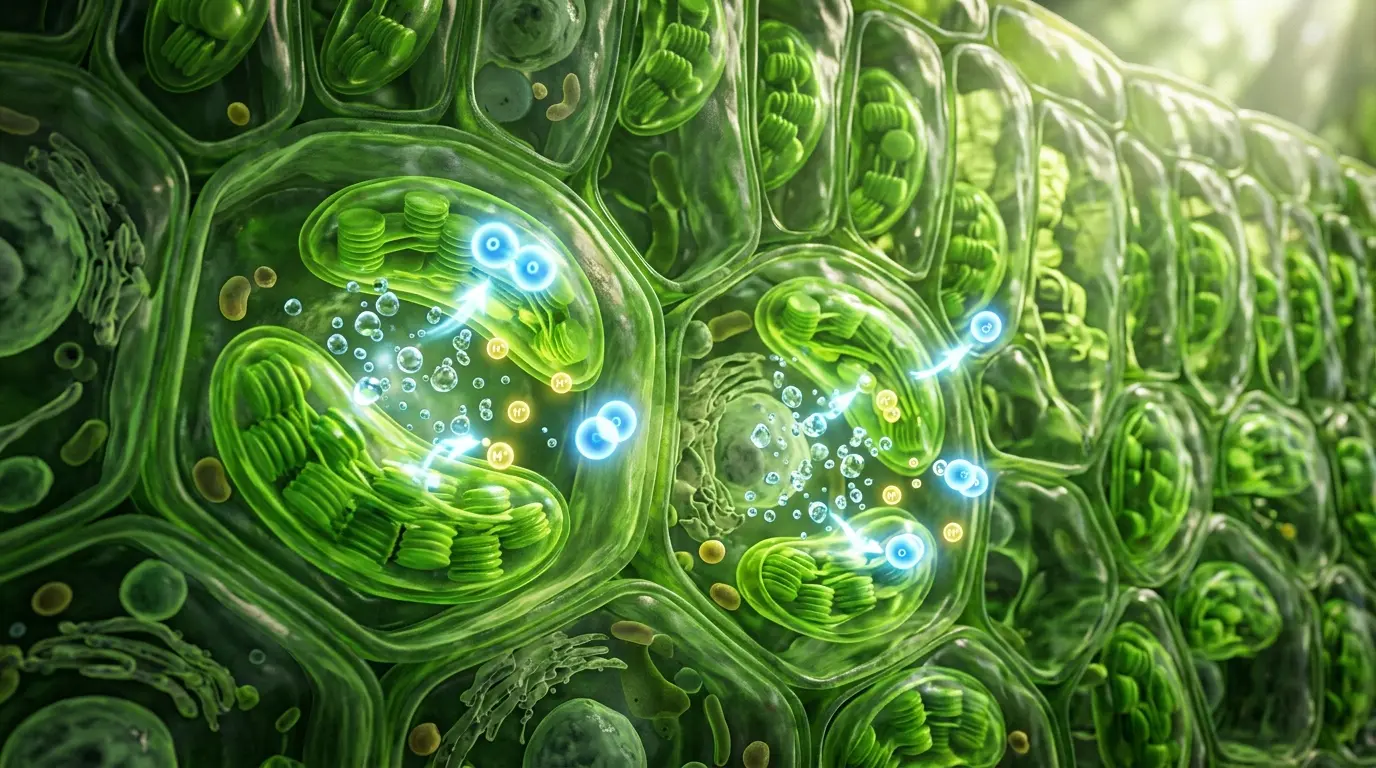
Oxygen evolution occurs within the thylakoid membranes of chloroplasts inside Photosystem II (PSII). At the photochemical reaction center of PSII sits a specialized pair of chlorophyll a molecules called P680, named for its absorption peak at 680 nanometers.
Upon absorbing a photon, P680 ejects an excited electron to pheophytin, creating the radical cation P680+. In biological systems, P680+ is one of the strongest known oxidizing agents, with an extraordinary redox potential of +1.25 volts. This extreme oxidizing power is energetic enough to extract electrons from highly stable water molecules.
The Oxygen-Evolving Complex and the Kok Cycle
To accept additional photons, P680+ must immediately be reduced back to its ground state. These electrons are supplied by the Oxygen-Evolving Complex (OEC) via a catalytic redox-active tyrosine residue (TyrZ).
The OEC features an inorganic catalytic cubane core with the formula Mn4CaO5. In 1970, Bessel Kok formulated the Kok cycle (or S-state clock), explaining how the manganese-calcium cluster accumulates four oxidizing equivalents across intermediate states S0 through S4:
- States S0 to S3: Each photon absorbed drives the extraction of one electron, advancing the cluster by one oxidation state.
- State S4: Upon reaching this transient, highly oxidized state, the complex spontaneously oxidizes two bound water molecules (2H2O).
- Oxygen Release: The reaction releases one molecule of O2, deposits four H+ ions into the thylakoid lumen, and returns the cluster to state S0.
Overall photolysis reaction in Photosystem II: 2H2O + 4 photons → O2 + 4H+ + 4e−
Bioenergetic Significance for the Biosphere
The proton accumulation inside the thylakoid lumen drives a transmembrane proton-motive force that powers ATP synthase. Together with NADPH generated by Photosystem I, ATP fuels carbon fixation in the Calvin cycle. Without the light-driven water splitting achieved by chlorophyll P680 and the OEC, Earth's oxygen-rich atmosphere and complex aerobic organisms could never have evolved.