Gateway to the Hadal Zone: Earth's Deepest Abyss
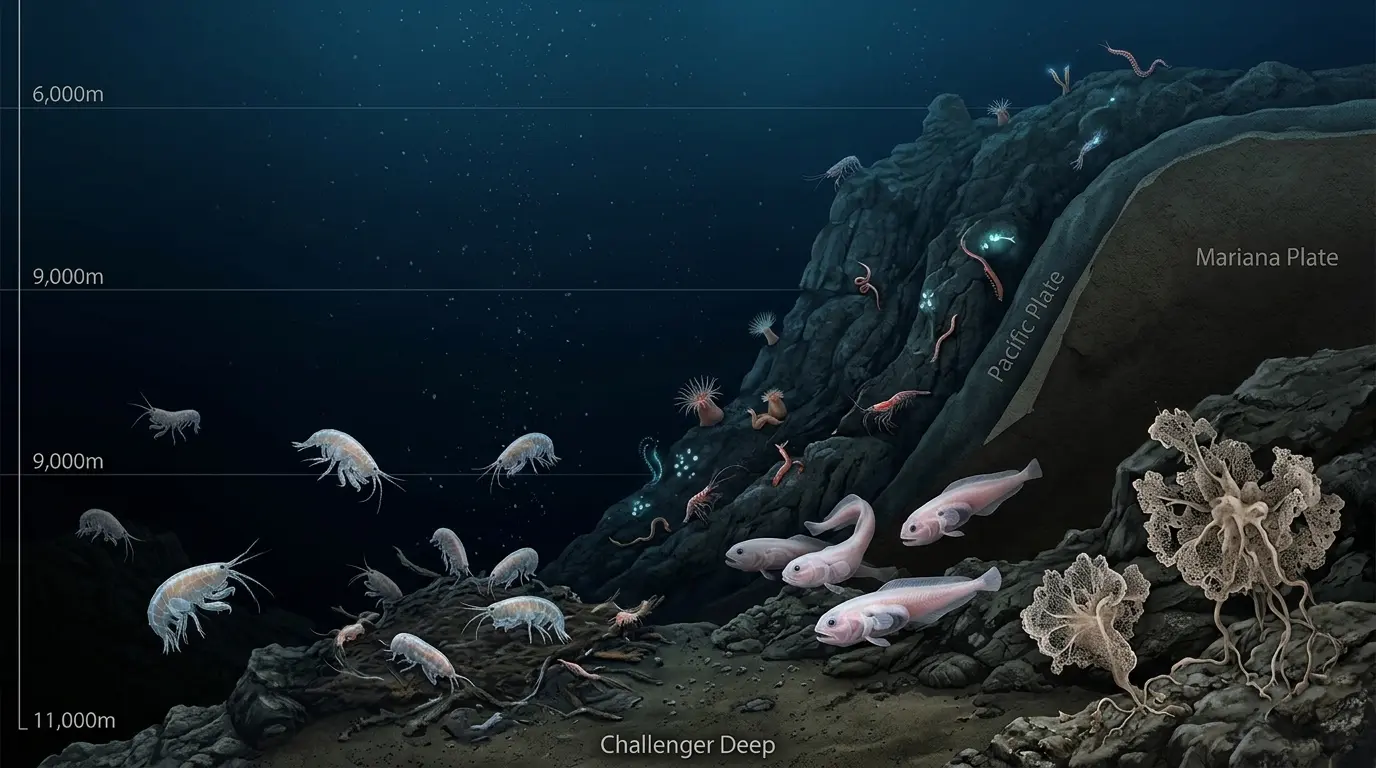
In the western Pacific Ocean lies the Mariana Trench, the deepest geological scar on our planet. Its lowest surveyed point, the renowned Challenger Deep, plunges roughly 10,994 meters (nearly 36,000 feet) beneath the surface. If Mount Everest were inverted into this chasm, its peak would remain submerged under more than two kilometers of water.
Regions plunging below 6,000 meters are classified scientifically as the hadal zone. Named after Hades, the ancient Greek underworld, this environment is characterized by perpetual pitch darkness, near-freezing water temperatures (1–4°C), and bone-crushing hydrostatic pressure exceeding 1,000 atmospheres (over 108 megapascals). This equals roughly eight tons of force per square inch. Far from being a barren wasteland, the hadal trenches host specialized ecosystems thriving against extreme physical odds.
Biochemical Shields: Conquering Hydrostatic Pressure
How does living tissue survive pressures capable of instantly imploding titanium hulls? The answer lies in sophisticated molecular biochemistry. High hydrostatic pressure forces water molecules into the internal cavities of proteins, threatening to denature essential cellular machinery. Organisms in the abyss counter this with several vital adaptations:
- Piezolytes and TMAO: Hadal organisms load their cells with small organic osmolytes termed piezolytes, primarily trimethylamine N-oxide (TMAO). TMAO binds tightly with intracellular water molecules, creating a rigid hydration shell that prevents proteins from collapsing under pressure.
- Membrane Fluidity: Cold temperatures and immense pressure naturally rigidify lipid bilayers. Deep-sea species maintain flexible cell membranes by packing them with polyunsaturated fatty acids (PUFAs).
- Absence of Gas Bladders: Any internal gas-filled space, such as a teleost swim bladder, would compress violently and rupture. Deep-sea fishes have dispensed entirely with swim bladders, relying on gelatinous, watery tissues for neutral buoyancy.
Masters of the Hadal Realm: The Mariana Snailfish
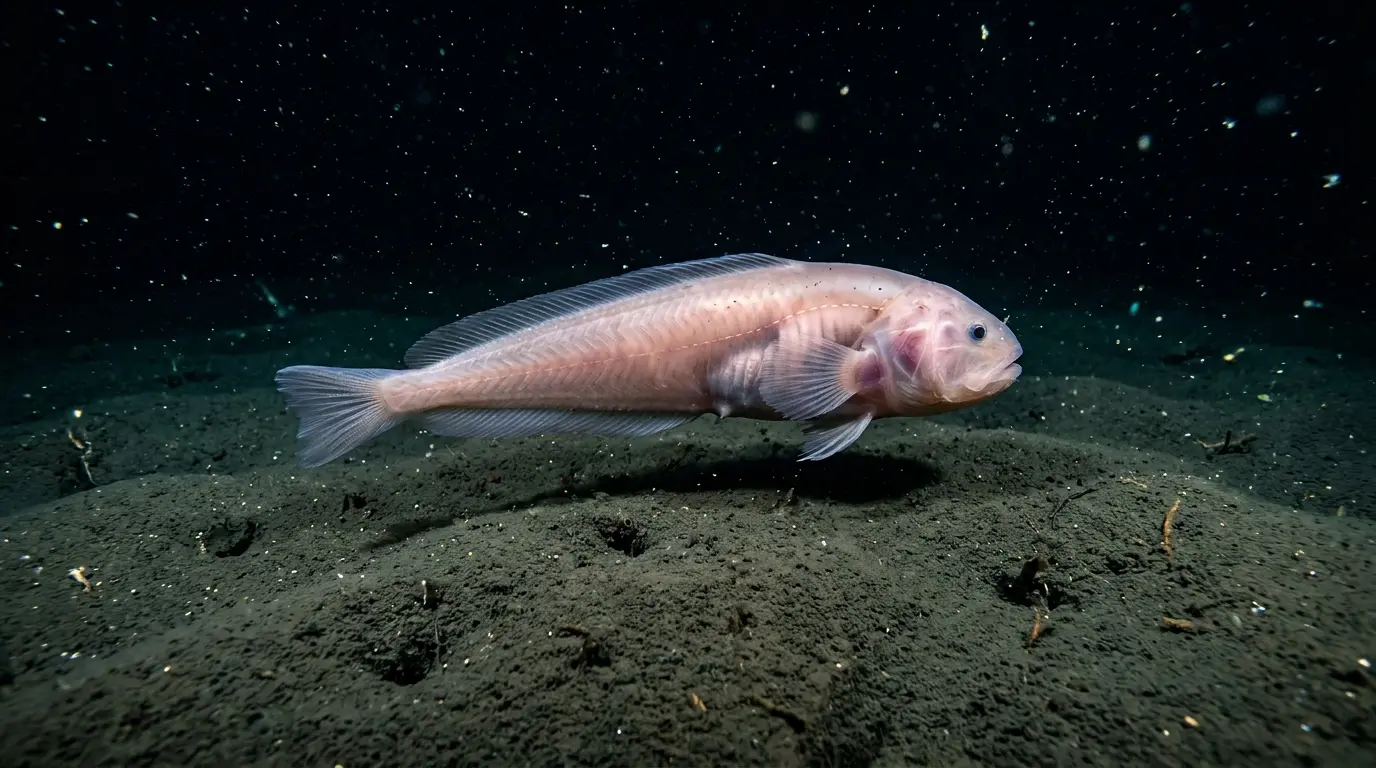
The apex vertebrate predator across these depths is the Mariana snailfish (Pseudoliparis swirei), recorded flourishing at depths down to roughly 8,000 meters. Defying popular tropes of monstrous, needle-toothed deep-sea creatures, P. swirei is small, scaleless, pinkish-translucent, and tadpole-like. Its skull possesses flexible, unfused sutures, and its skeleton consists largely of pliable cartilage rather than dense bone.
Groundbreaking research led by marine biologist Dr. Paul Yancey established that vertebrates face a strict physiological depth limit at approximately 8,200 to 8,400 meters. Beyond this threshold, the concentration of cellular TMAO necessary to stabilize proteins would exceed the osmolarity of seawater, precipitating catastrophic osmotic imbalances.
Thriving in the Challenger Deep
While vertebrates reach their physiological boundary at 8,400 meters, invertebrates and single-celled organisms colonize the deepest floor of Challenger Deep. Hadal amphipods such as Hirondellea gigas dominate depths beyond 10,000 meters, utilizing specialized gut enzymes and protective aluminum-based cuticular coatings. Alongside them dwell xenophyophores—giant, single-celled protozoans measuring several centimeters across.
Studying hadal trench life does not merely illuminate biological frontiers on Earth; it establishes fundamental physiological models for astrobiology, informing the search for extraterrestrial life in the sub-surface oceans of icy moons like Europa and Enceladus.
The Mariana Trench demonstrates that life does not merely endure extreme environments; through extraordinary biochemical precision, it flourishes.