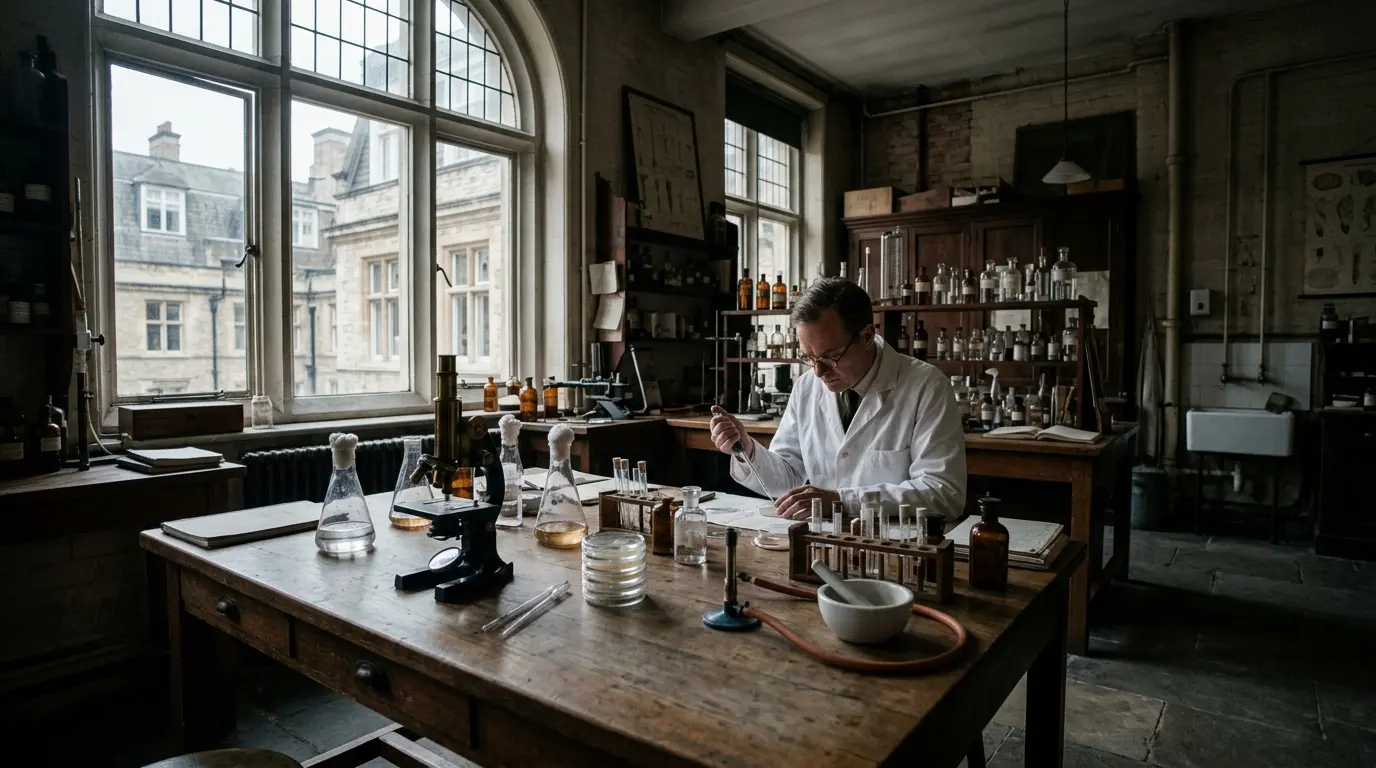
In September 1928, an accidental occurrence inside a modest laboratory at St. Mary's Hospital in London altered the course of human medical history forever. Alexander Fleming, a Scottish physician and bacteriologist, had just returned from a month-long summer holiday with his family in Suffolk. As he began sorting through stacked Petri dishes of Staphylococcus aureus cultures left on his workbench, Fleming noticed an unexpected biological anomaly that would ultimately inaugurate the modern antibiotic era.
A Serendipitous Breakthrough at St. Mary's
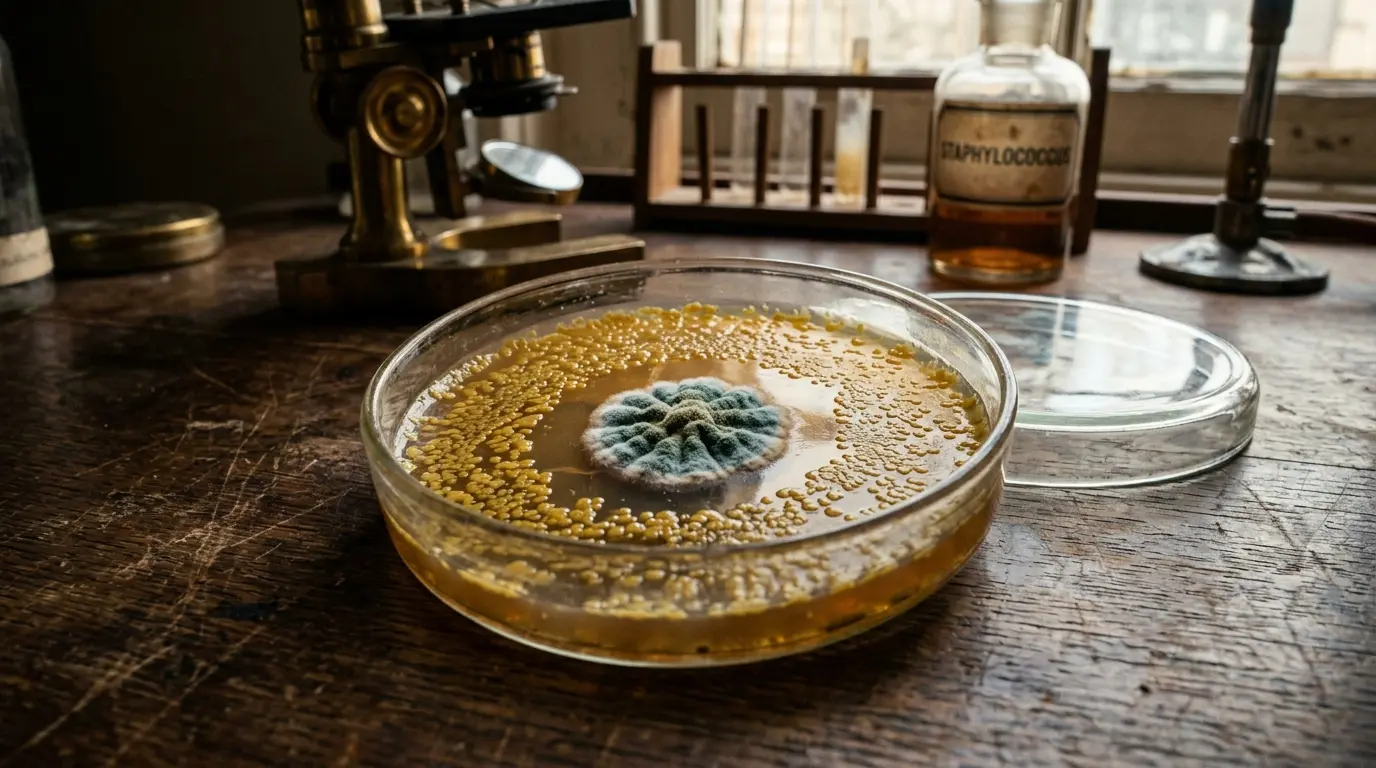
One of the culture plates had accidentally become contaminated with mold spores drifting in from the hospital environment. Rather than discarding the ruined dish into disinfectant, Fleming inspected it closely under a microscope. He observed that colonies of Staphylococcus bacteria immediately surrounding the fungal growth had lysed—their cell walls breaking down completely—leaving a distinctive, clear halo known as a zone of inhibition. Fleming deduced that the invading mold was secreting a soluble chemical agent capable of killing virulent pathogenic bacteria without damaging the nutrient agar.
"One sometimes finds what one is not looking for. When I woke up just after dawn on September 28, 1928, I certainly didn't plan to revolutionize all medicine by discovering the world's first antibiotic." — Sir Alexander Fleming
Identifying Penicillium and the 1929 Publication
Upon isolating and subculturing the fungus, Fleming identified it as a rare strain belonging to the genus Penicillium (initially identified as Penicillium notatum, and later reclassified by modern taxonomists as Penicillium rubens). On March 7, 1929, he officially coined the term penicillin to describe the bactericidal filtrate. Fleming published his groundbreaking findings in the British Journal of Experimental Pathology in June 1929, demonstrating that penicillin was lethal to Gram-positive pathogens—such as streptococci, staphylococci, and diphtheria bacilli—while remarkably non-toxic to human white blood cells.
From Bench Discovery to Mass Therapeutics
Despite Fleming's brilliant observation, practical clinical application stalled for nearly a decade. Crude penicillin was chemically unstable, sensitive to heat and pH shifts, and extraordinarily difficult to purify in quantities sufficient for systemic therapy. The pivotal breakthrough came in the late 1930s and early 1940s when an Oxford University team at the Sir William Dunn School of Pathology revitalized the project:
- Howard Florey: An Australian pathologist who directed the project, secured strategic wartime backing, and oversaw the first clinical trials in human patients.
- Ernst Boris Chain: A German-born biochemist who mapped penicillin's chemical instability and developed successful freeze-drying and purification protocols.
- Norman Heatley: An ingenious scientist who engineered multi-stage counter-current extraction systems and optimized surface cultures for high-yield production.
Global Legacy and Fleming's Prophetic Warning
Scaled up through American deep-tank industrial fermentation during World War II, penicillin revolutionized wartime surgery and eliminated fatal battlefield infections. In recognition of this monumental advance, Alexander Fleming, Howard Florey, and Ernst Chain were jointly awarded the 1945 Nobel Prize in Physiology or Medicine.
During his Nobel lecture, Fleming issued an extraordinarily prescient warning: treating infections with insufficient doses would inevitably train microbes to survive and develop drug resistance. Today, as antimicrobial resistance challenges modern medicine worldwide, Fleming's 1928 discovery and his subsequent cautionary words remain critically relevant.