
Why Is the Human Brain So Metabolically Demanding?
The modern human brain is one of the most remarkable yet metabolically expensive organs in nature. Although it accounts for merely 2 percent of total body mass, an adult brain demands roughly 20 percent of resting metabolic energy. In contrast, non-human primates allocate only 8 to 10 percent of their resting metabolic budget to their brains.
This striking disparity presents a profound evolutionary paradox: how did early hominins, particularly Homo erectus appearing roughly 1.8 to 1.9 million years ago, secure enough calories to expand cranial capacity from the 400–500 cubic centimeters of Australopithecus to approximately 900–1,100 cubic centimeters?
The Cooking Hypothesis: Richard Wrangham’s Breakthrough
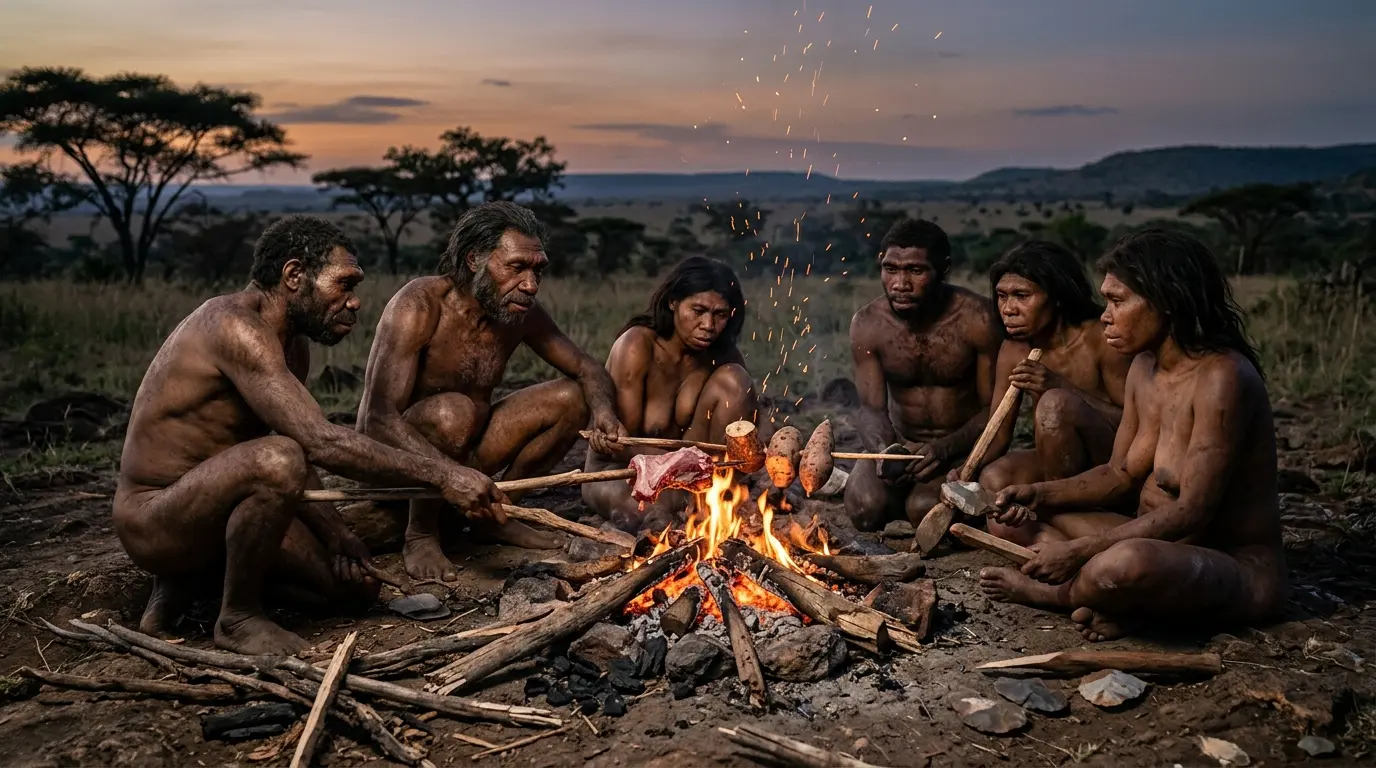
The solution lies in the mastery of controlled fire and cooking. Harvard biological anthropologist Richard Wrangham formulated the Cooking Hypothesis in his influential book, Catching Fire: How Cooking Made Us Human (2009).
Cooking is not simply a cultural invention; it is a vital biological adaptation that fundamentally transformed food chemistry and fueled human anatomical evolution.
Thermal food processing radically enhances caloric availability through two distinct biochemical mechanisms:
- Starch Gelatinization and Protein Denaturation: Heat unravels tightly coiled protein structures and breaks down resilient starch matrices, allowing digestive enzymes to absorb nutrients far more rapidly and completely.
- Lowered Energetic Cost of Digestion: Processing raw meat and fibrous roots requires substantial chewing and mechanical breakdown. Cooking serves as an external digestive aid, slashing the internal metabolic expenditure required to assimilate fuel.
Organ Trade-offs: The Expensive-Tissue Hypothesis
In 1995, anthropologists Leslie Aiello and Peter Wheeler published the Expensive-Tissue Hypothesis, identifying a physiological trade-off: both brain tissue and the gastrointestinal tract consume substantial metabolic resources. As our ancestors adopted easily digestible cooked diets, the hominin gut underwent significant evolutionary shrinkage. The metabolic energy freed by maintaining a smaller digestive tract was directly funneled into expanding cerebral tissue.
Metabolic Bottlenecks and Primate Ceilings
Neurobiological research by Suzana Herculano-Houzel and Karina Fonseca-Azevedo (2012) mathematically verified this metabolic limitation. They calculated that great apes constrained to a raw foraging diet would need to spend over nine hours per day chewing to support a human-scale brain of 86 billion neurons—an ecological impossibility. Controlled fire shattered this energetic barrier, laying the physiological foundation for Homo sapiens' brain volume of 1,350–1,400 cubic centimeters.
The Enduring Legacy of Fire
From microstratigraphic traces of controlled burning at South Africa's Wonderwerk Cave dating back 1 million years to widespread hearth sites from 400,000 years ago, fire served as our greatest biological catalyst. We did not merely start cooking because we became intelligent; we became intelligent because we learned to cook.