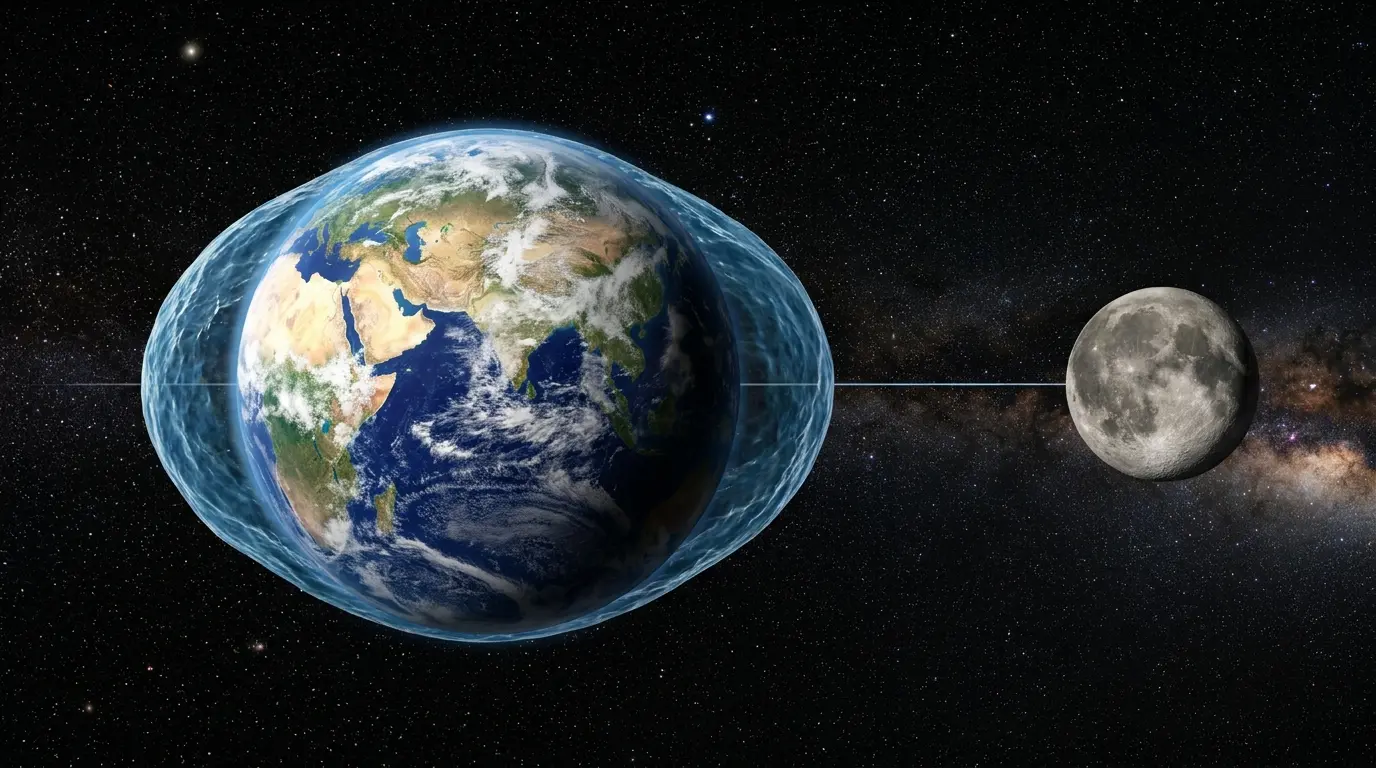

Every single day, billions of cubic meters of ocean water rise and fall in a reliable, rhythmic cadence. Ocean tides are far from random marine turbulence; they represent a majestic planetary interaction governed by gravitational mechanics between Earth, the Moon, and the Sun. Among all celestial neighbors, the Moon acts as the primary orchestrator of these oceanic rhythms.
Differential Gravity: Why Are There Two Tidal Bulges?
A widespread misconception suggests that lunar gravity simply pulls water toward the side of Earth facing the Moon, which would imply only one high tide per day. In reality, most coastlines experience two high tides and two low tides within a tidal day lasting approximately 24 hours and 50 minutes.
The physical principle behind this symmetry is the tidal force, derived from differential gravity across Earth's diameter. Gravitational pull weakens rapidly with distance. Consequently, the Moon exerts its strongest gravitational pull on the hemisphere closest to it, drawing the surface waters outward into a primary bulge (the sublunar bulge).
Conversely, on the hemisphere facing away from the Moon, lunar attraction reaches its minimum. At this antipodal location, the Moon pulls the solid body of Earth more strongly toward itself than it pulls the distant water layer. Combined with the orbital inertia of the Earth-Moon system, the water on the far side is effectively left behind, bulging outward in the opposite direction. Thus, Earth sustains two simultaneous tidal bulges on diametrically opposed hemispheres.
The Solar Role: Spring and Neap Tides
Although the Sun is approximately 27 million times more massive than the Moon, its vast distance of roughly 149.6 million kilometers causes its tide-generating capability to be only about 45% of the Moon's. However, the geometric positioning of the Sun strongly modulates the resulting tidal range:
- Spring Tides: When the Sun, Moon, and Earth align linearly (a configuration called syzygy during full and new moon phases), their tidal forces constructively reinforce one another. This alignment generates the highest high tides and lowest low tides of the lunar month.
- Neap Tides: When the Moon and Sun form a perpendicular 90-degree angle relative to Earth (during first and third quarter moon phases), their gravitational vectors partially cancel out. This produces neap tides, characterized by the narrowest tidal ranges.
Temporal Cadence and Coastal Topography
As Earth rotates through both oceanic bulges, coastlines experience alternating rising and receding seas. Because the Moon continuously orbits Earth in the direction of Earth's rotation, a complete tidal day spans 24 hours and 50 minutes, spacing semidiurnal tides roughly 12 hours and 25 minutes apart.
Local continental shelves, bay geometries, and seabed bathymetry further modify these planetary bulges, amplifying or moderating tides across different geographic basins.
The Moon's gravitational pull is not merely an astronomical curiosity; it is a global hydrological pump driving coastal nutrient cycles and sustaining marine biodiversity worldwide.