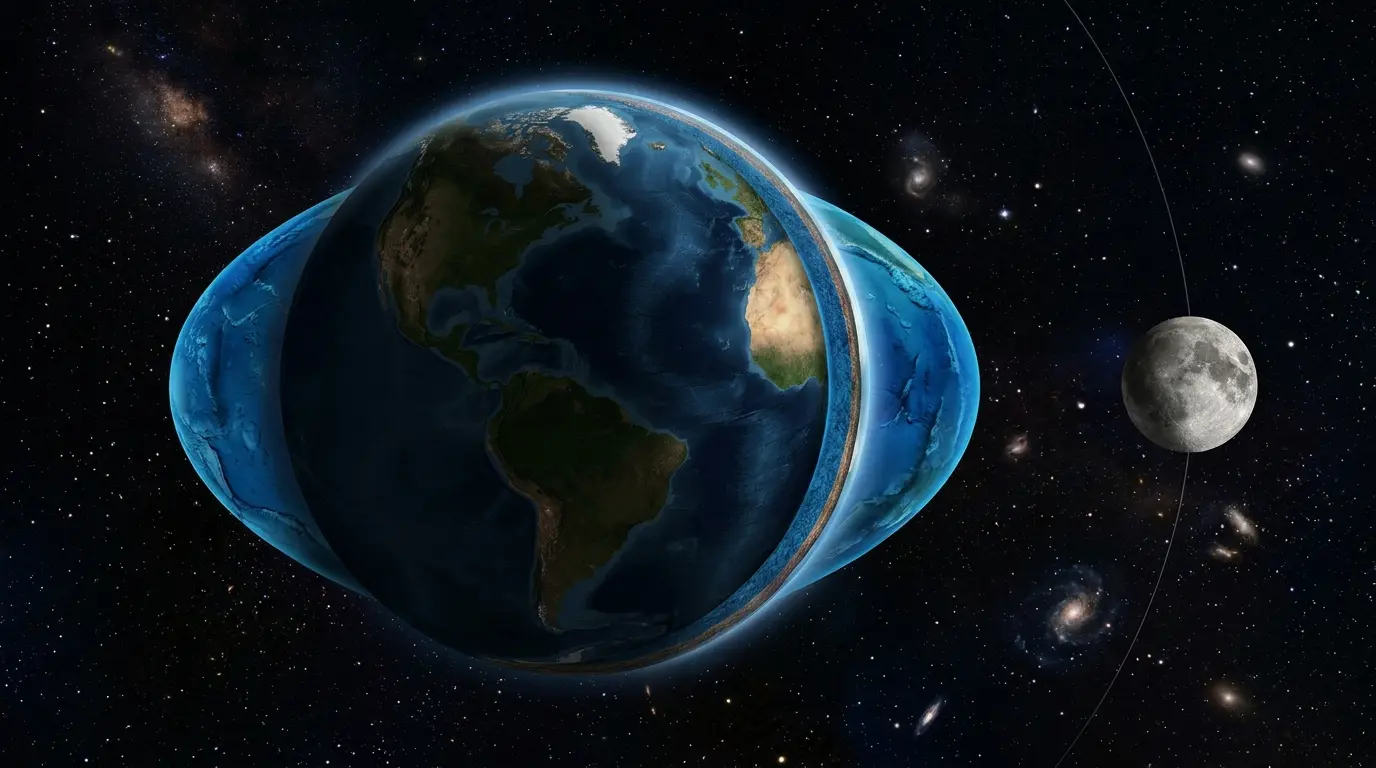
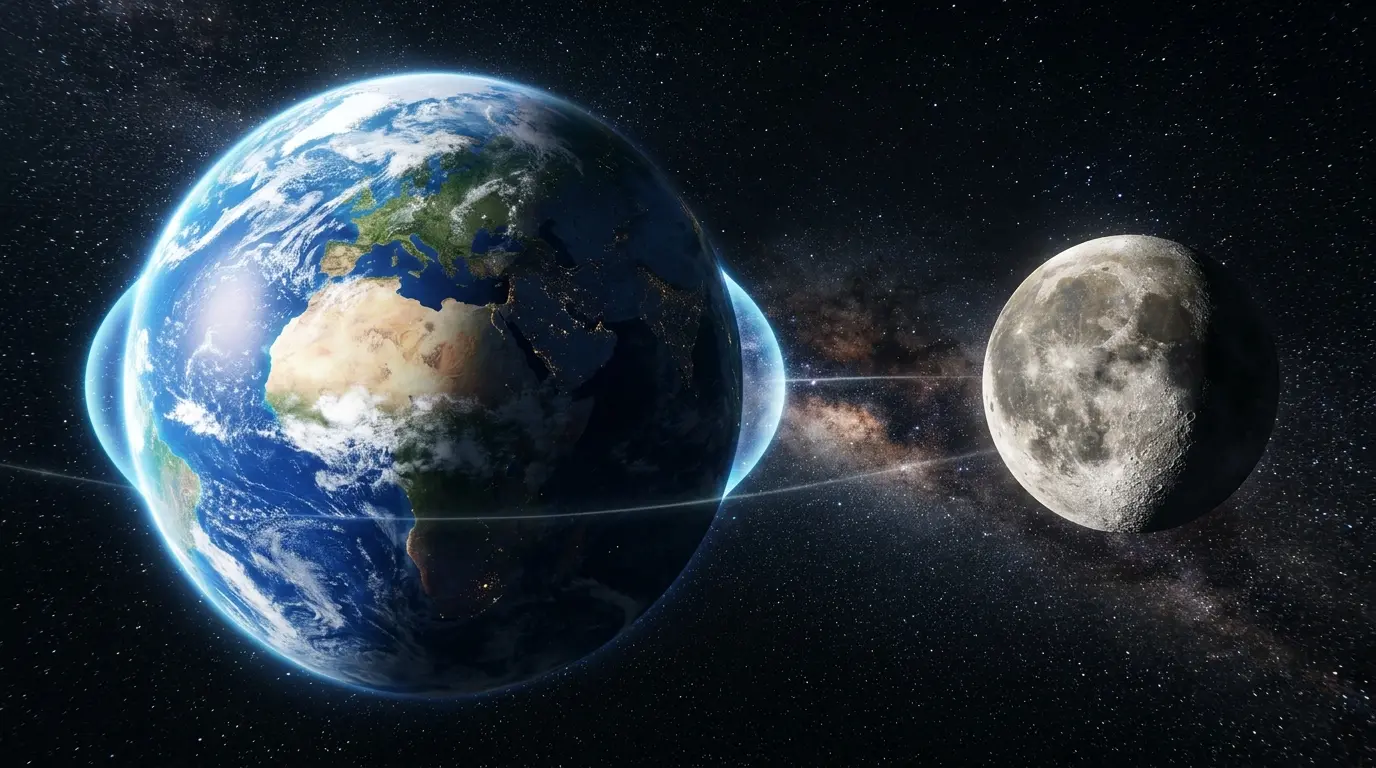
Have you ever watched an expansive shoreline recede hundreds of meters in the morning, only to be reclaimed by deep ocean water just hours later? This rhythmic phenomenon is known as the ocean tide. While it plays out along our coastlines, its primary engine operates roughly 384,400 kilometers away in space: the gravitational pull of the Moon.
The Differential Force Mechanism: The Mystery of Dual Tidal Bulges
A common misconception is that the Moon only pulls seawater toward itself on the side of Earth directly facing it. In reality, high tides occur simultaneously on two opposite sides of the planet. This dual phenomenon is governed by the principles of the differential gravitational force, scientifically termed the tide-generating force.
Gravitational attraction weakens with distance. The side of Earth closest to the Moon experiences the strongest gravitational pull, causing the ocean surface to swell outward into the primary tidal bulge. Meanwhile, Earth's solid center is attracted toward the Moon more strongly than the water on the far side. Consequently, Earth is effectively pulled inward away from the opposite oceans. Combined with inertial forces from the Earth-Moon barycentric orbit, a second symmetric tidal bulge forms on the opposite hemisphere.
Why Does the Moon Outpower the Massive Sun?
The Sun possesses roughly 27 million times more mass than the Moon. Why, then, does our small lunar neighbor dominate ocean tides? The secret lies in the mathematical physics of cosmic distance:
- Standard gravitational attraction follows the inverse-square law (1/r²).
- The tide-generating force diminishes much faster, following an inverse-cube law (1/r³).
Because the Sun is approximately 390 times farther away from Earth than the Moon, its tidal effect drops off exponentially. When calculated precisely, the Moon's tide-generating capability is approximately 2.17 times stronger than that of the Sun, making it the undisputed celestial conductor of our seas.
Spring Tides vs. Neap Tides: Celestial Alignments
Although the Moon dominates, the orbital alignment of the Sun, Earth, and Moon creates predictable cycles in tidal amplitude throughout each lunar month:
- Spring Tides: Occur during the New Moon and Full Moon phases when the Sun, Earth, and Moon align in syzygy. The gravitational vectors of both celestial bodies combine constructively, producing the highest high tides and lowest low tides (maximum tidal range).
- Neap Tides: Occur during the First and Third Quarter moon phases when the Sun and Moon form a 90-degree right angle relative to Earth (quadrature). Their gravitational pulls partially cancel out, generating the lowest tidal range with moderate high and low waters.
The Lunar Day and Daily Tidal Rhythm
As Earth rotates on its axis, the Moon simultaneously orbits Earth in the same eastward direction. Consequently, it takes Earth roughly 24 hours and 50 minutes—one tidal lunar day—for a specific geographic point to return to the same position beneath the Moon. For coastal regions experiencing semidiurnal tides, this causes high tides to recur approximately every 12 hours and 25 minutes.
Coastline Topography and Local Resonance
Beyond pure gravitational physics, the actual height of tides is heavily shaped by coastal geometry, bathymetry, and the Coriolis effect. In funnel-shaped bays, such as the Bay of Fundy in Canada, hydrodynamic resonance can amplify the difference between high and low water to an astonishing 16 meters.
The Moon's gravitational pull is far more than a physical curiosity; it is a celestial heartbeat driving marine nutrient cycles, coastal biology, and the fundamental rhythm of our blue planet.