A Technological Leap in 15th-Century Mainz
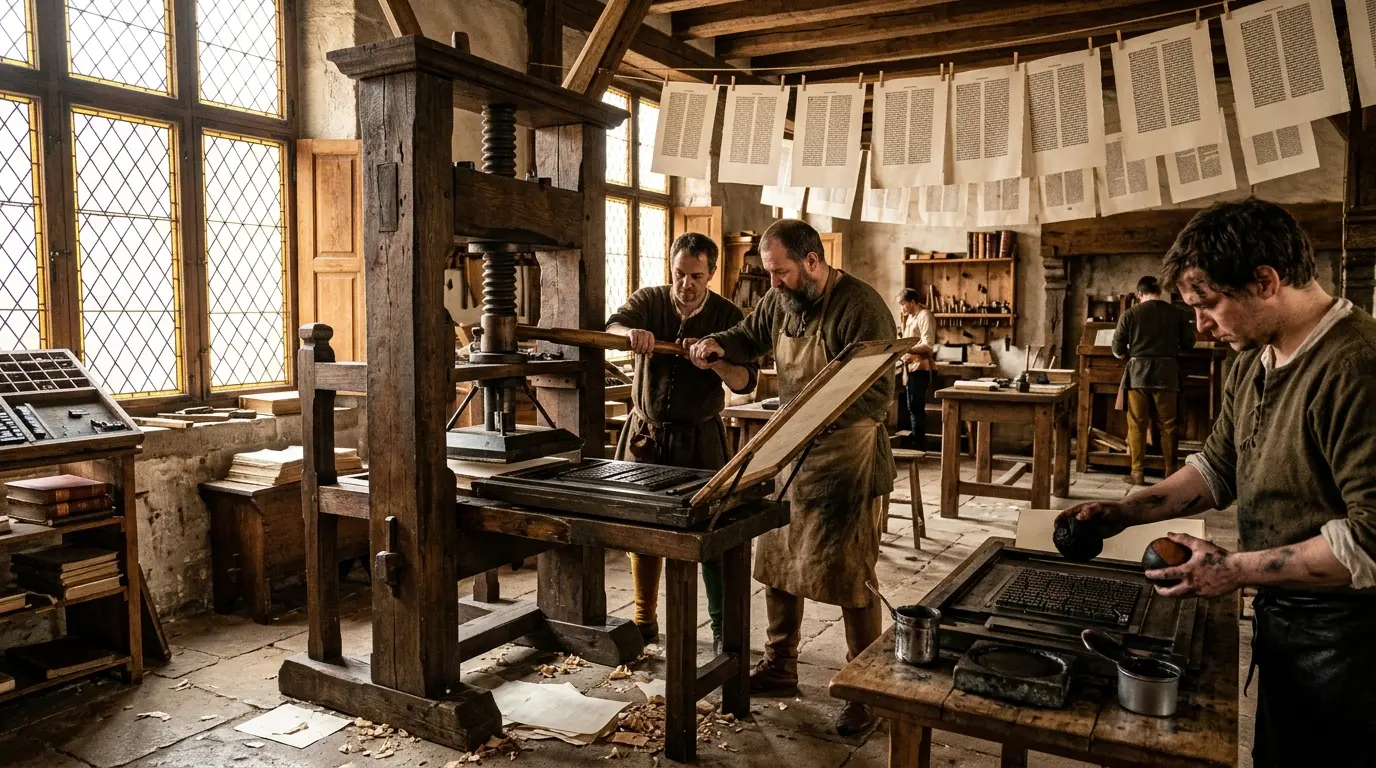
Between roughly 1440 and 1450 in the German city of Mainz, a skilled goldsmith and craftsman named Johannes Gensfleisch zur Laden zum Gutenberg devised a mechanical breakthrough that permanently transformed human civilization. Prior to Gutenberg's invention, the transmission of texts across Western Europe depended almost exclusively on laborious manual copying by scribes in monastic scriptoria or crude, inflexible woodblock printing (xylography). These painstaking methods required months or even years to duplicate a single work, rendering books exorbitant luxury items accessible only to wealthy aristocrats and high ecclesiastical authorities.
The Four Pillars of Gutenberg's Innovation
Gutenberg's enduring brilliance lay not merely in conceiving individual letterforms, but in synthesizing four interconnected mechanical and chemical technologies into an efficient manufacturing system:
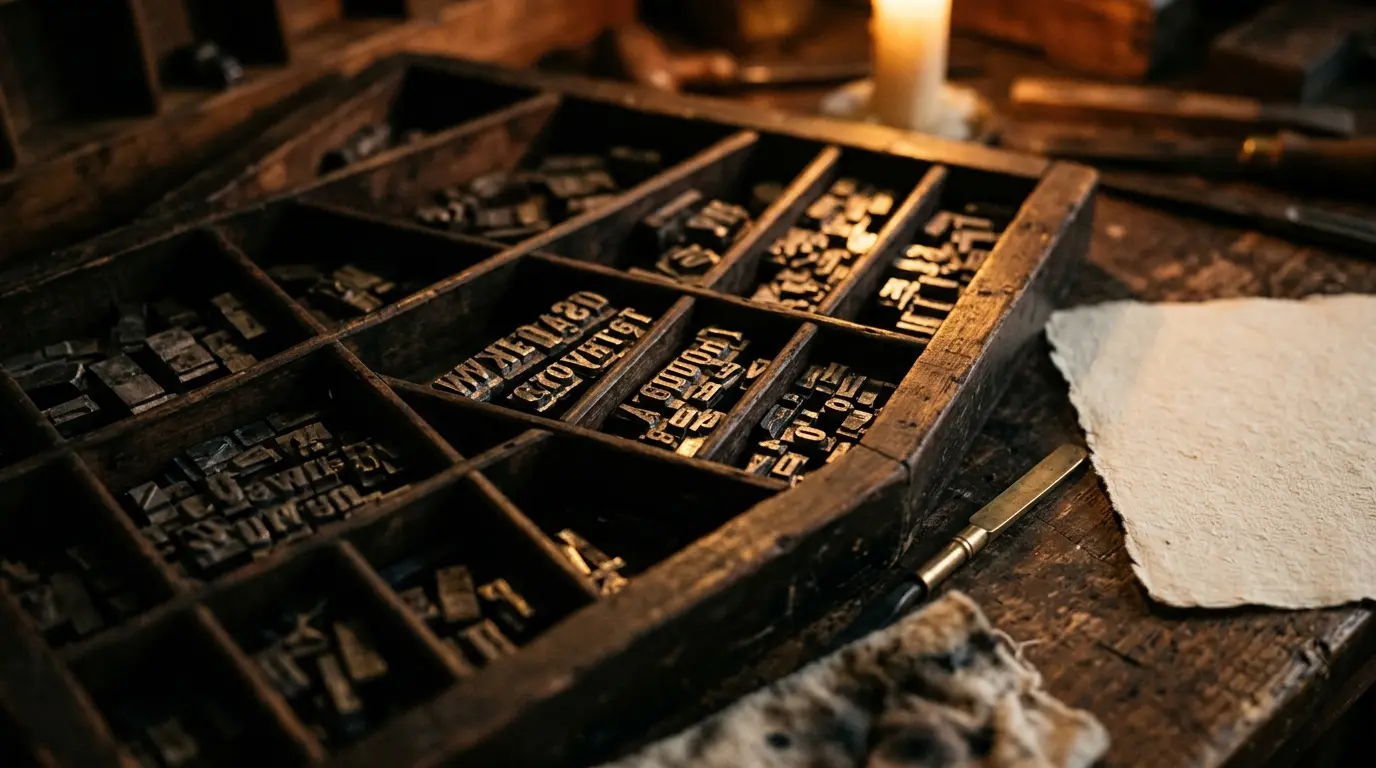
- The Precision Adjustable Hand Mold: Drawing upon his metallurgy background, Gutenberg developed a two-part adjustable steel hand mold. This tool enabled the rapid casting of interchangeable metal pieces of type with strictly identical height and crisp baselines.
- Durable Type Metal Alloy: He formulated a balanced metallurgical alloy consisting of lead, tin, and antimony. Antimony provided an indispensable physical property: it expanded slightly upon cooling, ensuring that the molten metal filled every microscopic groove of the punch matrix to yield razor-sharp typography.
- Viscous Oil-Based Ink: Traditional water-based manuscript inks beaded and ran off metal surfaces. Gutenberg solved this chemical obstacle by formulating an ink composed of linseed oil and lampblack soot, creating a viscous compound that coated metal type evenly and transferred cleanly into paper fibers.
- The Adapted Wooden Screw Press: Re-engineering the heavy timber screw presses traditionally employed in agricultural wine and olive harvesting, Gutenberg built a printing press capable of delivering controlled, uniform mechanical pressure across an entire sheet.
The 42-Line Bible: A Masterpiece of Mechanization
The definitive validation of Gutenberg’s apparatus arrived between 1454 and 1455 with the completion of the celebrated Gutenberg Bible, commonly known as the 42-Line Bible (B42) due to its standard layout of two columns containing 42 lines per page. Produced in an edition of approximately 180 copies on rag paper and fine calfskin vellum, this landmark publication proved conclusively that mechanized print could rival the artistic elegance of the most sophisticated illuminated manuscripts.
"Mechanized printing transformed human thought from a guarded treasure of the few into an unstoppable current of reproducible knowledge that reshaped human consciousness."
Socio-Cultural Legacy: The Democratization of Knowledge
The diffusion of movable type across the European continent proceeded at breakneck speed. During the incunabula era—the classification designating books printed prior to January 1, 1501—presses flourished in more than 250 European towns, issuing millions of individual volumes. By lowering the cost of book production by more than 80 percent, Gutenberg effectively dismantled the feudal monopoly on information. This unprecedented democratization of literature established the structural foundation for the European Renaissance, catalyzed the Protestant Reformation, and ignited the Scientific Revolution.