
The Dawn of Horology: Gnomons and Sundials
Long before humanity standardized seconds and minutes, time was measured directly through the celestial motions of the cosmos. The sundial stands as one of the oldest scientific instruments devised by human civilizations to quantify daylight through the shifting projection of a shadow.
The core component of any sundial is the gnomon—a vertical rod or pillar that casts a distinct shadow onto a calibrated dial face. In ancient Egypt, archaeologists documented L-shaped limestone shadow clocks tracing back to the reign of Pharaoh Thutmose III (15th century BCE). Furthermore, in 2013, researchers from the University of Basel excavating in the Valley of the Kings uncovered a flat limestone ostracon sundial divided into twelve distinct sectors, dated to the 19th Dynasty of Egypt (c. 13th century BCE).
Greek and Hellenistic scholars later refined the geometry of sundials. The Roman architect Vitruvius credited the Babylonian astronomer Berossus with inventing the hemicyclium in the 3rd century BCE—a concave, hemispherical dial that effectively corrected distortion in shadow projection. Despite their precision, sundials possessed fundamental limitations: they were useless at night or under overcast skies, and they measured seasonal "temporal hours" whose length varied throughout the year.
Hydraulic Bridges and Ancient Geared Masterpieces
The limitations of the sundial spurred the adoption of water clocks (clepsydrae), which tracked elapsed time via steady fluid displacement. While water clocks solved night timekeeping, the true pinnacle of ancient mechanical ingenuity occurred when engineers united fluid dynamics with complex bronze gearing.
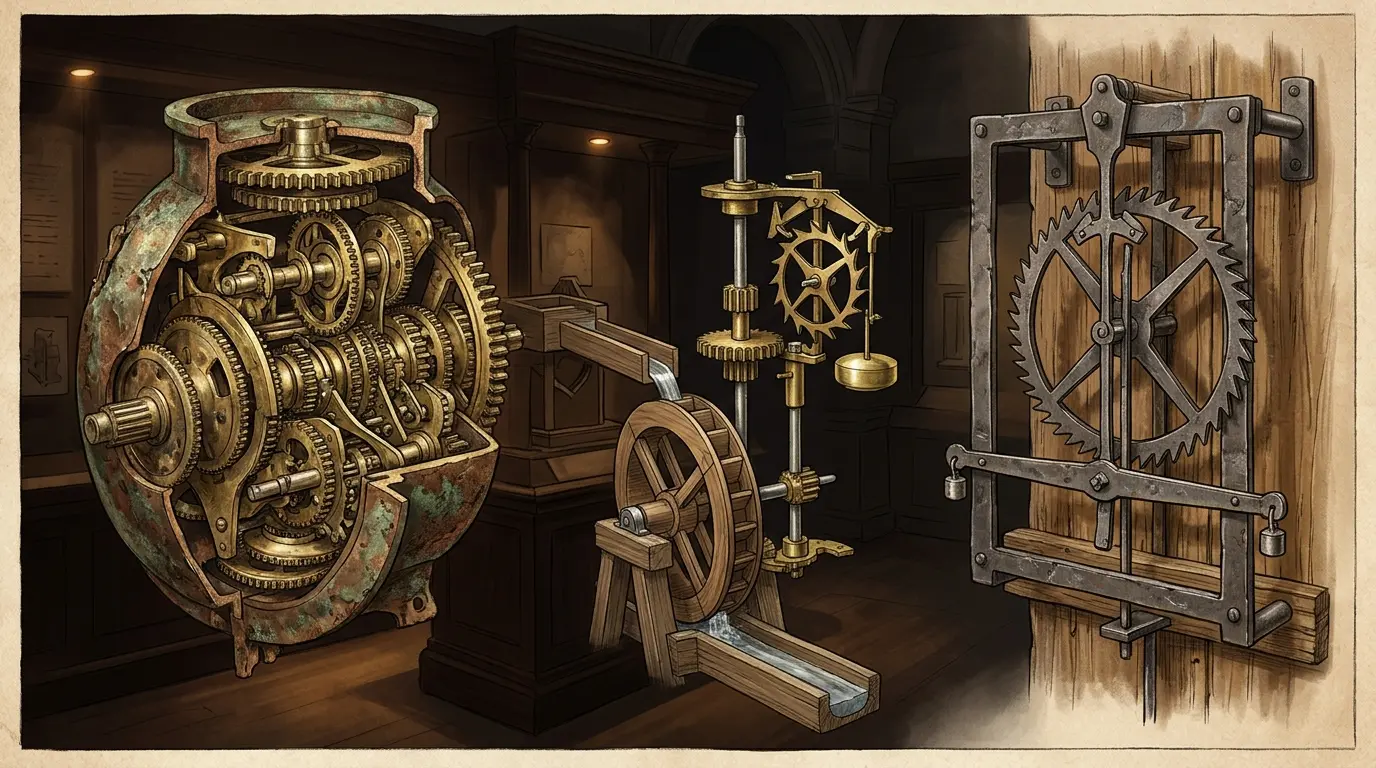
The most astonishing artifact of ancient mechanical engineering is the Antikythera Mechanism, recovered from a shipwreck off Greece and dated to approximately 150–100 BCE. Containing at least 30 intricately crafted bronze gear wheels, this analog calculating device predicted astronomical alignments, lunar phases, and eclipse cycles. While not a ticking domestic clock, it demonstrated that advanced epicyclic and differential gear trains existed millennia earlier than previously believed.
In East Asia, horological engineering achieved an extraordinary milestone during China's Song Dynasty. In 1092 CE, polymath Su Song completed an astronomical clock tower over ten meters tall in Kaifeng. Driven by a waterwheel, it incorporated an early mechanical escapement system—the "celestial balance"—alongside an endless chain drive that rotated armillary spheres and chiming jacks at precise intervals.
The Genesis of True Mechanical Clocks
The definitive revolution in timekeeping occurred in Western Europe during the late 13th and early 14th centuries with the invention of the verge and foliot escapement. This mechanical regulator replaced unpredictable fluid flow with a falling gravity weight whose energy was metered in discrete oscillatory beats by a crown wheel and pallet arbor.
By disconnecting time measurement from natural daylight and fluid dynamics, the mechanical escapement transformed time into a uniform, measurable mathematical dimension.
One of the earliest surviving mechanical clocks without a dial that remains operational today is the Salisbury Cathedral clock in England, constructed around 1386 CE. The historic arc spanning from Egyptian gnomons on desert sands to the rhythmic iron ticking of medieval cathedral towers laid the intellectual and technical cornerstone for the modern scientific revolution.