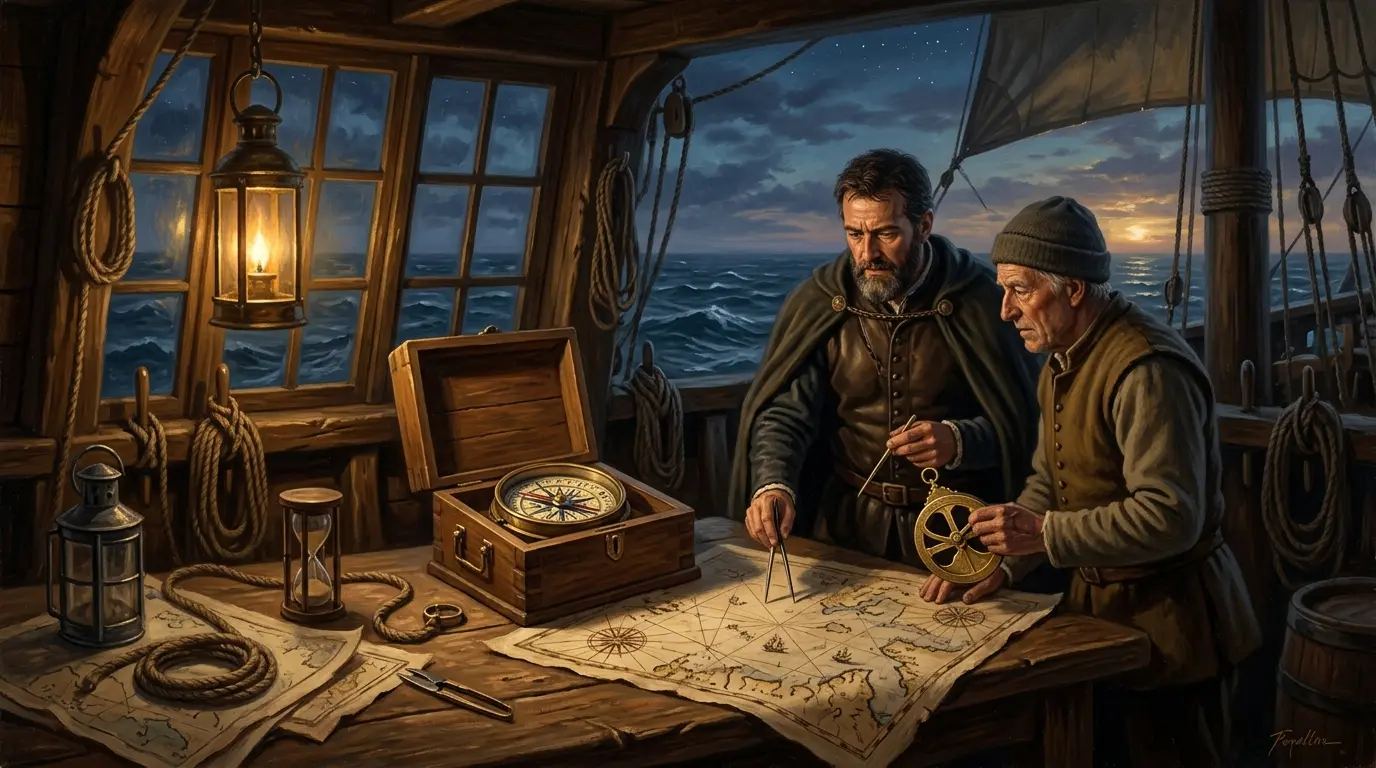
Before the invention of the magnetic compass, ancient seafarers relied entirely on celestial bodies—such as the Sun, the North Star, and seasonal constellations—alongside visible coastlines for navigation. When severe storms struck and heavy overcast skies persisted for days, ships were often hopelessly lost at sea. The emergence of the magnetic compass revolutionized human civilization by providing an unwavering directional reference point impervious to weather, ultimately unlocking the age of oceanic exploration.
The Han Dynasty and the Lodestone Si Nan
The origins of the compass trace back to ancient China during the Han Dynasty (roughly 2nd century BCE to 2nd century CE). Early Chinese craftsmen discovered the unique properties of lodestone, a naturally magnetized iron ore. Around 80 CE, philosopher Wang Chong documented a remarkable instrument called the Si Nan (South-Pointer) in his philosophical treatise Lunheng.
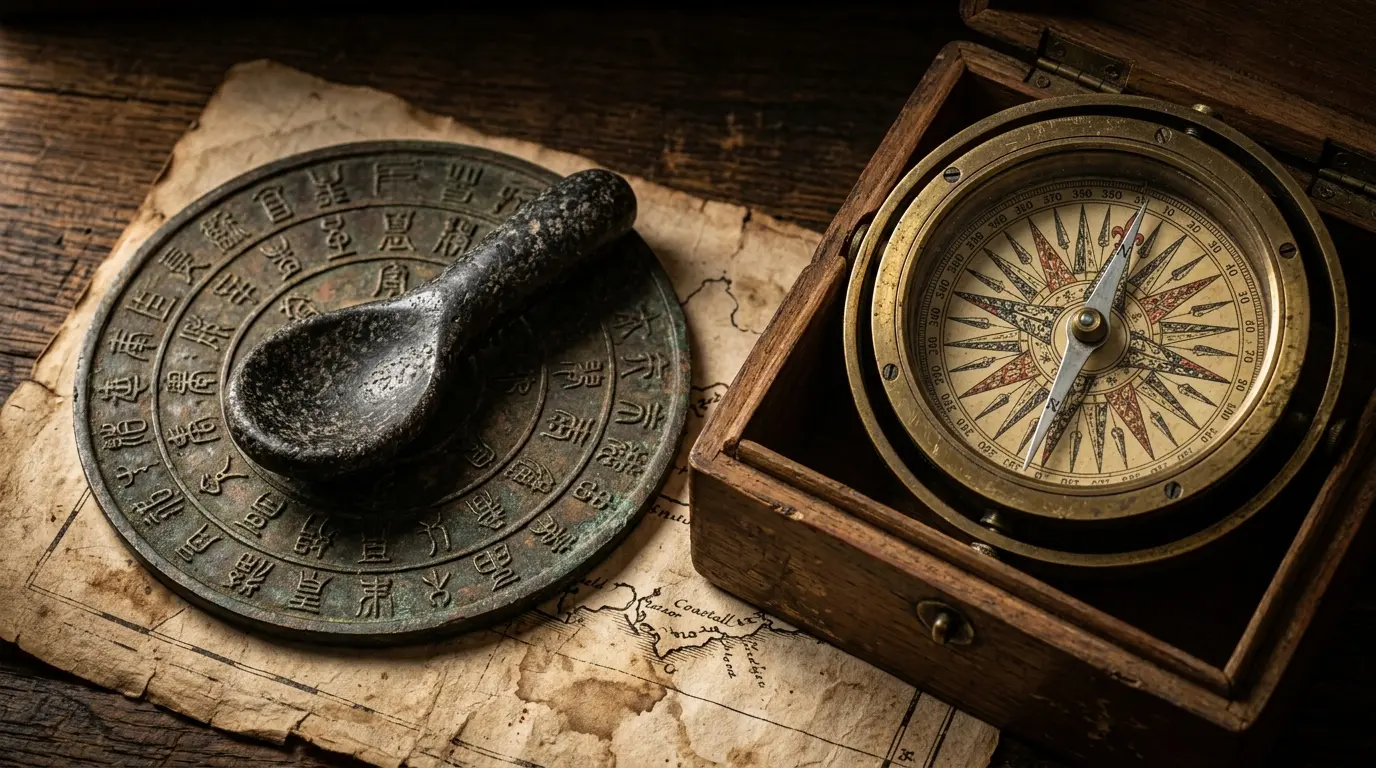
The Si Nan consisted of a spoon carved from lodestone balanced atop a polished bronze diviner's plate inscribed with astronomical and cosmological symbols. When gently spun, its friction-minimized handle naturally aligned toward magnetic south. During the Han era, however, this fascinating device was not deployed on ships; instead, it served geomantic purposes (feng shui) and court divination rituals to harmonize earthly human affairs with cosmic forces.
The Song Dynasty: Needle Magnetization and Maritime Use
The pivotal transition from a mystical orientation tool to practical maritime navigation took place during the Song Dynasty (960–1279 CE). Chinese metallurgists and scholars transitioned away from brittle, heavy lodestones toward lightweight artificially magnetized iron needles.
- The South-Pointing Fish (1044 CE): The military manual Wujing Zongyao by Zeng Gongliang documented thermoremanent magnetization: heating thin iron sheets cut like fish and quenching them aligned with Earth's magnetic field to induce magnetic polarity.
- Magnetic Declination and Shen Kuo (1088 CE): In his seminal work Mengxi Bitan (Dream Pool Essays), polymath Shen Kuo described needle compasses suspended by fine silk threads or balanced on pivots. Crucially, Shen Kuo was the first person in recorded history to document magnetic declination—noting that compass needles pointed slightly south-by-east rather than toward true geographic south.
- First Maritime Navigation Record (c. 1111–1117 CE): Author Zhu Yu recorded in Pingzhou Ketan that ocean-going merchant ship captains navigated open waters using south-pointing needles whenever heavy overcast or nocturnal storms obscured celestial bodies.
Transmission to Europe and the Dry Mariner's Compass
Carried along the Maritime Silk Road and through trade interactions across the Indian Ocean and the Islamic world, knowledge of the magnetic needle reached Europe by the late 12th century, appearing in writings by English scholar Alexander Neckam around 1190.
A transformative engineering breakthrough occurred in the Mediterranean—notably credited to mariners in Amalfi, Italy—by the late 13th and early 14th centuries. Navigators affixed the magnetic needle directly beneath a rotating windrose (compass card) balanced on a sharp brass pivot. Mounted inside a set of concentric brass rings known as gimbals, the instrument remained horizontal regardless of the vessel's pitching and rolling. This created the dry mariner's compass, far superior to fragile water-floating bowls.
The Age of Exploration: Navigating Global Oceans
By the 15th through 17th centuries, the gimballed dry compass became the cornerstone of the Age of Exploration. Pioneering navigators such as Vasco da Gama, Christopher Columbus, and Ferdinand Magellan relied on it to cross vast open expanses of the Atlantic, Pacific, and Indian Oceans without coastal landmarks.
During his trans-Atlantic voyage in 1492, Christopher Columbus systematically charted the changing variation of magnetic declination across ocean longitudes, laying empirical groundwork for modern geomagnetism.
From an ancient Han divination spoon to the robust nautical instrument that guided world-crossing caravels, the magnetic compass demonstrates how applied scientific discovery can dismantle geographical barriers and unite the global world.