Thermoregulatory Wonders of the African Savanna
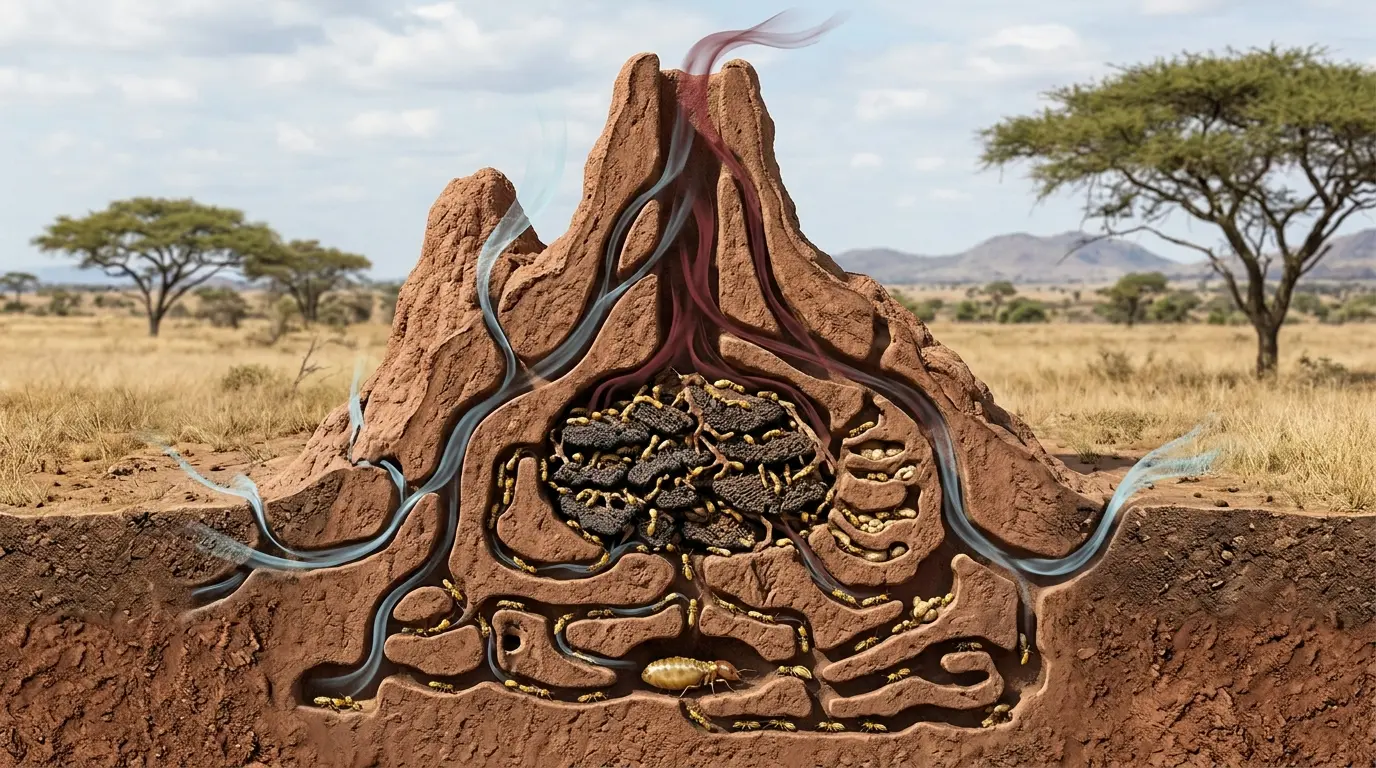
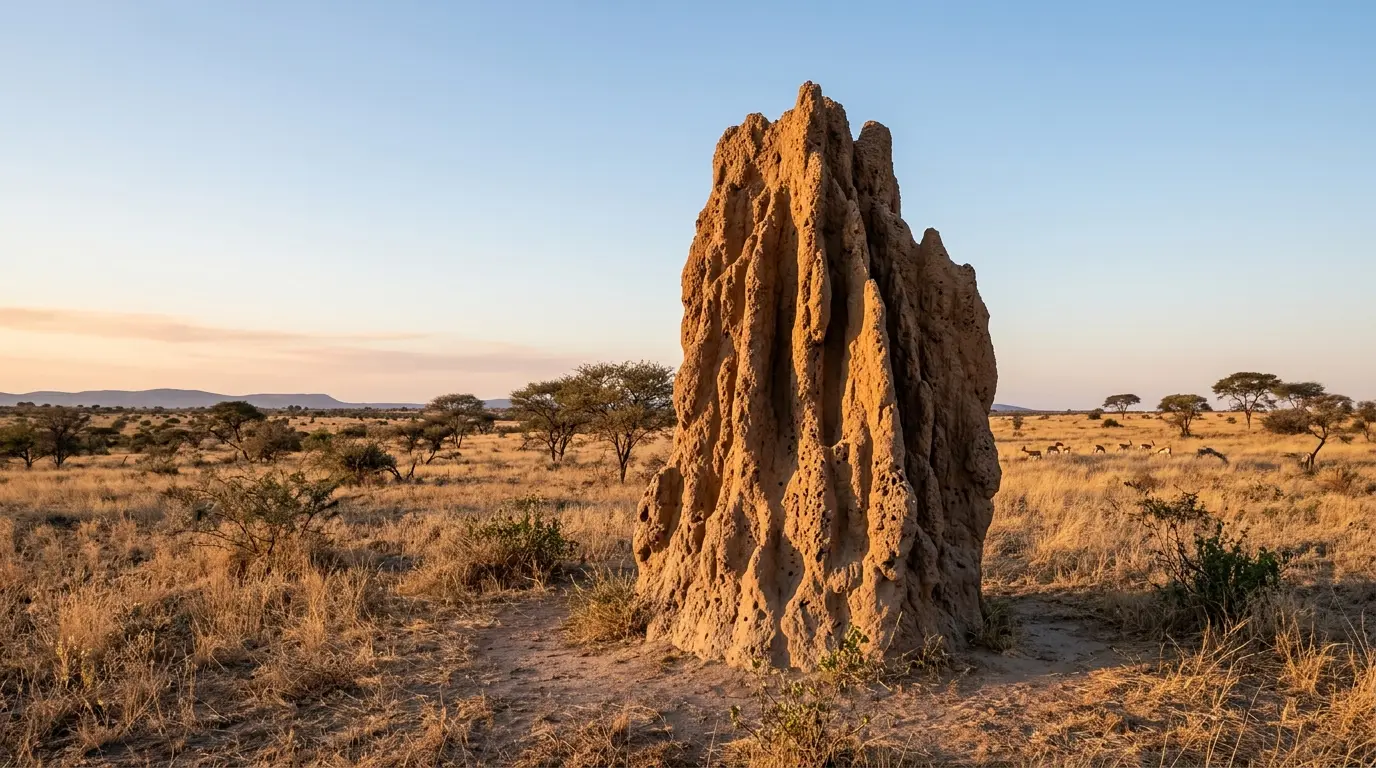
Across the arid African savannas, ambient temperatures oscillate drastically from chilling night lows of 10°C to scorching midday peaks exceeding 40°C. Despite these harsh fluctuations, towering earthen spires rise several meters into the sky. These monumental mounds are engineered by termites belonging to the genus Macrotermes. Within the subterranean depths of these structures, millions of tiny insects sustain their colony while cultivating delicate symbiotic fungus gardens of the genus Termitomyces.
This fungal crop is the primary nutritional cornerstone of the colony, yet it requires an extraordinarily rigid microclimate: internal temperatures must remain tightly locked between 29°C and 31°C, accompanied by relative humidity above 80 percent. Without electrical grids or mechanical air conditioning, termites achieve this thermal homeostasis exclusively through natural passive ventilation and earthen architecture.
The Biophysics of Termite Mound Ventilation
For decades, scientific consensus followed the classical “thermosiphon” hypothesis proposed by Martin Lüscher in the 1960s. This theory suggested that metabolic heat generated by the colony propelled warm air up through a central flue, which then circulated down along outer surface conduits. However, modern biophysical investigations—led by researchers such as Dr. J. Scott Turner and international biomechanics teams—have uncovered a far more dynamic mechanism.
Rather than acting as continuous chimneys, termite mounds operate much like an external lung that breathes in response to external wind turbulence and diurnal temperature waves:
- Thermal Inertia and Mass: Thick walls sculpted from clay, sand, and organic secretions exhibit high thermal mass. This dense exterior absorbs intense solar radiation during the day and gradually conducts that stored warmth inward during frigid nights, completely dampening internal temperature spikes.
- Wind-Driven Gas Exchange: Intricate porous networks and surface flutes intercept external wind gusts. Dynamic pressure gradients created across the mound drive tidal ventilation, flushing out lethal accumulations of carbon dioxide from subterranean chambers while replenishing oxygen without compromising internal humidity.
“The termite mound is not merely a static shelter; it is an externalized physiological organ that taps directly into atmospheric kinetic energy to maintain equilibrium with zero auxiliary metabolic cost.”
Biomimicry: Transforming Modern Sustainable Architecture
The remarkable cooling mechanics of termite mounds have become foundational to biomimicry—the science of translating biological ingenuity into human engineering. The most prominent real-world application of this design is the iconic Eastgate Centre in Harare, Zimbabwe, designed by architect Mick Pearce in collaboration with Arup engineering in 1996.
Constructed with high-thermal-mass concrete and masonry, the Eastgate Centre mimics the earthen walls of a Macrotermes mound. Cool night air is drawn into hollow floor slabs, pre-cooling the physical building structure for the following day. During daytime hours, heat generated by occupants and computers naturally rises and discharges through vertical rooftop chimneys via the natural stack effect. Consequently, the building consumes roughly 90 percent less energy for climate control compared to conventional air-conditioned buildings of equivalent scale, proving that nature’s millions-of-years-old designs hold the blueprint for modern green construction.