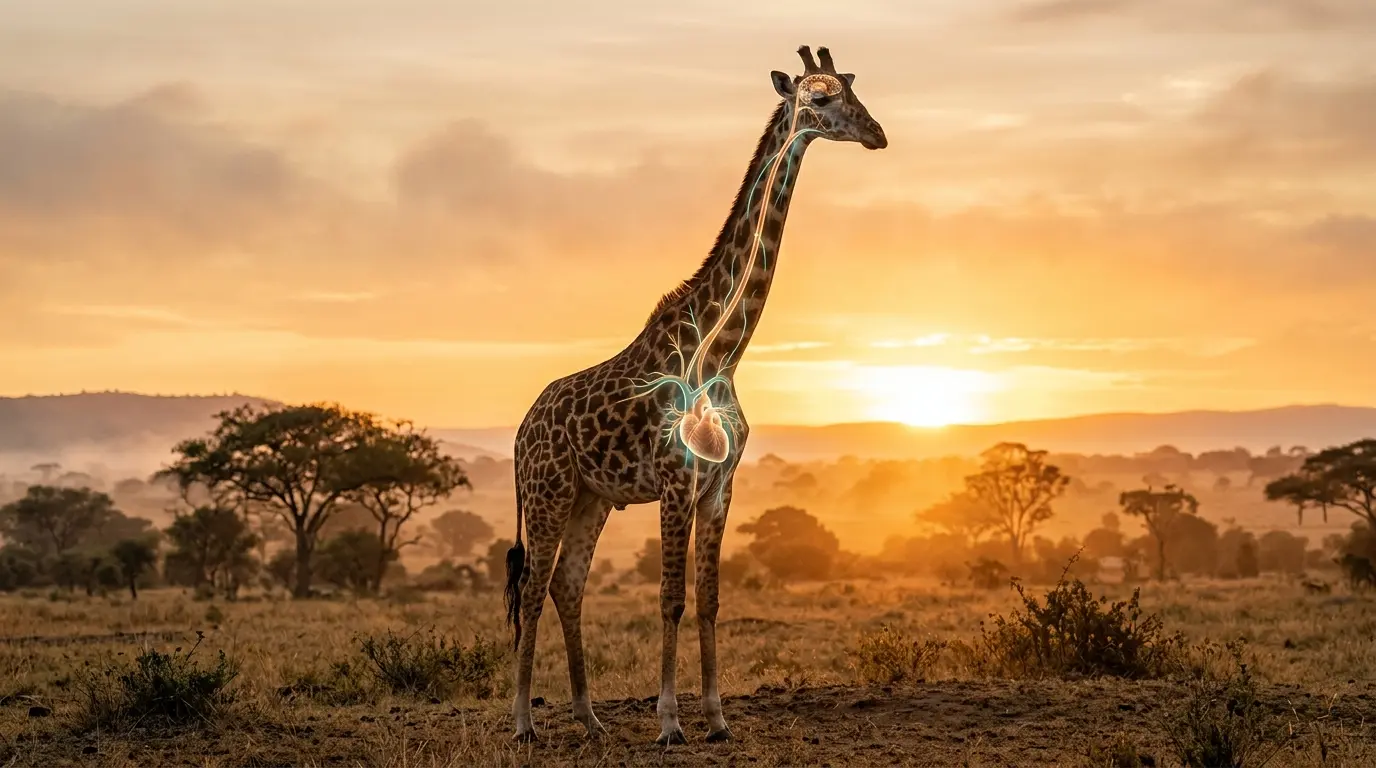
As the tallest living terrestrial mammal, an adult giraffe must pump oxygenated blood upward against gravity nearly two meters to reach its elevated brain. To conquer this immense hydrodynamic hurdle, the giraffe maintains a circulatory system with systemic blood pressure roughly double that of humans and other mammals. In humans, chronic arterial pressures of this magnitude cause catastrophic hypertension, stroke, or congestive heart failure. Yet giraffes thrive unscathed, relying on an extraordinary suite of anatomical and genetic adaptations.
Extreme Blood Pressure and a Specialized Cardiac Pump
Near the heart level, an adult giraffe maintains a resting blood pressure of approximately 280/180 mmHg, yielding a mean arterial pressure well above 200 mmHg. However, as blood climbs against gravity along the towering neck, hydrostatic pressure drops predictably. By the time blood reaches the cranium, its pressure settles at an optimal 100 to 110 mmHg—the standard cranial perfusion pressure required by mammalian brain tissue.
Protective Myocardial Architecture
To generate this tremendous driving pressure without causing self-inflicted organ trauma, the giraffe heart exhibits remarkable structural specializations:
- Hypertrophied left ventricle: The muscular wall of the left ventricle reaches between 3 and 4 centimeters in thickness, whereas the right ventricle wall measures only about 1 centimeter.
- Proportional cardiac mass: Weighing roughly 11 kilograms (representing about 0.5% to 1% of total body weight), the heart is remarkably compact rather than pathologically enlarged.
- Superior diastolic elasticity: Despite thick walls, the giraffe myocardium resists pathological fibrosis, preserving compliance so the chambers fill efficiently during diastole.
Pressure Regulators: Venous Valves and the Rete Mirabile
The giraffe faces its greatest hemodynamic challenge when lowering its head to drink from waterholes. In this posture, gravity amplifies arterial inflow toward the skull, which could cause lethal intracranial hemorrhage without counter-regulation. Giraffes mitigate this threat using two key anatomical buffers:
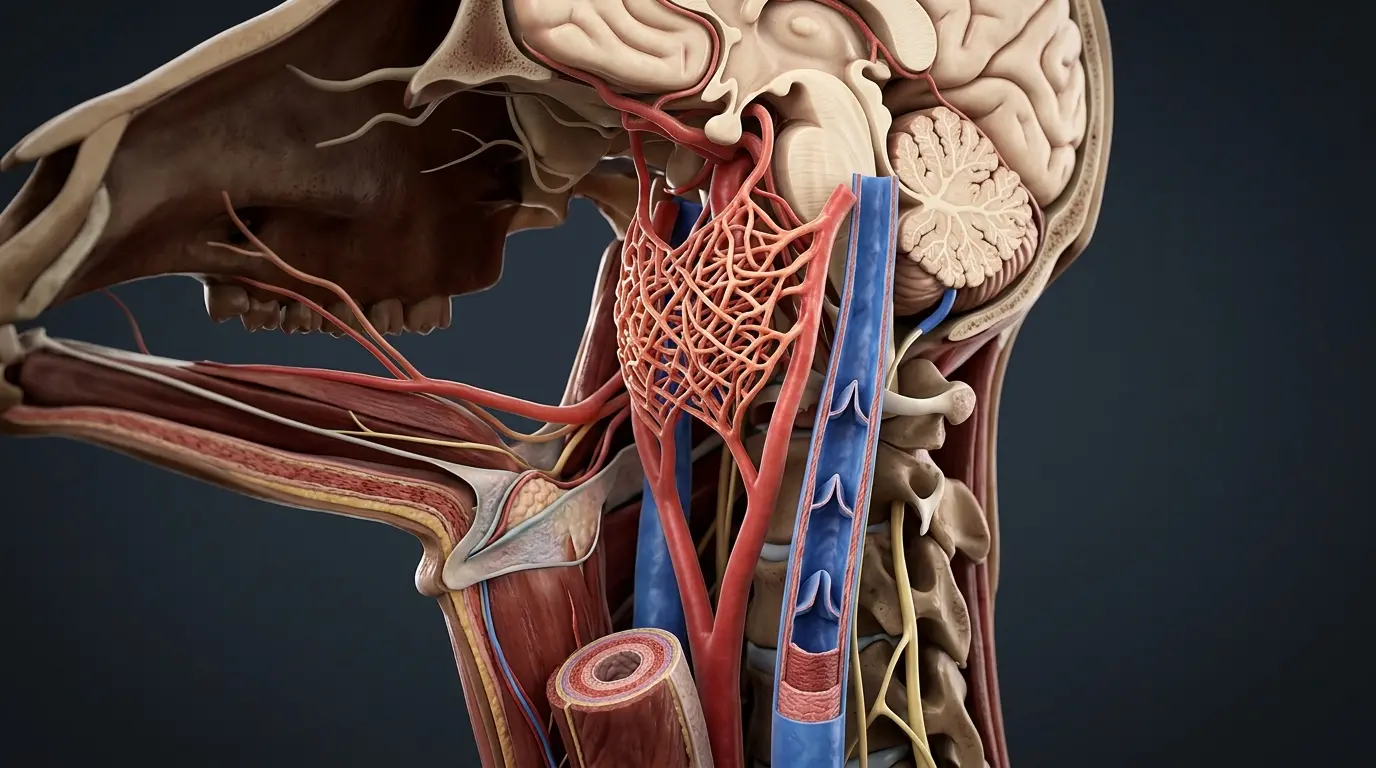
- Carotid rete mirabile: A dense network of fine, branching arterioles located at the base of the skull acts as a hydraulic shock absorber, dispersing and buffering acute arterial pressure spikes before blood enters delicate brain capillaries.
- One-way jugular valves: A series of functional valves in the jugular veins prevents the retrograde pooling of venous blood back toward the head during drinking, while also preventing syncope when the animal swings its neck upright.
Nature's Anti-Gravity Suit: Lower Limb Adaptations
At the hooves, gravitational forces generate hydrostatic pressures that can exceed 300 to 400 mmHg. In human limbs, such extreme dependent hydrostatic pressure would inevitably cause severe edema and tissue necrosis.
The giraffe overcomes this through a biological anti-gravity suit. The lower legs are tightly wrapped in exceptionally thick, tough, inelastic skin and dense deep fascia. This rigid envelope elevates interstitial fluid pressure, neutralizing capillary filtration and stopping plasma extravasation. Furthermore, continuous skeletal muscle contractions within this non-compliant sheath act as a powerful venomotor pump, propelling venous blood back toward the heart. This biomechanical principle has directly informed human medical compression therapy and NASA countermeasure garments for astronauts.
Molecular Resilience: The Protective FGFRL1 Gene
The giraffe's defense against chronic hypertension extends beyond macroscopic biomechanics into genomics. Whole-genome sequencing has revealed specific positive selection in the FGFRL1 (Fibroblast Growth Factor Receptor-Like 1) gene. Functional assays demonstrate that giraffe-specific FGFRL1 variants confer robust resistance against myocardial fibrosis and maintain skeletal bone density, preventing the cellular stiffness that typically impairs hypertensive hearts.
The giraffe cardiovascular system represents an evolutionary masterpiece: integrating high-pressure hydraulics, the rete mirabile shock absorber, tight fascial compression, and genetic resilience in flawless physiological equilibrium.