Natural Architectural Wonders of the Savanna
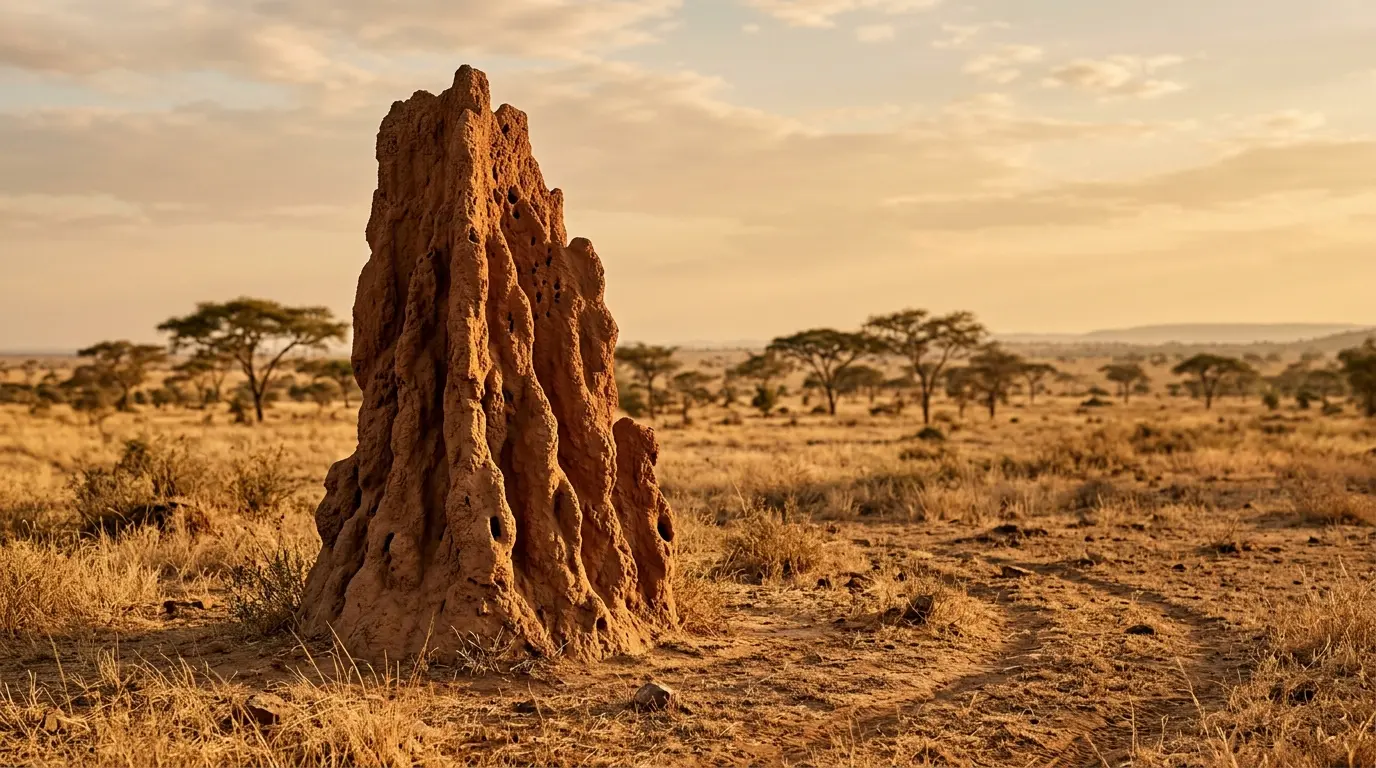
Across arid savannas subject to extreme heat, red earthen mounds tower meters high against the open sky. These monumental structures are termite mounds, particularly crafted by the genus Macrotermes. Engineered by millions of tiny, sightless insects without blueprints or powered cooling equipment, these mounds represent an evolutionary marvel of civil engineering. Although external savanna temperatures fluctuate wildly between scorching days and chilly nights, the subterranean nest retains a remarkably stable temperature, steady humidity, and continuous fresh airflow.
Air Circulation and Tidal Ventilation Dynamics
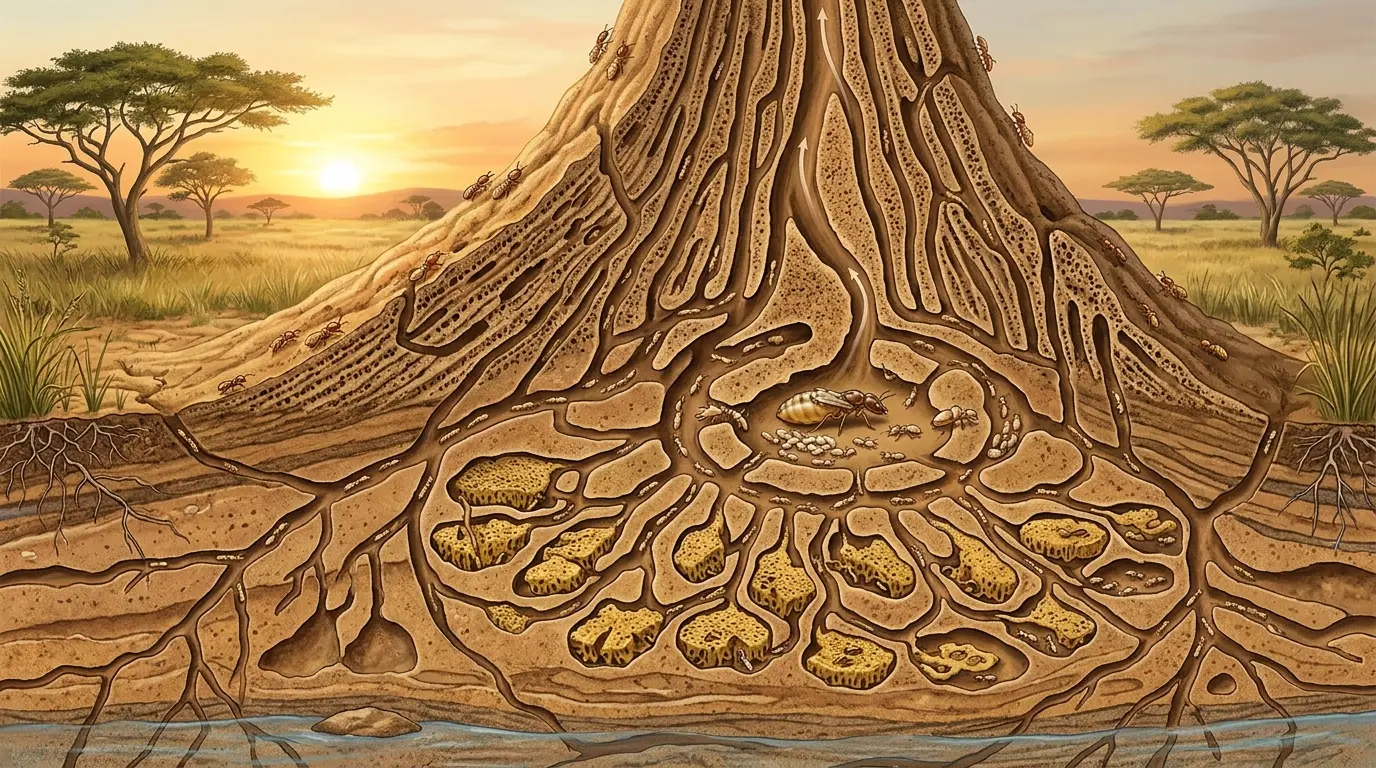
Far from a solid heap of clay, a termite mound is an intricately engineered porous labyrinth interlaced with tunnels, flues, and conduit networks. The termites require relentless air circulation to solve two fundamental biological challenges:
- Colony Respiration: A population numbering in the millions generates significant volumes of carbon dioxide (CO2), which would quickly become toxic if allowed to pool in the nest.
- Symbiotic Fungus Farming: Termites cultivate specialized Termitomyces fungal gardens as their primary food source. These fungal beds produce massive metabolic heat and require stable humidity above 90% alongside constant oxygen exchange.
While early scientific models proposed a closed, convective thermosiphon mechanism, modern biophysical studies reveal a much more sophisticated dynamic driven by wind turbulence. The mound's semi-permeable outer walls interact with external gusts to produce dynamic pressure oscillations. This creates a passive 'tidal ventilation' system—comparable to the breathing of lungs—drawing fresh oxygen into internal chambers while flushing out stale CO2 without desiccating the moisture-dependent fungal gardens.
The Critical Role of Thermal Mass
Beyond aerodynamic channels, the key to the mound's internal stability is its building material. Termites cement local clay, silt, sand, saliva, and organic secretions into dense, rock-hard walls. This robust structure possesses immense thermal mass. Throughout the blazing day, the thick perimeter absorbs solar radiation, delaying heat penetration to the central living quarters. As temperatures plunge after nightfall, this stored thermal energy slowly radiates inward, buffering the colony against cold desert nights.
Inspiring Biomimetic Architecture
The passive thermoregulation of termite mounds has become a quintessential benchmark in the field of sustainable biomimicry. The most celebrated real-world translation is the Eastgate Centre in Harare, Zimbabwe, designed by architect Mick Pearce alongside engineers from Arup. The mixed-use complex utilizes thermal concrete mass and passive vertical chimneys, pulling in cool ambient air during the night and expelling warm air during the day. By emulating the termite mound's natural ventilation system, the complex uses over 35% less energy than comparable conventional air-conditioned buildings.
Millions of years of evolutionary engineering show that precise environmental control can be achieved through clever geometry, natural materials, and physics rather than fossil-fuel reliance.
The humble termite mound offers a vital lesson for sustainable urban development: the most efficient cooling strategies do not fight against nature, but instead harness natural physical gradients to achieve effortless balance.