Symbolic Language Inside the Pitch-Black Hive
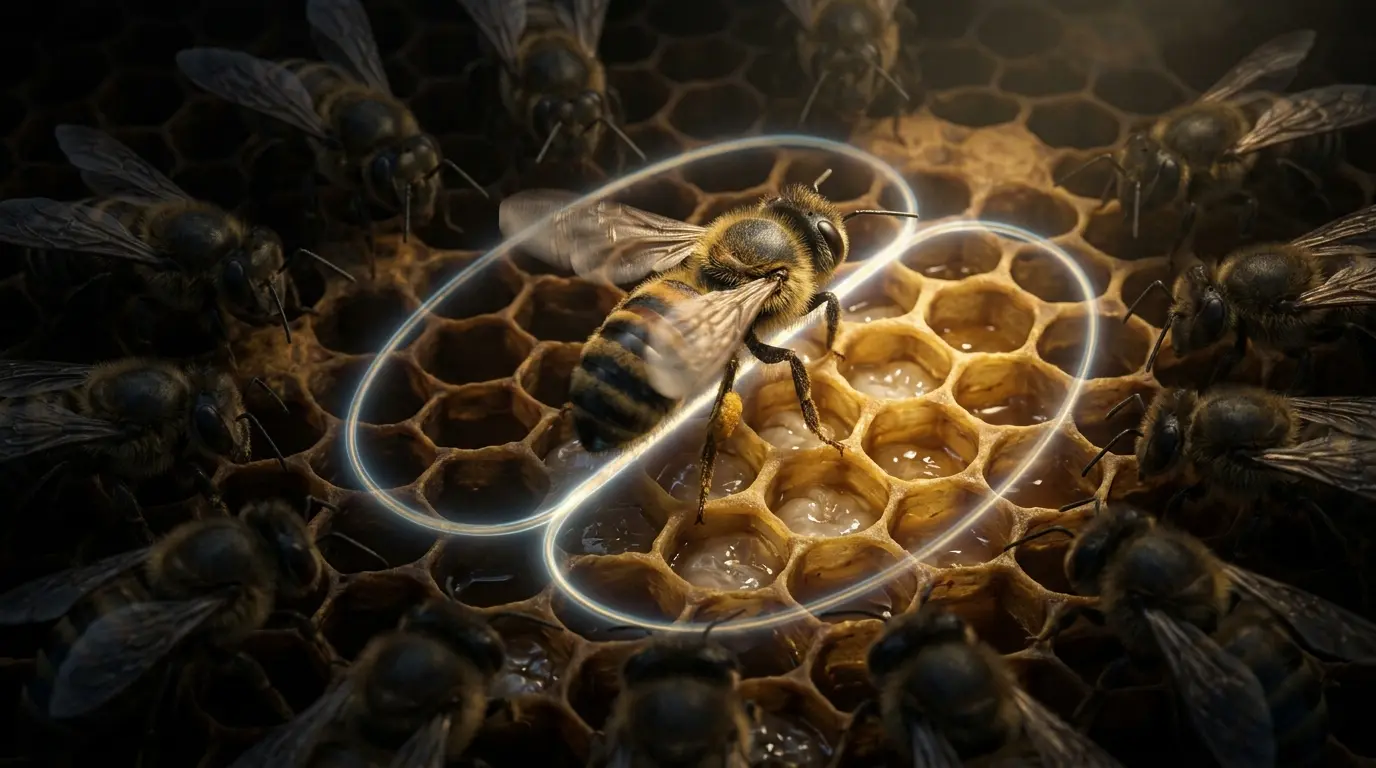
Inside the lightless interior of the beehive, a successful forager of the western honeybee (Apis mellifera) does far more than regurgitate floral nectar. To recruit nestmates to a bountiful floral patch, she executes a sophisticated figure-eight choreography known as the waggle dance. Through this ritual, honeybees encode and transmit high-precision two-dimensional navigational vectors without visual references.
"The waggle dance represents one of the most sophisticated examples of non-human symbolic communication, translating celestial coordinates into gravitational angles."
Encoding Direction Relative to Solar Azimuth
The core of the dance is the waggle run, during which the bee vigorously vibrates her abdomen from side to side while running forward in a straight line. She then circles back alternately to the left and right to complete the figure-eight pattern and repeat the cycle.
Because honeycombs hang vertically in the dark hive, gravity serves as the primary coordinate frame. The dancing bee projects celestial vectors onto the vertical comb, where straight upward represents the current azimuth of the sun. The angle of the waggle run relative to vertical precisely corresponds to the angle between the sun and the floral patch:
- Straight upward: The food source lies directly toward the sun.
- 60 degrees to the right: The foraging site is positioned 60 degrees to the right of the sun.
- Straight downward: The nectar patch lies directly opposite the sun.
Remarkably, honeybees possess an endogenous circadian clock that accounts for celestial movement throughout the day. Even as the sun traverses the sky while dancers remain inside the dark cavity, foragers continuously adjust their dance angle to maintain navigational accuracy.
Measuring Distance via Acoustic and Temporal Duration
In addition to directional heading, the waggle dance mathematically conveys flight distance. The duration of the waggle run is directly proportional to the journey ahead:
- Waggle duration: Approximately one second of waggle vibration corresponds to roughly 750 to 1,000 meters of flight distance. Bees quantify this distance not by flight time or energetic output, but through optical flow integration accumulated across their compound eyes during flight.
- The round dance: When a flower patch is located nearby (typically within 50 to 100 meters), foragers omit the directional waggle run and instead perform an alternating circular round dance, signaling proximity without complex directional coordinates.
Sensory Decoding in Complete Darkness
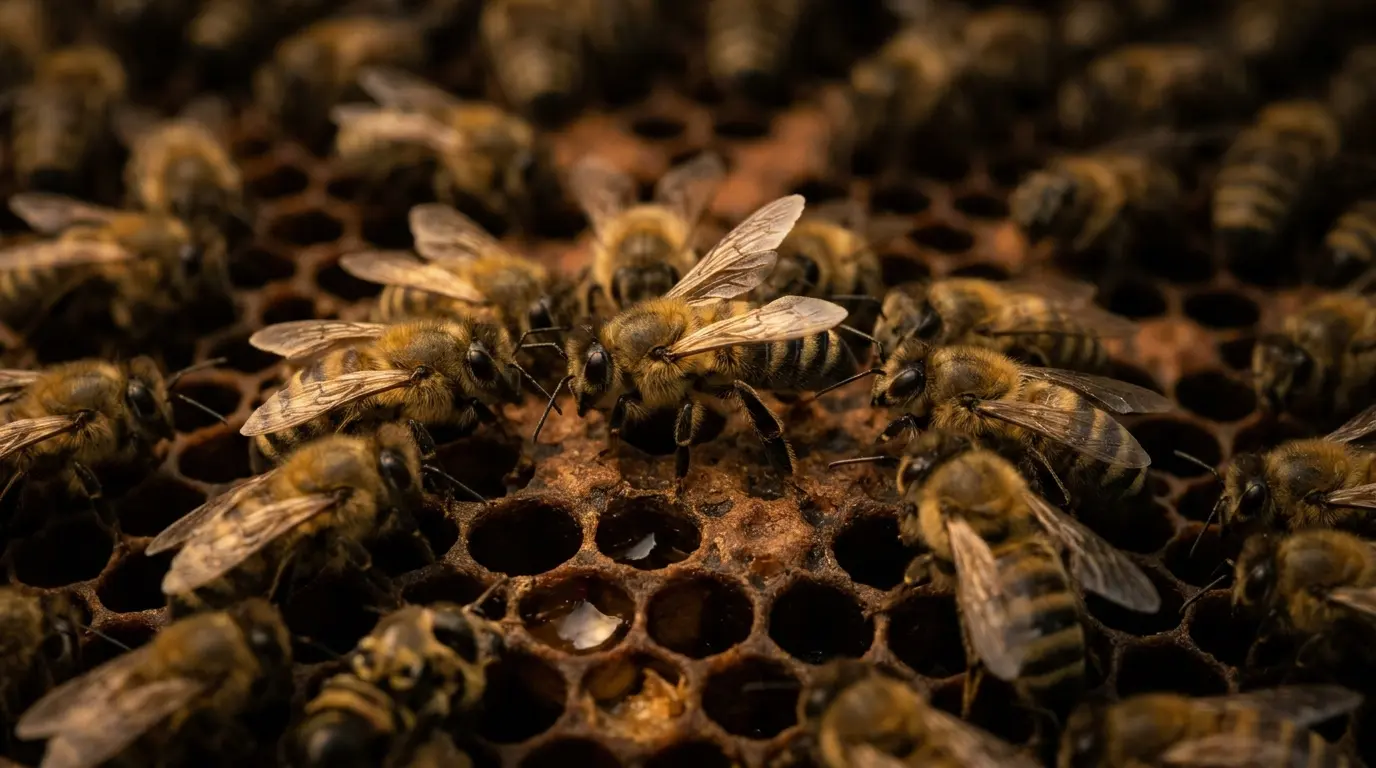
How do recruit bees decipher these signals without ambient light? Nestmates follow the dancer in close quarters, pressing their antennae against her vibrating body to decode trajectory. They also perceive mechanical comb vibrations via their subgenual leg organs and detect near-field acoustic pulses (approximately 250 to 300 Hertz) generated by thoracic wing fluttering. Combined with floral scent samples exchanged through oral trophallaxis, recruits receive an exhaustive navigational packet: floral identity, distance, and heading.