Inside the pitch-black darkness of the hive, thousands of worker honey bees (Apis mellifera) coordinate foraging expeditions with astonishing mathematical accuracy. Without visual maps or vocal sounds, a successful forager communicates the precise geographic coordinates of distant flower patches through a series of rhythmic movements. This remarkable behavior is known as the waggle dance. The code of this dance was first deciphered by Austrian zoologist Karl von Frisch, a landmark scientific breakthrough that earned him the Nobel Prize in Physiology or Medicine in 1973.
Anatomy of the Dance: The Figure-Eight Pattern
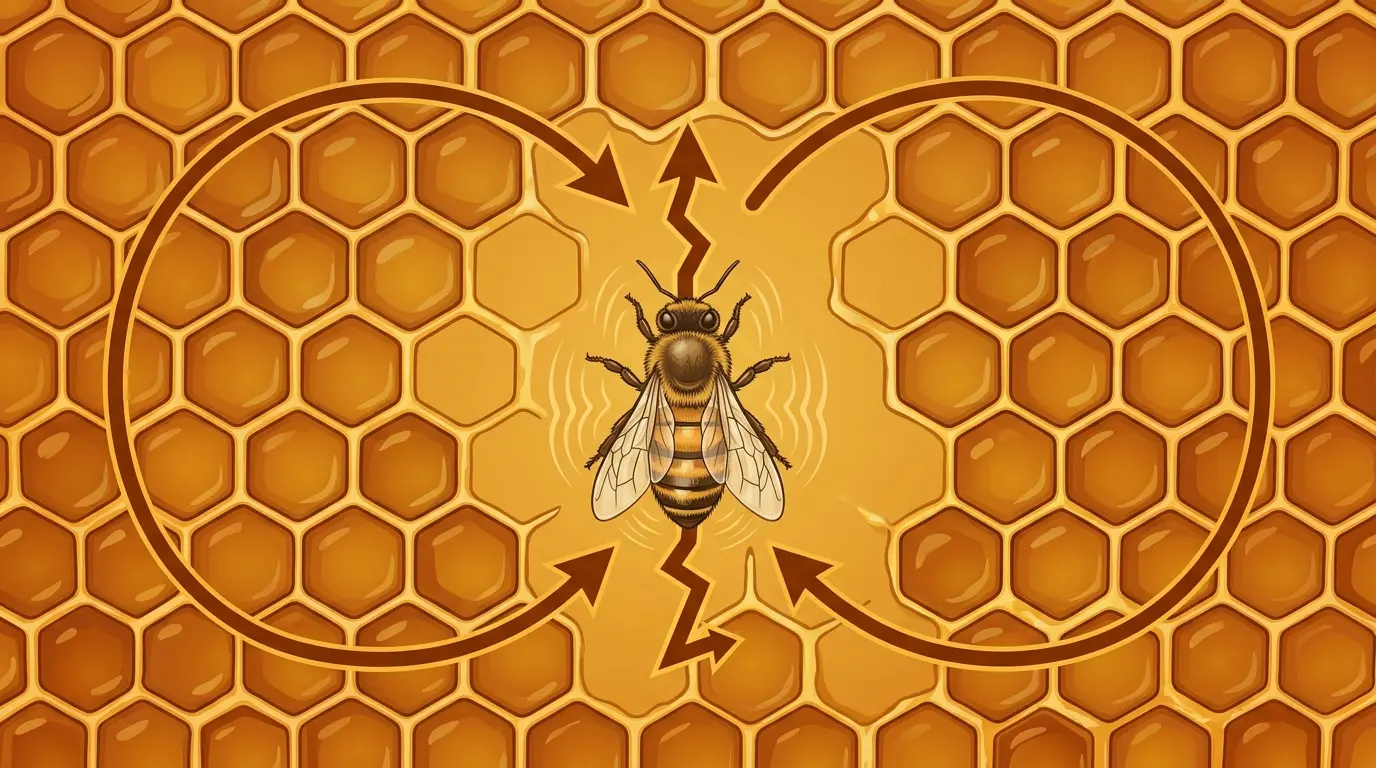
When a food source is located more than 50 to 100 meters from the colony, the returning bee transitions from the simpler round dance to the waggle dance. Performed directly on the vertical surface of the wax comb, the dance traces a distinctive figure-eight pattern consisting of two primary alternating phases:
- The Waggle Phase: The bee runs straight forward while rapidly shaking her abdomen from side to side (at roughly 13 to 15 Hertz) and vibrating her wings.
- The Return Phase: The bee circles back in a semicircle to the starting point, performs another waggle run along the straight line, and then loops back in the opposite direction.
Decoding the Navigation Vectors: Direction and Distance
The waggle dance translates three-dimensional outdoor flight vectors into a symbolic two-dimensional language on a vertical plane.
1. Encoding Direction Relative to Solar Azimuth
Because the interior of the hive is completely dark, bees use gravity as a reference point. Vertical upright (against gravity) represents the current azimuth position of the sun. The angle of the straight waggle run relative to vertical matches the precise angle the foraging bee must fly relative to the sun. Even more impressively, bees possess an endogenous circadian clock. Even if a dance continues for hours inside the hive, the dancer continuously shifts the angle of her waggle run to compensate for the sun's passage across the sky.
2. Measuring Distance Through Run Duration
The distance to the nectar source is directly correlated with the duration of the waggle phase. The farther away the floral patch, the longer the dancer waggles her abdomen along the straight line. As an established rule of thumb, each second of waggle duration corresponds to approximately 1,000 meters (one kilometer) of flight. Low-frequency acoustic buzzing pulses (around 250 to 300 Hertz) generated by wing movements also convey quantitative distance cues to observing bees.
Interpreting the Dance in the Dark
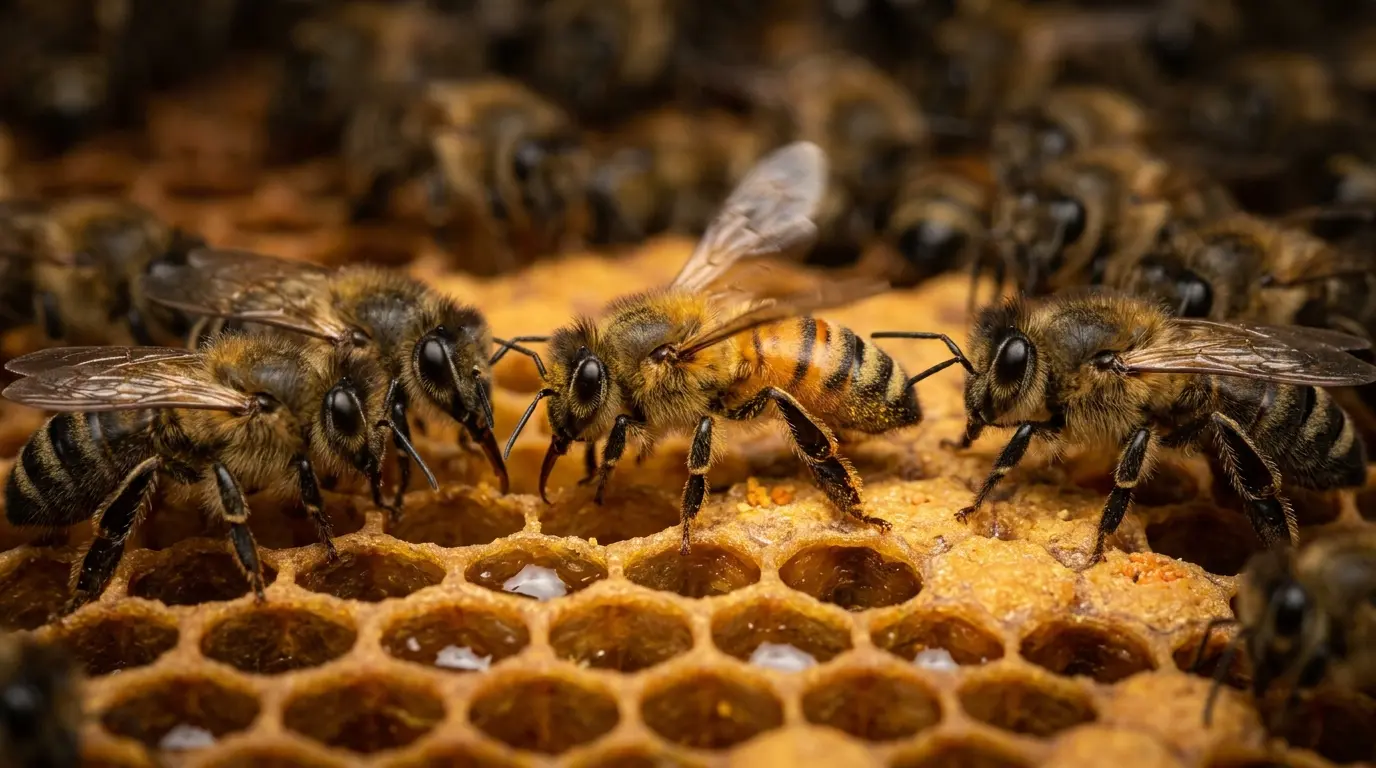
Since the dance occurs in total darkness, nestmates (recruits) do not rely on compound eyes to observe the performance. Instead, they position themselves closely alongside the dancer, using their antennae to sense acoustic air currents via Johnston's organ and detecting substrate-borne vibrations through the wax comb. The dancer also regurgitates droplets of collected nectar, providing floral scent samples and sugar-concentration data that motivate recruit bees to depart.
The waggle dance demonstrates that abstract symbolic communication is not unique to humans, but an evolutionary marvel vital to colony survival.