The Dawn of the Digital Era: ARPA's Vision
In the late 1960s, against the backdrop of the Cold War, the U.S. Department of Defense's Advanced Research Projects Agency (ARPA) launched a groundbreaking networking project connecting academic and scientific research centers. Directed by Bob Taylor and engineered under the guidance of Larry Roberts, the initiative aimed to enable distributed computing resource sharing while maintaining an ultra-resilient communication infrastructure capable of surviving hardware breakdowns and network line disruptions.
This initiative gave birth to ARPANET (Advanced Research Projects Agency Network)—the direct technological ancestor of the modern global internet.
A Radical Innovation: The Advent of Packet Switching
Prior to ARPANET, telecommunications operated strictly on circuit switching—the legacy model powering telephone networks where an exclusive, unbroken physical circuit had to remain open for the duration of a call. This approach was highly inefficient for bursty computer data and critically vulnerable to single points of failure.
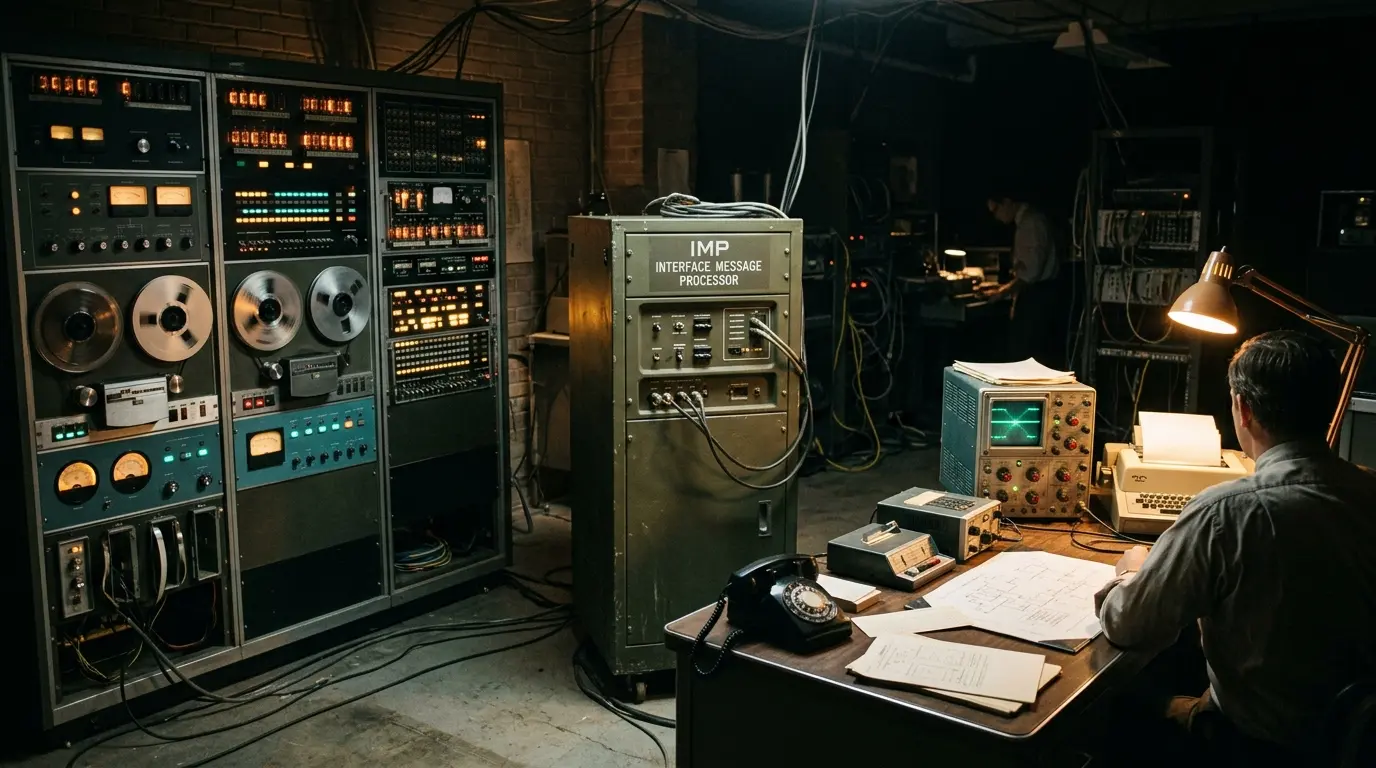
ARPANET broke this barrier by adopting packet switching, an innovative architecture formulated independently by Paul Baran at the RAND Corporation and Donald Davies at the National Physical Laboratory (NPL) in the United Kingdom. Under packet switching, digital messages are broken down into small units called packets. Each packet carries destination headers and navigates dynamic communication routes via specialized gateway minicomputers known as Interface Message Processors (IMPs)—engineered by Bolt, Beranek and Newman (BBN)—before reassembling seamlessly at the target host.
October 29, 1969: The Historic "LO" Transmission
The defining moment in digital communications unfolded on October 29, 1969, at 10:30 PM PST inside the computer laboratory at the University of California, Los Angeles (UCLA). Supervised by Professor Leonard Kleinrock, graduate student programmer Charley Kline set out to send the very first inter-computer transmission to Stanford Research Institute (SRI) in Menlo Park, situated roughly 350 miles away.
The UCLA team operated an SDS Sigma 7 mainframe linked to IMP Number 1, while programmer Bill Duvall sat at SRI's SDS 940 terminal hooked to IMP Number 2. Kline and Duvall maintained an open telephone voice channel to verify each transmitted character in real time.
The objective was to transmit the command LOGIN. Kline typed the character "L" and asked over the phone line, "Did you get the L?" Duvall answered affirmatively. Kline pressed "O", which also registered cleanly on SRI's display. However, when Kline pressed the letter "G", a memory buffer overflow caused SRI's SDS 940 system to abruptly crash.
Consequently, the very first digital message transmitted across the precursor to the internet consisted solely of two letters: "LO". Unintentionally prophetic, the snippet echoed the timeless expression "Lo and behold". Within an hour, engineers fixed the buffer error, and the full word LOGIN was successfully transmitted and processed.
"We hadn't prepared a grand message like Neil Armstrong stepping onto the Moon. We just wanted to type 'LOGIN'. Yet, accidentally transmitting 'LO' became an extraordinary omen for the revolution that followed." — Prof. Leonard Kleinrock
From the First Four Nodes to the Global Web
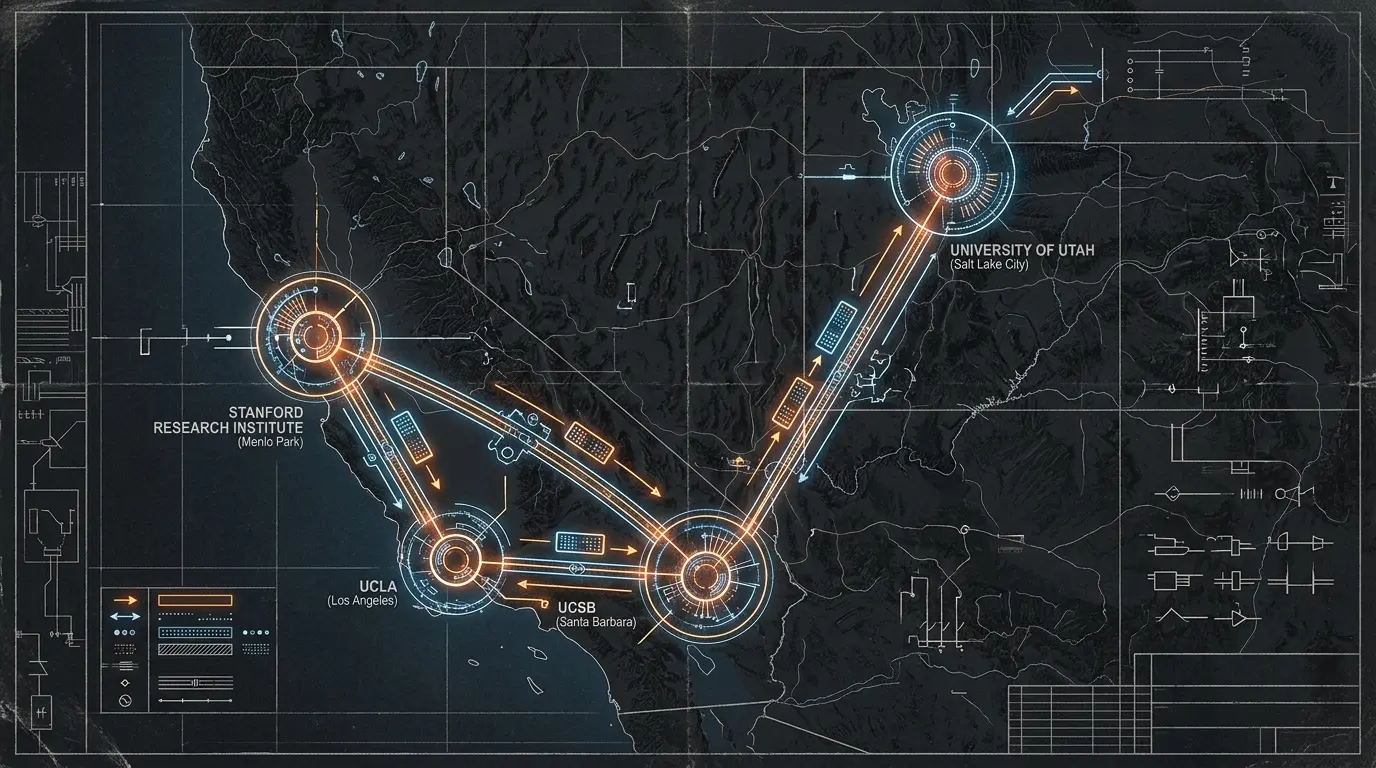
By late December 1969, ARPANET had successfully interconnected its initial four-node network:
- UCLA: Network Measurement Center (SDS Sigma 7).
- Stanford Research Institute (SRI): Douglas Engelbart's Augmentation Research Center (SDS 940).
- University of California, Santa Barbara (UCSB): Interactive Computer Graphics Center (IBM 360/75).
- University of Utah: 3D Graphics and Computer Science Research (DEC PDP-10).
This four-site milestone proved that heterogeneous computers with disparate architectures could communicate reliably using vendor-agnostic packet protocols. ARPANET expanded continuously over the following decade, culminating in the mandatory adoption of TCP/IP (developed by Vint Cerf and Bob Kahn) on January 1, 1983, which formally inaugurated the modern internet. That modest crash in a Southern California lab in 1969 quietly opened the gates to our interconnected world.